ice jam on Riverton Yacht Club pier. January 1920Riverton Fire Co. 1925
I am privileged to know Mrs. Elsie Waters through our membership in the Historical Society. Among the many things which she has permitted the HSR the use of are some of her family’s treasured photographs. These stereoviews are just a few of the photos, stereoviews, and movies which chronicle the history and growth of Elsie’s many kin.
The Waters/Knight/Wright/Flach Family Tree has a considerable history, parts of which have been entangled in many of the significant chapters of Riverton’s saga.
July 4, 1924
I am motivated by the increased ability of our amped up website to display media, and so I am revisiting resources such as this in order to bring them to a new audience. Jim Flach and his dad, Richard Flach, generously sent me these higher resolution files via Internet from Florida.
Click on each thumbnail for a hi-res file.
With some time on the PhotoShop bench, I was able to unwarp the curve in the cardboard mount.
I have wondered if one were to print these at actual size (3½” x 7″), how they would look in a stereoscope viewer. Somebody, let me know.
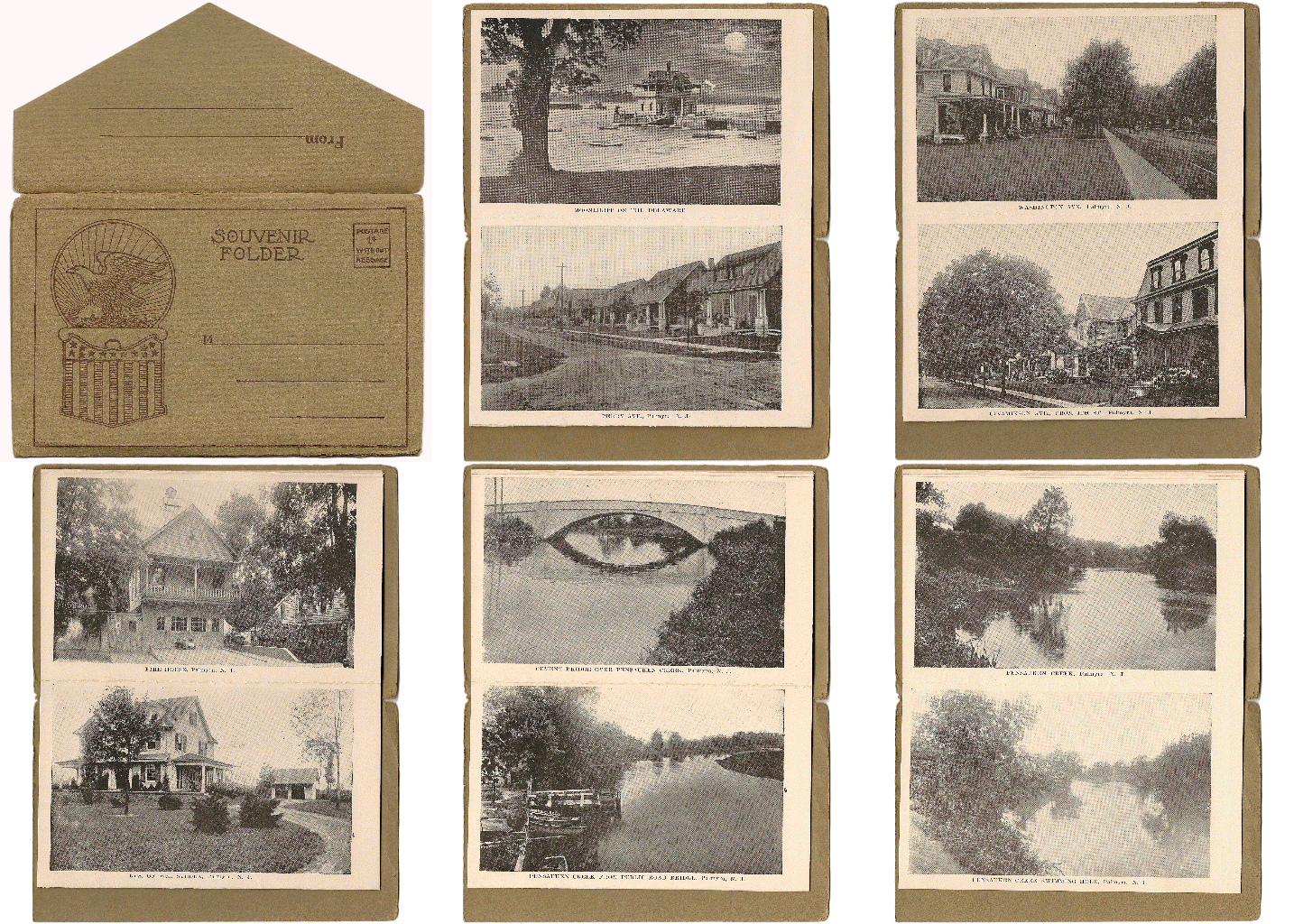
It seems to be “Palmyra Week” here at the HSR website. This great Palmyra keepsake comes from “across the miles” via the Internet from a collector friend in Ohio. I have seen a few of these Palmyra Souvenir Folders, but rarely is one found in this very fine unused condition. Too often, they are taken apart and the cards are sold à la carte. Click on the image at left to see the animation. Check out larger images in the IMAGES section under PALMYRA SOUVENIR FOLDER. – John McCormick, Gaslight News Editor
We have never had the capability on our website until now to post video clips. Turns out that HSR President Gerald Weaber has a stash of video clips recorded at various events over the last few years. He set us up with a YouTube account, and Mike Solin, our computer guy, added a YouTube button to my WordPress Dashboard, so I’ll take this new feature for a test drive.
Surely, there are many more Riverton related videos, vintage photos, and missing bits of information out there in cyberspace. When I get the hang of making use of the social networking potential of Facebook, we can make the resources of a wider community of history lovers available and start some discussions.
This first video is a slide show about Riverton’s 2006 Victorian Day.
The next three are from Victorian day 2007. Here is the first of three short clips, “Civil War reenactor, Miss Amanda, on Victorian Day 2007, at HSR Museum for a Day.”
“Civil War reenactor, Mr. Allan, on Victorian Day 2007, at HSR Museum for a Day”
Last, is this too short clip of maestro William “Willie” Harris, who passed away in December 2010.
I look forward to receiving and posting more files for videos, texts, slideshows, and scans of photos, maps, and ephemera from Rivertonians near and far. – John McCormick, Gaslight News Editor
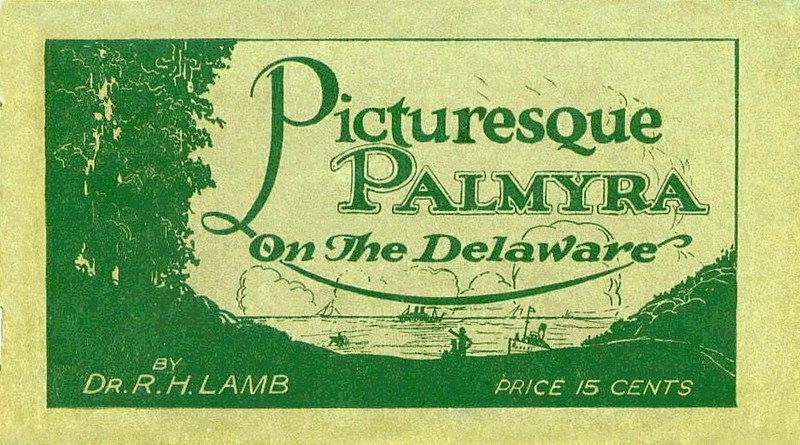
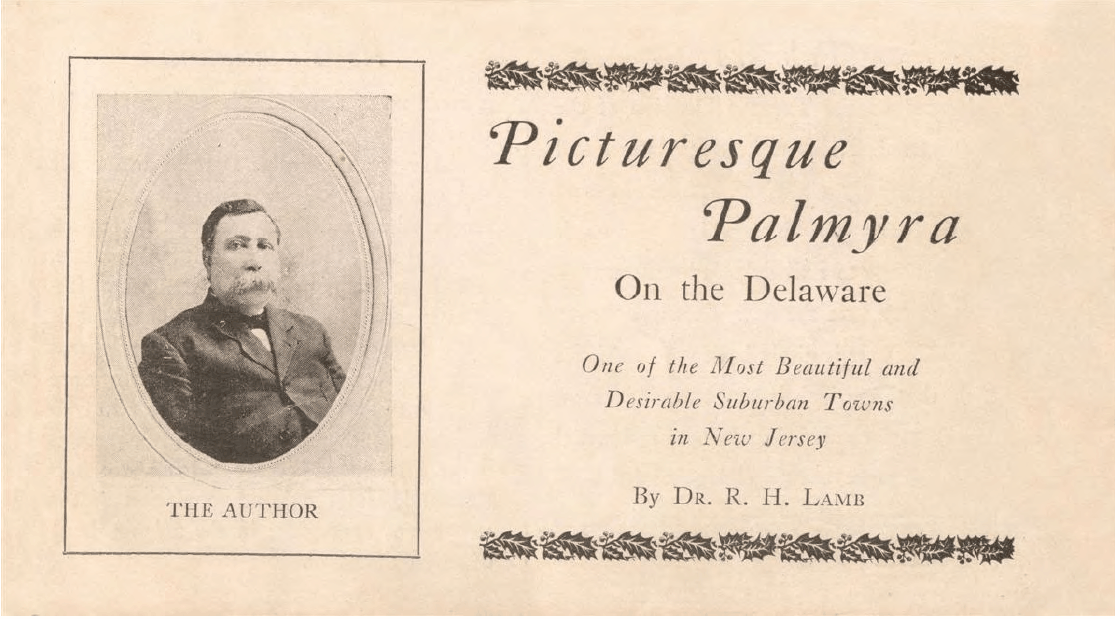
Picturesque Palmyra on the Delaware is a diminutive pamphlet which was used by various civics groups and public officials during the 1920s in order to promote a favorable image among the public toward Palmyra, with the objective of attracting investors, especially home buyers and business investors. It was an unabashed public relations piece, a kind of infomercial in 48 tiny pages, authored by a Dr. R.H. Lamb, whose grand mustachioed photo appears on the index card sized booklet.
Immodestly subtitled, “One of the Most Beautiful and Desirable Suburban Towns in New Jersey,” the pamphlet extols the many virtues of the flourishing borough as it existed in 1923. The best real estate advice about buying property was then, and still is, all about location. Accordingly, Picturesque Palmyra touts that all important key factor for home buyers by mentioning the easy access to Camden and Philadelphia by rail, trolley, and ferry. It further promises “all the advantages without the disadvantages of the city.”
Among a long list of Palmyra’s advantages listed are its rapid population growth, well-maintained homes, the “majestic Delaware,” the “picturesque Pensauken Creek” (sic), and its “fertile and productive” soil. The population of about four thousand is tagged as “middle class’’ and “…satisfied to dwell here forever in contentment and happiness.”
At a time when many of its readers could very well recall the 1918 influenza epidemic five years earlier, which afflicted over 25 percent of the U.S. population and killed thousands, the promise of Palmyra’s healthfulness “…unexcelled in any part of the state” may have been a claim of considerable importance. Even the weather cooperated to create this Utopia on the Delaware, with rarely occurring fog and quickly melting snow. After how long it has taken the accumulated snow from the last three snows of winter 2010-2011 to finally melt here, that sounds like a nice option.
Abundant artesian well water, “…cold, limpid, pure, and healthful,” supplied the household and emergency needs. Lamentably, as your water company will confirm, because of the effects of the gradual intrusion of the salt line moving up the Delaware, Palmyra and adjacent communities have not enjoyed artesian well water for many years.
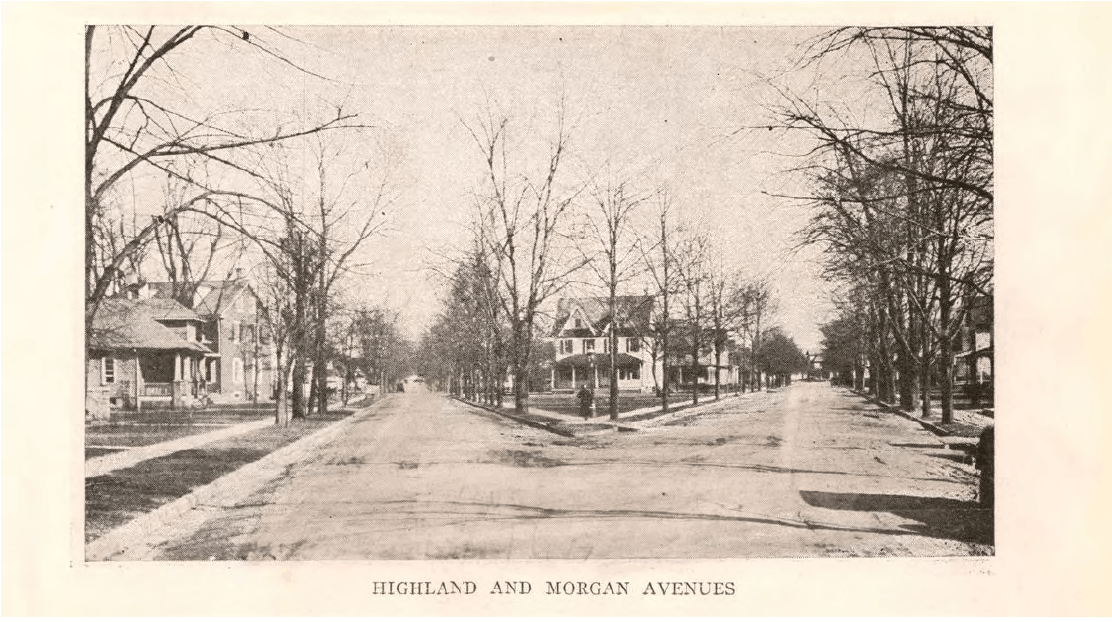
Dozens of photographs, many of which are full page images, confirm the booklet’s claims of well-kept homes on gravel- coated tree-lined streets having cement sidewalks. Within a mile and a half stood at least ten houses of worship plus several fraternal and patriotic organizations. The educational facilities “…unexcelled by any town of its size adjacent to Philadelphia” included a brick schoolhouse for primary and middle grade students plus a high school.
Palmyra sustained a remarkable number and variety of businesses listed on page 33: several grocers and markets including Acme, A&P, and American Stores, two drug stores, two hardware stores, several dry goods stores, two bakeries, a restaurant, a theater, a newspaper, a store just for hats, a bank, and three garages. Of course, there is a also large real estate ad for Dr. Lamb at 429 Horace Avenue, and a smaller dentistry ad for his practice at the same address. It was a different time; a different economy. Most people generally made purchases close to home.
Dr. Lamb’s real estate holdings were indeed considerable, containing more than twelve acres of building land situated between the railroad and the river, near the high school. Readers were assured that the demand for houses was beyond the supply, that property values had been on the increase, and that a real estate boom was imminent. Then, as today, “Buy now,” was the not-so-subtle message.
Dr. Lamb thoughtfully pointed out that, between Riverton and Palmyra, there were three building and loan societies through which borrowers could pay off a home loan in eleven years. Sweet! We are invited to visit in order to verify that, “It’s All Here and It’s All True.”
An examination of the two-page business directory at the end of the publication shows only one enterprise which has survived to the present—a small advert for H.C. Schwering’s Hardware. At the time of the booklet’s 1923 publication, Schwering’s Wayside Hardware had only been open a matter of months. Way to go Schwering’s! I am looking forward to your centennial celebration in 2022.
Today’s public relations agents who write advertising copy might learn a thing or two from the good Spin Doctor Lamb. Understandably, his motive for producing this piece of positive Palmyra propaganda was for profit. Presumably, he did, for Palmyra is today, like Riverton, fully developed. However, it can be inferred from his direct and earnest tone and, from his own choice to live and work in the same community, that his investment in the community was wholehearted and sincere.
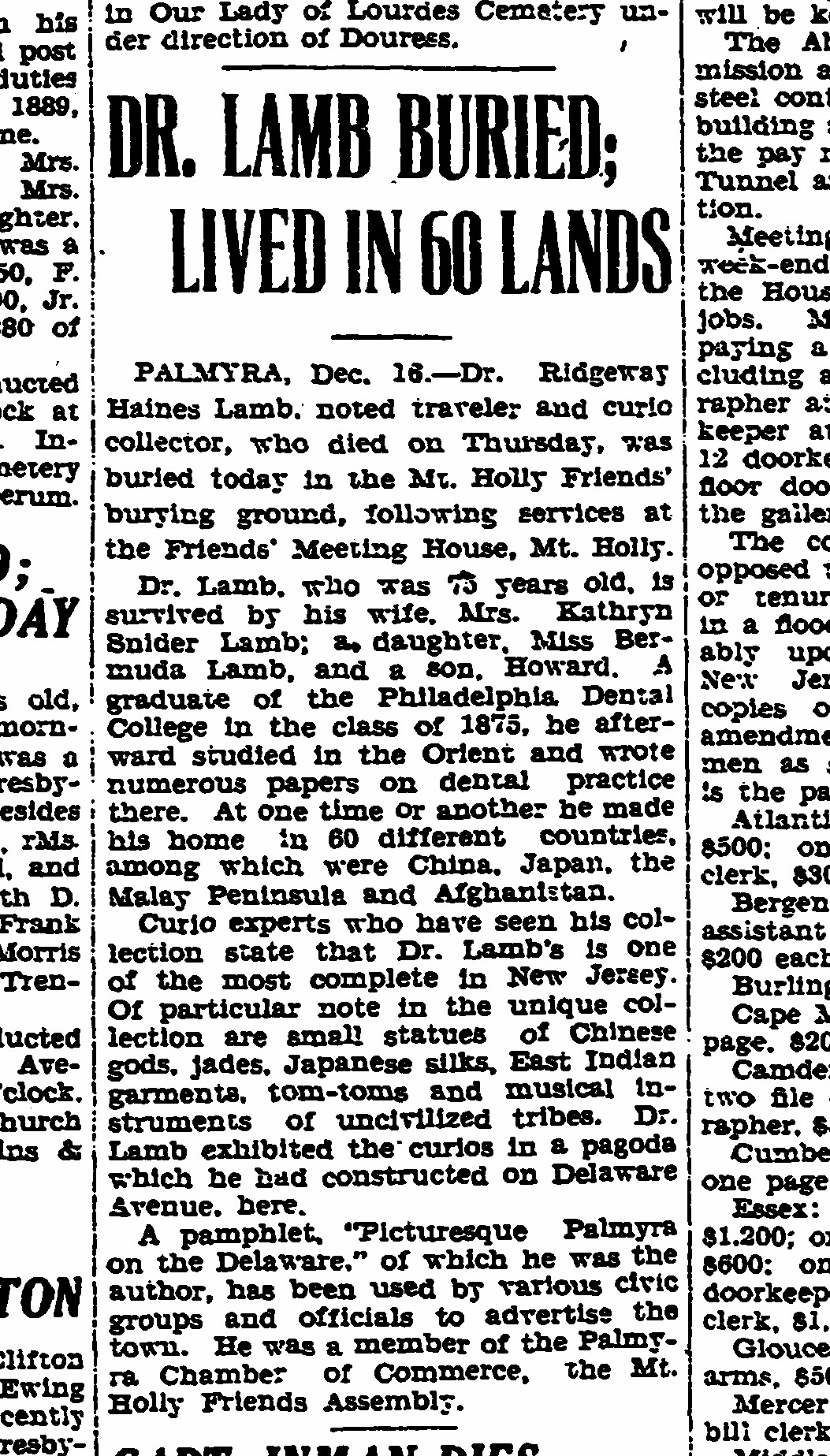
Trenton Evening Times 12-16-1929 Dr. Lamb’s obituaryTrenton Evening Times 12-12-1929 News of Dr. Lamb’s death
Dr. Lamb’s experience, however, extended far beyond the boundaries of Palmyra borough. When he passed away suddenly, of heart trouble December 12, 1929, he had been on his way to inspect his real estate development in New Egypt, NJ. An article in the Trenton Evening Times reporting his death, and a later obituary in the same newspaper, characterized him as a prominent physician, real estate developer, noted traveler, and curio collector who had lived in 60 different countries.
A listing in a 1906 biographical sketch book, The Natal Who’s Who, indicates that the ancestry of Dr. Ridgeway Haines Lamb “…extends through 1,000 years of English history, including about 20 generations of Royalty. A lineal descendant of ‘Alfred the Great.’” It noted that the Philadelphia Dental College graduate had “…practiced in every continent upon the globe” and was a “Pioneer of American Dentistry in many countries,” including India, Ceylon, Malaysia, Afghanistan, Japan, the Orient, and the South African cities of Natal, and Durban.
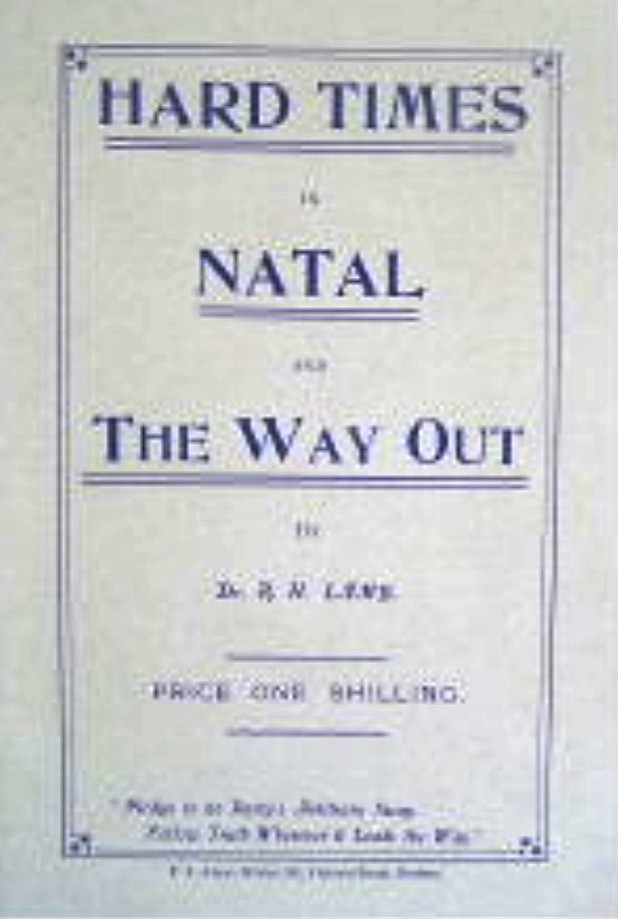
Hard Times in Natal and the Way Out 1992 facsimile reprint of 1906 text
While a resident in Africa, he published a slim 30 page attack on Natal officialdom in 1906, Hard Times in Natal and the Way Out. He wrote a number of articles and treatises for professional dentistry publications while abroad and, after returning to America, lectured with stereopticon illustrations of Japan and Ceylon.
I know what you’re thinking. Really? Sixty countries? Alfred the Great?
Obviously, an accomplished self-promoter, as well as a devoted Palmyra booster, Dr. Lamb’s life reads like a plot outline for a Hollywood blockbuster. But that is no reason to suspect that it is fiction. Googling for any scrap of information on him, incredibly, this confirmation came from an Internet source halfway around the world in a Singapore newspaper database.
An October 1910 article in The Straits Times announced, “Something New in Singapore,” with the opening of Dr. R.H. Lamb’s new dental practice. Ever the entrepreneur, Dr. Lamb advertised his practice in a September 1911 issue of Singapore’s Weekly Sunalong with a dentifrice of is own composition, Teaberry Tooth Powder. From this June 1913 ad in The Straits Times, advising that the doctor had just returned to resume his practice on Coleman Street, having returned from Borneo and the Philippines, it may be inferred that he visited other Far East destinations during his stay in Singapore .
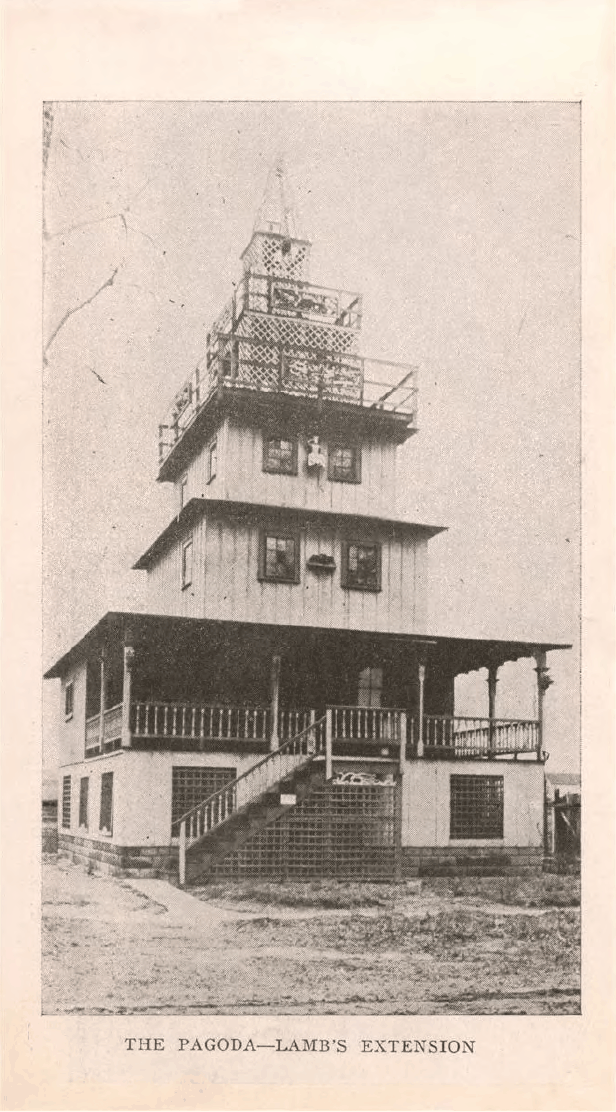
This pagoda displayed curios collected from Dr. Lamb’s world travels
A February 1913 Weekly Sun ad solicited buyers for a 3½″x6″ souvenir booklet of Singapore. Could this small 48 page pamphlet have been a dress rehearsal for Picturesque Palmyra? Altogether, there were dozens of other advertisements for Dr. R.H. Lamb in three different Singapore newspapers published from 1910– 1914. Presumably, he returned to America when the ads ceased in May 1915.
His obituary in the Trenton Evening Times referred to a pagoda built by Dr. Lamb in which to house and display his very large and unique curio collection, acquired as a result of his world travels. Doubtless, the photo on page 31, captioned “Pagoda—Lamb’s Extension” is that shrine to his globe-trotting adventures.
The 1926 Burlington County Directory lists Lamb as “retired,” living at 429 Horace Street, Palmyra. At the same address is his wife, Kathryn, his son Howard R. Lamb (no occupation), and daughter, Bermuda Lamb, a nurse. If any reader has more information or photos about Dr. Ridgeway Haines Lamb, his real estate interests in Palmyra or elsewhere, writings, lectures, his descendants, or any other aspect of this extraordinary gentleman’s life, please comment or contact us so that this saga may be made more complete.
A sincere thank you to Palmyra Cultural and Historical Society President, Jim May, for generously permitting me to scan his copy of Picturesque Palmyra, and to HSR Board member and professional historian, Paul W. Schopp, for providing the two Trenton Evening Times newspaper clippings.— John McCormick, Gaslight News editor Click here to view a PDF file of the entire 48 page Picturesque Palmyra booklet. Be advised, it is a 6.63MB file. Viewing tip: After the file uploads to your computer, it will likely have the pages turned sideways. Hit your escape button which will take you out of the “full-screen” view. Then, right-mouse click anywhere on the image to choose “rotate clockwise” from a pop-up menu. Voila! Now you don’t have to turn on your head to look at the pages. – John McCormick, Gaslight News editor
Dear Reader,
This second installment of the 1909 Christmas issue of the New Era includes pages 25-44 plus the inside and outside of the back cover of this remarkable nostalgic tour of the various political and social organizations and business establishments of Riverton, Palmyra, and Cinnaminson.
While Part 1 included information mainly about Riverton and a number of advertisers, this second part is mainly about Palmyra, and Cinnaminson, and more advertisers. Some facts may be old news to followers of Palmyra history, but others just seem the stuff of winning bar bets. That is, if you know the answers.
Railroad Station at Palmyra, N.J., once known as Texas
In its early days, Palmyra was known as Texas. Yeah, I know. Living in a place called Texas, New Jersey must have been confusing. In any case, the name was changed to Palmyra by a man named Isaiah Toy who “…did not like the name Texas for a town that had aspired to the dignity of a postoffice, and changed it to Palmyra, a name suggested by his sister, Caroline.”
The pages paint a portrait of the community’s economic vitality as they boast of Palmyra and Riverton’s first schoolhouse and expanding school enrollment, the building of the Camden & Amboy Railroad (the 19th century forerunner of the RiverLine light rail passenger service which follows the same route), and the practice of five neighborhood farmers to ship their produce by boats which each carried 100 baskets of corn. Once part of Cinnaminson like its upriver cousin, Riverton, Palmyra became a separate township in 1894.
The publication traces the origins and 1909 status for a number of social and fraternal clubs and organizations. Among the more curious are the hundred member Palmyra Bicycle Club, the Loyal Temperance Union (a group which spearheaded the crusade for prohibition), the storied Palmyra Field Club, the Independence Fire Company No.1, and several patriotic groups.
Another amazing Palmyra fact involves one of its churches which actually was built in Riverton in 1859 and was moved to Palmyra to “…open for divine service on the new site Friday, May 8, 1885.”
“About Our Advertisers” on page 35-38 is a who’s who of the area’s 45 principal commercial establishments. Brief descriptions of each of the businesses appear for grocers, butchers, painters, plumbers, druggists, tailors, bakers, and other merchants and tradesmen of all sorts. Advertisements take up the remainder of the publication, some at a full page like the one for Dreer’s Nursery, and others at a half, or smaller fraction, as in the ad for John B. Murphy, Horseshoer at Broad and Cinnaminson.
Altogether, it is a pretty cool history local history lesson in twenty pages from a primary source that you won’t find on your typical public library shelf. Click on the link to download and view the pages. Be advised that it is a large 5.23MB PDF file.
The original copy is about 9¼″x12¼″ but these scans have been cropped to 8½″x11.″ We thank Mr. Fred DeVece for providing the original issue from which I scanned these pages. – John McCormick, Gaslight News Editor Click here to view a PDF file of the Part 2 of the 1909 New Era Christmas Issue. Be advised, it is a 5.23MB file. – John McCormick, Gaslight News editor
Dear Reader,
Since 2011 is still young, you may find this much sought after collectible to be a realization of how far we’ve come, or perhaps it’s a nostalgic reminder of days gone by. The 1909 Christmas issue of The New Era included descriptions of virtually every social, civic, economic, religious, and educational institution in Riverton, Cinnaminson, and Palmyra.
From A through almost-Z, including the Ancient Order of Hibernians, through each of the area’s nine churches, the DAR, the Loyal Temperance Union, to the Union League and the YMCA, along with a four-page “About Our Advertisers” section, the engrossing periodical serves as a glimpse into life in Riverton during the very early 20th century.
Remember, reminisce, or just imagine a time when Riverton was the destination for tours of Dreer’s Nurseries greenhouses and hundred-acre trial grounds and Riverton’s census included names of wealthy families listed in the Philadelphia and New York social registers as well as the first generation immigrant hired help who served in their elaborate homes.
This first installment includes the charming cover with its portrait of Santa sorting letters through page 24 of the 44 page publication. Of particular note is the selection entitled. “Early Days in Riverton” on pages 9-24. “Palmyra: Then and Now” and “About Our Advertisers” will be covered in Part 2 of this scan of the entire 1909 Christmas Issue of The New Era.
The original copy is about 9¼″x12¼″ but these scans have been cropped to 8½″x11.″ We thank Mr. Fred DeVece for providing the original issue from which I scanned these pages. – John McCormick, Gaslight News Editor Click here to view a PDF file of the Part 1 of the 1909 New Era Christmas Issue. Be advised, it is a 5.31MB file.


 With some time on the PhotoShop bench, I was able to unwarp the curve in the cardboard mount.