The page lists the names of 16 local artists, past and present. Clicking on a name displays an article with a brief bio and examples of their work, if available.
Have we missed anyone? Almost certainly. We need you to suggest someone and provide contact info, a bit about the person, some scans, and photos so we can showcase the work and connect our audience with artists and craftspeople who have works to sell. Nominate yourself if you wish.
We welcome comments, suggestions, and corrections. -JMc
And now, a word from Heather MacIntosh Huffnagle, our Membership Chair…
Greetings!
As a Riverton resident and Historical Society of Riverton (HSR) board member, I am extremely proud of what we’ve been able to accomplish in 2020, thanks to your support. Here are some of the highlights.
We continue to expand our excellent quarterly, Gaslight News, which is now digital. Our Facebook page receives between 500 and 1000 views each month and we have produced 35 new articles on our website’s blog this past year, and 14 more just since January.
106 Lippincott, Riverton, NJ, PHOTO CREDIT: Roger Prichard
Our board helped realtors understand the history, architectural significance, and zoning restrictions for the amazing mansion at 106 Lippincott. This extraordinary house, attributed to architect Frank Furness, now has new owners with experience renovating historic houses. The previous owners, Bob and Aggie Kennedy, now deceased, were great supporters of the HSR and generously included the Society in their wills.
We also commissioned a high-resolution scan of the original 1890 birds-eye view of Riverton so that residents can once again it can soon be available to residents to display in their homes.
Porch Club large map – Plan of the New Town of Riverton.
We assisted the Porch Club in commissioning a similarly high-quality scan of their large, ca. 1851 map of Riverton, the earliest known map of the town.
Romance of Riverton screenshot
This year, the 1926 film, The Romance of Riverton, will receive a high-quality digital scan as well.
Lyceum photo from glass plate by Richard Gaughan 1976
Thanks to your donations in 2020 and an unexpected but welcomed wreath fundraiser, we will have 19 beautiful glass plate negatives from 1910 professionally scanned at high resolution.
The resurrection of Henry Box Brown at Philadelphia CREDIT: Library Company of Philadelphia
Board members have been extensively researching two upcoming interpretative markers for early Riverton houses. One of these houses was built for the man who ran the Antislavery Society in Philadelphia for 25 years. This abolitionist opened the crate in which celebrated slave Henry “Box” Brown shipped from slavery in Richmond, VA to freedom in Philadelphia. The full history of that house is now over 200 pages. I can’t wait to see what else they will turn up!
On behalf of the board, I hope you will continue to support us in the new year!
Sincerely,
Heather MacIntosh Huffnagle
Membership Chair
If you find something of value in the nearly 500 posts and over 8,500 media items on display here and wish to help illuminate Riverton’s past and preserve its history, please support the Historical Society of Riverton with your membership or a donation (see PayPal DONATE button at lower left.) -JMc, Editor
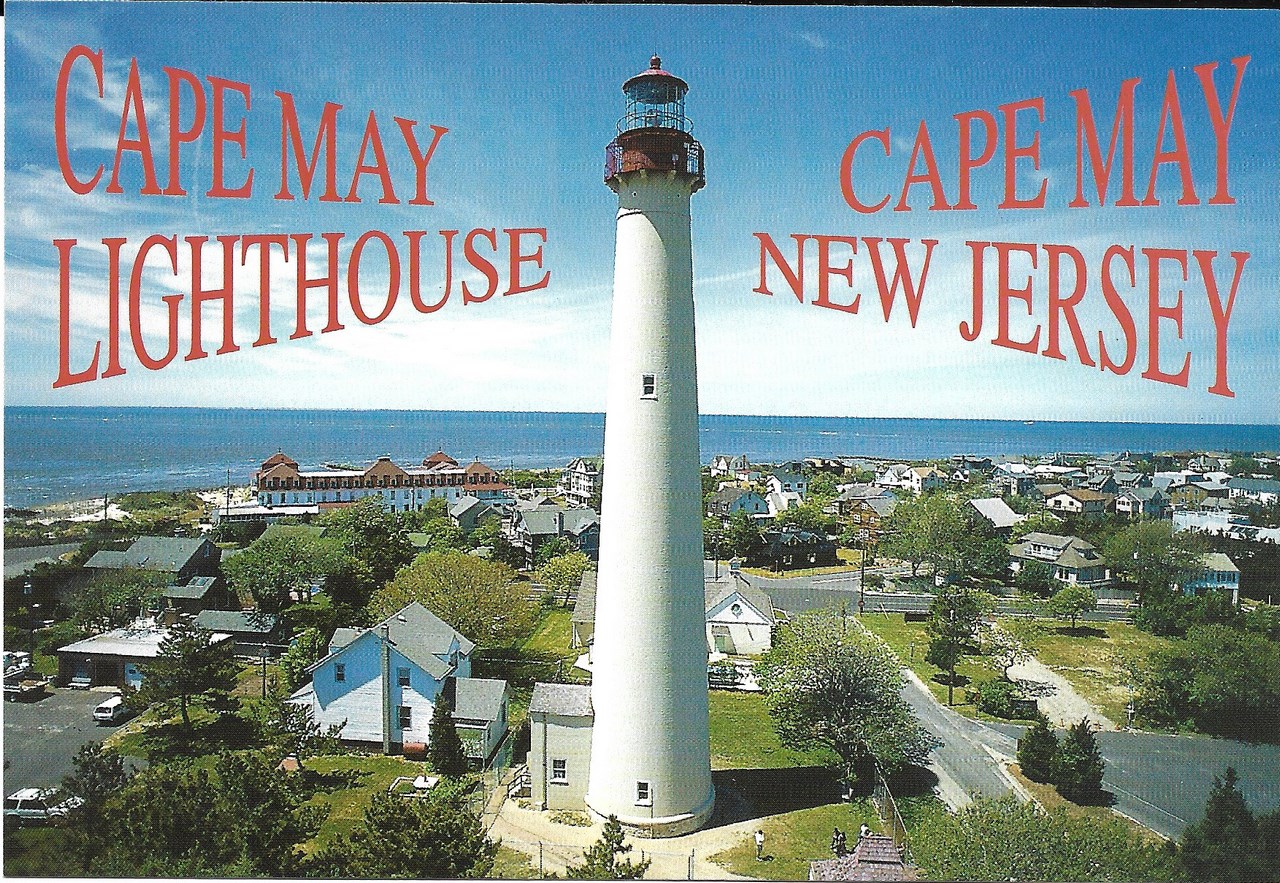
Cape May Lighthouse, oversize chrome postcard c2000
We finally get a sunny day and a break in the temps and folks start to have visions of the Jersey Shore dancing in their heads. Nothing could be more emblematic of the beach than a lighthouse – in this case, the Cape May Lighthouse, constructed in 1859. Fully restored and open to the public since 1988, this stalwart sentinel of the Jersey Cape is the very epitome of a historic preservation success story. -JMc, Editor
CAPE MAY LIGHTHOUSE, CAPE MAY, NEW JERSEY
by Harlan B. Radford, Jr.
The Light house, Cape May, N.J., 1907
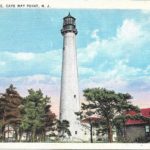
One of the largest lighthouses on the Atlantic Coast standing at 157 feet, Cape May Lighthouse still serves as an active aid to navigation. It was built in 1859, succeeding two previous lighthouses that were lost to the sea by erosion. The lighthouse is located at the southern-most tip of Cape May Peninsula in Cape May County, New Jersey, and is geographically positioned where the Delaware Bay meets the Atlantic Ocean.
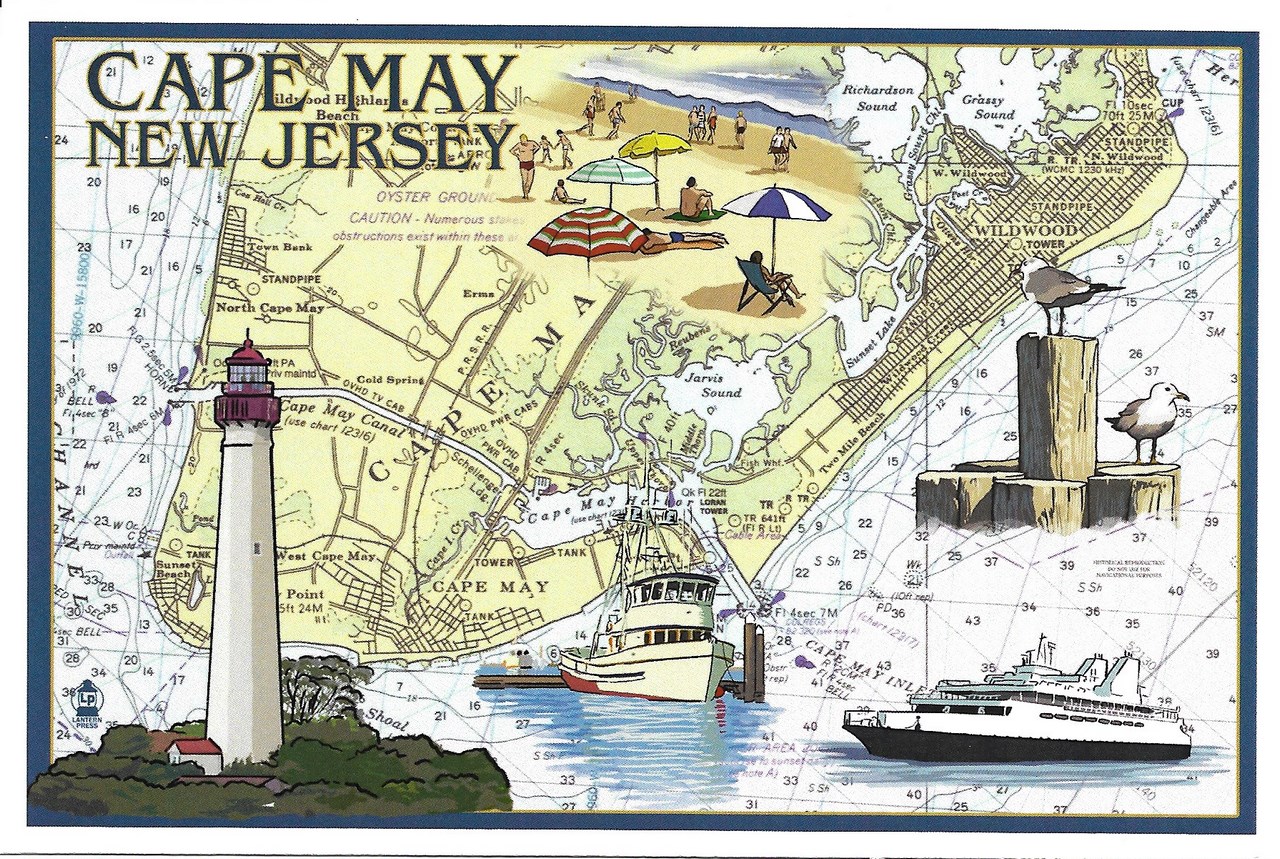
Cape May, New Jersey, oversize chrome postcard c2000
The early attempts to build lasting lighthouses along New Jersey’s coast have proved costly and unsuccessful. As we have seen in the case of the Barnegat Lighthouse, the Cape May Lighthouse was no different. Erosion, lack of proper maintenance, and poor construction have been among the culprits that have thwarted the early efforts to build these navigational beacons.
The first known lighthouse at Cape May was built in 1822 and came to life the following year. Standing 70 feet tall, this particular sentinel did not last beyond 1847 when it was decommissioned due to its collapse into the ocean.
Then a second tower was constructed a bit further inland and was operational between 1847 and 1859 whereupon it too was overcome by storms and the constant battering of waves.
A third lighthouse which is the present lighthouse was built in 1859 and this time It was set back considerably further from the ocean. In addition to the erosion, the wind at Cape May Point was considered a major problem. To combat the wind this third structure was constructed of double brick masonry walls. Added strength was accomplished by building two concentric walls with the outer wall more than 3 feet thick at the base and the inner wall a foot and a half at its base with a space left between the two.
Shortly after this tower was built, two keepers’ houses were constructed. In 1893, and in order to reduce the risk of fire in the tower, a brick oil house was built for the safe storage of all-important oil supply. By 1902, one of the keepers’ houses was expanded and was able to house three keepers and their families.
Cape May Light House N.J. 1908
Cape May Lighthouse
The routine for the keepers consisted of their nightly 4-hour watches spent in the watch room situated just below the lantern. During a watch the keepers were responsible for rewinding the clockwork weight mechanism, trimming the wicks when needed, replenishing the fuel or the oil level in the lamps, actually lighting the lamp a half-hour before sunset, and extinguishing the lamp a half-hour after sunrise. When there was limited visibility, the lamps had to be lit.
There were numerous other duties such as carefully and frequently cleaning the lamp as well as general maintenance of the property to keep everything in good working order. Clearly, being a lighthouse keeper back in the day carried a great deal of responsibility.
Another important feature of the lighthouse is the lantern which is the enclosed or roofed-over room completely surrounded by windows. This housing most importantly protected the entire light apparatus including the lens and the lamp. The lantern itself was 12 feet high with 16 large glass windows and a diameter of 12 feet.
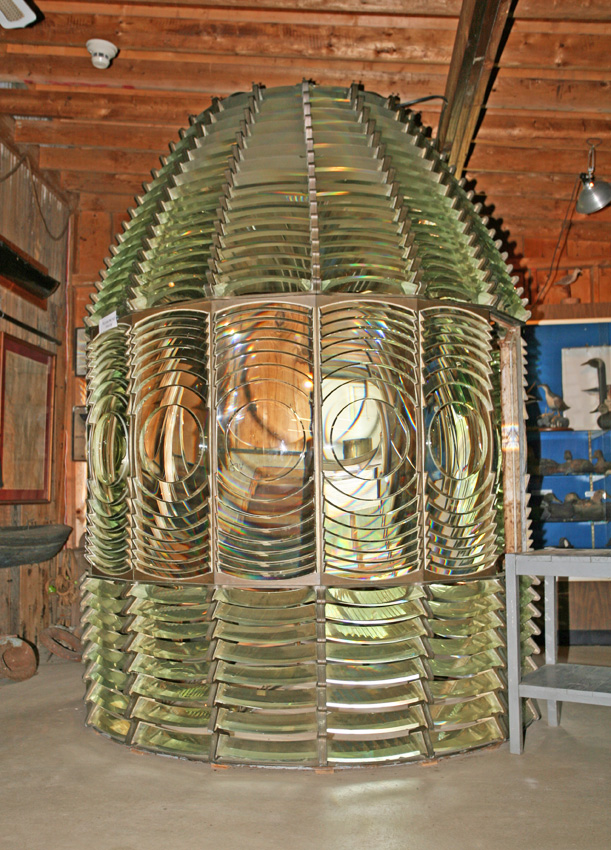
The actual lens originally was a first-order revolving Fresnel lens and this was state-of-the-art for that time period. Seacoast lights of this era stood 7 feet 10 inches tall with a six-foot diameter which enabled the keeper to actually access the inside and service the lamp itself. Today that very Fresnel lens is on display at the Cape May County Historical Museum, which is located a short distance in the nearby community of Cape May Court House.
Cape May Point Lighthouse, oversize chrome postcard c2000
Today, Cape May Lighthouse bears its characteristic solid white daymark paint job in order to serve as a daytime identification aid allowing mariners to distinguish between the lighthouses.
The beacon flashes every 15 seconds with a range of 24 nautical miles. There are 217 steps from the ground to the top and access can be made by a cast-iron spiral staircase.
In 1938, the lighthouse was updated and electrified and when World War II commenced in 1941, the light was extinguished for the duration of the war. In 1946 the Fresnel lens was dismantled and replaced by another but updated light unit. After 56 years of service yet another more modern and efficient light beacon device was installed in 2002. That light continues in operation today thanks mainly to ongoing maintenance by the U. S. Coast Guard.
In 1973 the Cape May Lighthouse was added to the National Register of Historic Places. Then, in 1986, the Cape May Lighthouse underwent a much needed major restoration project. Presently the lighthouse is owned by the State of New Jersey after ownership was transferred from the U.S. Coast Guard in 1992. The State, in turn, leases the structure and grounds to the Mid-Atlantic Center for the Arts & Humanities (MAC), a non-profit which raised funds to restore the tower and open it to the public in 1988.
Cape May Point from Lighthouse, 1922
Last April 2020, MAC announced that COVID-19 restrictions had canceled its tours, activities, and events until further notice. Since its budget is largely dependent upon admissions, memberships, and donationsthey will appreciate your support.
Starting March 13, 2021, the lighthouse is open on Saturdays and Sundays for an admission charge from noon-3pm and is open daily beginning March 26 at reduced capacity. Climbs to the top are rewarded with spectacular panoramic views. If you can’t go in person, take MAC’s virtual climb.The Oil House on the grounds contains a fully accessible Visitors’ Orientation Center and Museum Shop.
Get the latest on their activities and hours open on the official Facebook page for Cape May MAC. No matter where you are, you can celebrate Cape May with the virtual tours and educational lecture series on Cape May MAC’s YouTube Channel.
Greetings from Cape May New Jersey
The following selection of picture postcards shows the important role and the prominence of this lighthouse to Cape May, New Jersey. It certainly can be said that this is a place where memories last a lifetime!
Lighthouse, Cape May Point, hand-colored
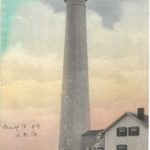
Light House, Cape May Point, Cape May, N.J., hand-colored, prior to 1920
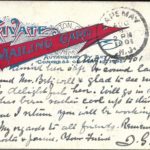
message side of Light House, Cape May Point, Cape May, N.J., prior to 1920
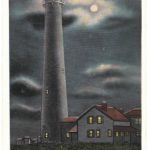
Cape May Light, Cape May Point, N.J.
Cape Point Lighthouse, Cape May, N.J.
Light House, Cape May N.J.
Light House, Cape May, N.J.
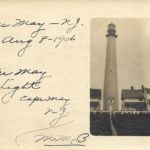
Cape May Light, 1906
U.S. Life Saving Station and Cape May Light House
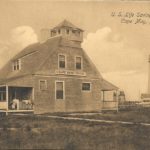
U.S. Life Saving Station, Cape May Point, N.J.
U.S. Life Saving Station, Cape May, N.J.
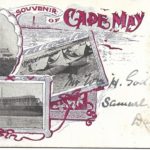
Souvenir of Cape May, 1901
message side of Souvenir of Cape May, 1901
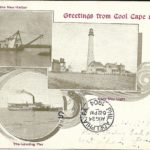
Greetings from Cool Cape May, 1904
U.S. Life Saving Station and Light House
U.S. Coast Guard Life Saving Station and Light House, Cape May Point, N.J.
 I introduced the idea for this tribute page to local artists in “Art Appreciation,” an article in the May 2020 Gaslight News.