Memories of Wartime Scouting in Beverly, NJ

A post about Medford’s Camp Lenape seen here almost two years ago and another last January continue to engage readers who no doubt land on rivertonhistory.com because scarce information exists elsewhere on the web about the now-gone Boy Scout camp.

After Don Ulmer commented in April that he had been Aquatic Director there in 1944-45, and had material to contribute, we reached out to him.

Don writes:

…we downsized from 3600 to 1600 sq.ft. I know there is more Lenape/Scouting stuff, including a number of superb photos taken summer of ’44. Am certain they will pop out in time and will get them to you when they do. Believe they include a US Navy Captain from Riverton, but can’t be sure of that. The name Ryan resonates, though a long time ago. Recollection tells me he was a mover/shaker in getting C. Lenape set up…
If you have specific questions about that time, perhaps asking them will trigger memories.
At age 89, am in sort of rush to get whatever I have into the right hands to preserve it for future generations. All my scouting years were concurrent with WWII which made for interesting times.

We communicated by email and phone, and apparently managed to “trigger some memories” because the following memoir is the result.

Memories of Wartime Scouting in Beverly, NJ
by Don Ulmer

Spring 1941 found an America struggling to recover from the Great Depression and in the final pre-World War II months of peace.  However, hovering war clouds nonetheless made their marks on Scouting.  By spring, a leaderless Beverly Troop 8 depended upon older scout and Assistant Scoutmaster Austin Haines to fill the void until LCDR Kenneth Heinrich, USN, stationed at the Philadelphia Navy Yard and Church Street resident jumped into the breach. In this same time frame, an expanding Fort Dix claimed what once had been Burlington County Council Scout Camp Edge.  This left Burlington County scouts dependent upon the kindness of other Councils in and out of state for annual summer camping.

Despite mounting international pressures, LCDR Heinrich showed up dutifully at Troop 8 meetings each Friday evening in St. Stephen’s Episcopal Church Parish Hall.  Austin Haines remained on as Assistant Scout Master.  ‘Dutch’ Wilmerton was Senior Patrol Leader over the Eagle and Moose Patrols, led respectively by Bonsall MacFarland and Howard Cramer.  Eagle Patrollers included Frank Pisa, Earl Adams, Ralph Anderson, Joe Orfe, Ralph Ulissi, Ken and George Heinrich (both drummers when the troop practiced for the Beverly Memorial Day Parade); Moose Patrol consisted of Kenny Rogers, Marvin Weiss, Bob Thompson, Cook Stockton, Ron & Don Ulmer, John Hines, O. B. Thompson and Billy Lucas. Hopefully, better memories than mine will fill in the many omissions.  Track has been lost with all but a few of these scouts, but many reports over the interim are consistently good.

Camp Edge gone, Del-Mar-Va Council invited Troop 8 scouts that summer of ’41 to camp at Rodney Scout Reservation, a Boy Scout camp located near North East, Maryland. Indeed a magnificent setting, it shares a long border with the woodlands of Elk Neck State Park and Chesapeake Bay on the other.  Beverly lads frequently made their presence known with renditions of their marching song.

(To the tune of Gary Owen)

There’s a bunch of boys from Beverly town

who belong to a scout troop up and down

Their reputation is best to be found

Their Troop is Troop 8 Beverly

(Chorus)

Now they are all good scouts and they know their ins and outs

They always work and never shirk

Their Troop is Troop 8 Beverly

However, ominous harbingers of the impending war echoed from the Army’s Aberdeen Proving Ground across Chesapeake Bay from Camp Rodney.  Principal among these, the new Bofors forty-millimeter anti-aircraft automatic cannon. Since sound travels slower than light, five air bursts, visible as black smoke puffs in the distance, appeared seconds before the blast of the explosions.

On December 12, 1941, our first meeting after the attack on Pearl Harbor which plunged America into World War II, a grim LCDR Heinrich stood before Troop 8. “Last week we met in a nation at peace.  This evening we meet in a nation embarked upon a terrible war.”  Specifics of his remaining speech are lost to time, only that LCDR Heinrich reluctantly passed leadership of Troop 8 to Mr. Sam Phillips.

An interesting aside – though Troop 8 is how the rest of Burlington County regarded Beverlyites, for years it had been Troop 5, and our scouts were reluctant to change uniform arm patches to the new number.  Mr. Philips gently brought his Troop into compliance and the white number 8 replaced 5 on the square red sleeve patches.

World War II fell upon Troop 8, and it quickly immersed itself in scrap drives and just about anything they could do to aid the war effort.  The Troop, as it was custom over the years, marched with great pride in the annual Memorial Day Parade after practice marches up and down Church Street to the beat of the Heinrich boys’ drums.
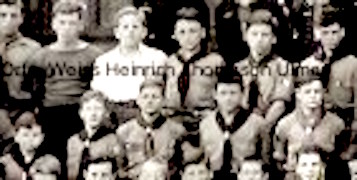
Left to right, Joe Orfe, Marvin Weiss,Ken Heinrich, O. B. Thompson, Don Ulmer at Camp Minitik

In the summer of ’42, at the invitation of Camden County Boy Scout Council, Troop 8 visited Camp Minitik near Uhlertown, PA on the Delaware River.  The balance of the summer passed in war effort related jobs and keeping track of older siblings who disappeared into the service at a great rate.

The summer of ’43 saw the opening of Burlington County Council Camp Lenape near Medford Lakes.  Property included an abandoned cranberry bog equipped with an adjustable height dam that permitted flooding a sizeable swimming and boating lake that accommodated swimming, boating and canoeing tests for advancement from second to first class scout and subsequent merit badges. Trails cut through the Pine Barrens permitted observing plentiful nature of the area.  This included a nearby nest of flying squirrels, king snakes, and occasional deer that dropped by, no doubt wondering what this hubbub was all about. Rumors of venomous copperhead snakes abounded, but none sighted.
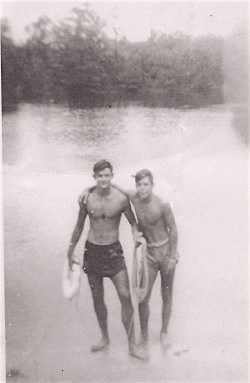
Don Ulmer and Marty Hamel of Beverly at Camp Lenape waterfront, 1944

As young men went off in the service, younger scouts took over duties of camp counselors. From Troop 8, Ron Ulmer served as Camp Naturalist and his cousin Don Ulmer as Waterfront Director.  Don attended classes at Mortimer L. Schiff Scout Reservation near Bernardsville, NJ to prepare for his job.  Full-blooded Sioux Indian and Princeton college professor J. P. Baldeagle served as Camp Director ’44-45 and drew upon both qualifications much to the benefit of his charges. Tents served as shelters and a mess hall for Beverly youngsters and other scouts of Burlington County.

Only a few World War II era Troop 8 scouts remain among us and to a man treasure all gained from those wonderful years.  They are ever grateful for them and for leaders who always found time from their busy schedules to support scouting.  So, to LCDR (later Captain, US Navy) Heinrich, Austin Haines, Dutch Wilmerton and Mr. Phillips, the many volunteer merit badge counselors about town, and countless others, your qualities and wisdom passed down sustained us well. From what is known, when scouting days ended and Troop 8ers went their separate ways, all traveled successful careers and lived happy lives, most putting something back into scouting.  They wish for Beverly scouts who followed the same good experiences of those happy times.
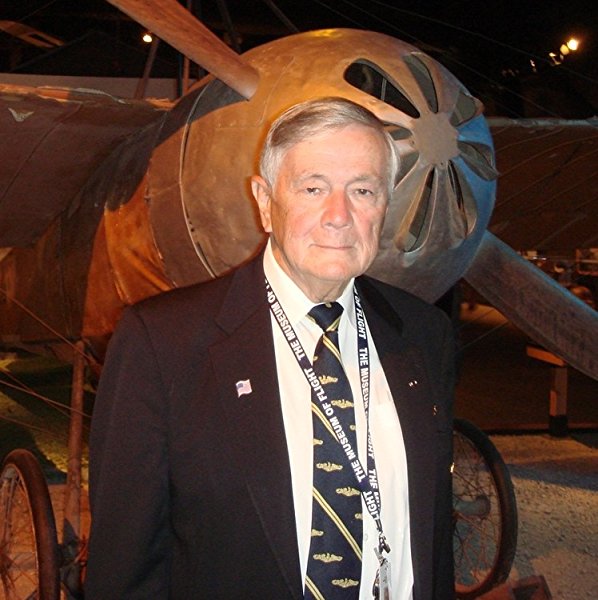
D.M. Ulmer PHOTO CREDIT: amazon.com

We sincerely thank Mr. Ulmer for entrusting us to share his scouting story here. He served in the US Navy from 1947-1979, worked at the Boeing Company (1979-96), and authored a dozen fiction books under the name D.M. Ulmer. We invite reader comments and contributions which will further fill out this chapter in local history.  – JMc

June 9, 2018:  Mr. Ulmer adds some names to his Camp Lenape recollection.

Other staff I remember at Camp Lenape

Scout Vondy, Assistant Camp Director, Bordentown, ’44
Scouts Tom and Jim Morrisey, Beverly, ’45
Scout Jerry Levy, Nature Counselor, Maple Shade, ’44
Scout Ed Sumner, Bugler, Moorestown, ’45 Metal scarce during WWII, his bugle was plastic.
Scout Bill Steinke, Maple Shade

Hanley Diehl, 1943, First Lenape Aquatic Director.  Hanley was a Quaker and Conscientious Objector during WWII.  He and I corresponded a bit to help me better understand the waterfront job.  His address was at a CO camp. I vaguely recall he once spelled me for a weekend off.  Do not know what became of him. Definitely recall him to be  a superb young man, as were all the Lenape-ers.

Those were wonderful years indeed.

Added 1/3/2019: Don sent in these c1944 Camp Lenape snapshots. If you have something to add, there are plenty more pages available in this virtual photo album.

Added 1/16/2019: Photos and memories from Ron Rudderow, Harlan Radford, Michael Abbott, Robert Dovey, and Leslies Rogers expand on Don Ulmer’s recollections in this enlarged Camp Lenape Memory Album.

Click on the image below to open the PDF for this virtual photo book.


McWhorter Mfg. Co., Riverton, NJ

When this unusual c.1907 farm implement catalog for McWhorter Mfg. Co. in Riverton, NJ with a purple cover and green text surfaced on eBay I bid for it even though I had no clue where such a factory would have stood.

eBay item, McWhorter ad 1911

With having a saved search on eBay for “Riverton, NJ” for some time, I had already seen small ads for sale from periodicals like this one:

FS McWhorter obit, The New Era, Sept 5, 1919


HSR Board member Roger Prichard joined the search and found this obit in The New Era for F.S. McWhorter, the president of the company, who once lived at Eighth and Lippincott and…

McWhorter Edger, The New Era, April 15, 1921


…another ad for a grass edger made by Allen McWhorter (presumably a son or other relative) indicating a 420 Lippincott address.

However, both of those residential neighborhood  addresses seemed like an unlikely place for a manufacturer of farm and garden implements.

detail, Sheet 14, Riverton, NJ Sanborn Insurance Map, 1919

While I was stumped on the location, Roger kept digging and found the plant in East Riverton, as shown on Sheet 14 of this 1919 Sanborn Insurance Map for Riverton.


View the entire 28-page catalog here: McWhorter Special Farm and Garden Implements Catalog c.1907

If any century-old McWhorter manufactured items are still around, please send us a photo. -JMc


Donations enrich the historical community

Apologies for the inactivity here since my computer spontaneously combusted last week. This post by phone is the best I can do for now.

In other news, this past week we received two separate offers to donate postcards to the Society.

I received a phone call from John Poss in Gastonia, NC, who offered to send us a Dreer’s Nursery shipment postcard dated 1911. It seems that he sometimes obtains postcard collections through his work and he then makes an effort to track down a sender or recipient and sends the item to them.

In our case, John saw the name DREER, and when he googled it, the search led him to rivertonhistory.com, arguably the greatest source of information and images on the web for the defunct nursery. This card is a welcome addition to the Society’s collection since it is not one we had seen before.

He wrote:

John –
Great to see this artifact return home –
Thanks,
John

This must be the week for Johns.

Riverton resident John Criqui made a special trip to my home today in Delran to pass along five vintage postcards, one of which is a real photo post card, or RPPC, showing Keating’s Drugstore at the intersection of Broad and Main Streets (second photo down on the right). (Read more about Keating’s Drugstore in this previous post.) Can a classic car buff suggest a date for the photo?

I really must emphasize the gratitude with which we accept these relics from Riverton’s past. The HSR only actually owns a small fraction of the postcards and photos you find displayed here. Most images are simply scans supplied by collectors, so this was a treat to receive these six vintage postcards for our collection, two of which have not been displayed here before.

Additionally, when ready disposal of historical ephemera for cash is just a few mouse-clicks away on eBay, we applaud these men for choosing instead to benefit the Society with their philanthropy.

I will get better images posted in the IMAGES gallery when my computer gets fixed. – John McCormick, newsletter and website editor

REV. 5/28/18: You can see scans of the above items on the IMAGES page under Palmyra, Riverton Businesses, Organizations, Public Buildings and Dreer’s Nursery.

The Ladies of Riverton’s Bezique Club

One of the most intriguing photos of old Riverton I have seen is this cabinet card with the caption, “Bezique Club” on the back.

I say intrigued because I had to look it up.

bezique
bəˈzēk/ noun:
  1. a trick-taking card game for two, played with a double pack of 64 cards, including the seven to ace only in each suit.
  2. the holding of the queen of spades and the jack of diamonds in this game.
antique Bezique set c. 1895 UK

A google search of “bezique” resulted in images of vintage and modern Bezique playing card sets as well as instructions and tutorials for playing variations of the game.

Czar Nicholas II and Alexandra played Bezique.

Winston Churchill, Tolstoy, and the Lord Alfred Duke of Edinburgh played it.

Well, not together.

Gustave Caillebotte, “Game of Bezique,” 1880

Gustave Caillebotte’s painting, Game of Bezique, depicts four 19th-century upper-class French gentlemen crowding around a card table observing two other gentlemen playing the trick-taking card game.

Bezique set box, c1895

We may reasonably conclude from the photo and the following news clippings that some women folk of Riverton also came to enjoy the Royal Game of Bezique during the last years of the 19th century.

a typical society column banner for the Philadelphia Inquirer

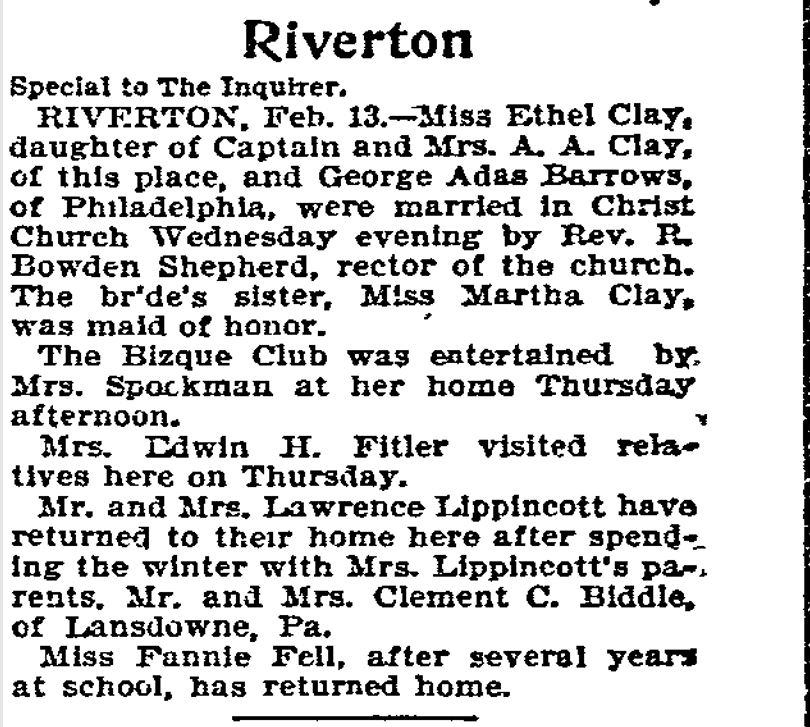
The first mention of the Bezique Club in the society columns of the Philadelphia Inquirer appeared on February 14, 1897, when Mrs. Spackman entertained the Bizque Club at her home on the 13th.

Philadelphia Inquirer, Feb 14, 1897, p39

“Mrs. Cowperthwaite entertained the Besique club on Thursday afternoon.” – The Weekly News (Palmyra), Nov 20, 1897, p2

The Weekly News, Nov 20, 1897, p2

The Weekly News reported on December 4, 1897, that “Mrs. Cornelius entertained the Besique Club on Thursday afternoon.”

The Weekly News, Dec 4, 1897, p2

Two weeks later on December 19, the Philadelphia Inquirer announced, “The Misses Cook (presumably sisters L. and J.) entertained the members of the Bezique Club at their home on Main street on Thursday afternoon.

December 19, 1897, Philadelphia Inquirer, p37

(Apparently, the spelling of bezique baffled some journalists of the day.)

Mrs. Frishmuth entertained the Besique Club on Thursday.” – The Weekly News, Jan 15, 1898, p2

The Weekly News, Jan 15, 1898, p2

The Philadelphia Inquirer told of Mrs. Edwin H. Fitler‘s attendance to the Thursday, February 12, 1898 meeting of the Bisque Club. The Weekly News explained that the club had full attendance at Dr. Hall‘s. A Mrs. Hall is pictured in the group photo.

Philadelphia Inquirer, Feb 13, 1898, p37
The Weekly News, Feb 12, 1898, p2

The Inquirer noted the attendance of Mrs. William S. Poulterer, of Philadelphia, to the Thursday, October 22, 1898 meeting of the Besique Club in Riverton. According to The Weekly News, Mrs. Spackman and the Misses Campbell hosted the meeting.

Philadelphia Inquirer, October 23, 1898, p29
The Weekly News, Oct 22,1898, p2

The last news we found of the club was for the winter of 1898-1899.

Mrs. Edwin H. Fitler journeyed again from Philadelphia to Riverton for the card game on December 17.

Philadelphia Inquirer, Dec 18, 1898, p3

A month later, on January 21, 1899, Mrs. Cowperthwait entertained the club in her home for another Thursday meeting.

Philadelphia, Inquirer, Jan 22, 1899, p11

Names of card players are on the front, but one is illegible. Any guesses?

This slideshow requires JavaScript.

We welcome any additional information about the Bezique Club and its members that will further illuminate the everyday life of this borough’s inhabitants over a century ago.
-JMc

Sheet music collector Sandy Marrone struck a chord at January HSR meeting

Cinnaminson resident, Sandy Marrone, shared a sampling from her private collection of 600,00 pieces of American sheet music dating from the 19th century through the present at the HSR meeting January 17, 2018. The program included a wide range of topics, sometimes serious and sometimes humorous.

HSR Board member Susan Dechnik introduced her friend Sandy Marrone

Of special interest is anything historical that focuses on actual events such as elections. One such selection is How Could Washington Be a Married Man And Never Tell A Lie, though this was written in more modern times.

Also of historical interest are disasters such as the sinking of the Titanic, the kidnapping of the Lindbergh baby, and songs about war.

Songs about food are fun and funny; I’ll Make The Pies Like Mother Makes If You’ll Make the Dough Like Dad.

Animal music is full of humor; I’d Rather Stay Home With Mickey Mouse, Than Go Out With A Rat Like You.

Some of the sheet music she displayed is appreciated for its visual design and beauty as well as topic.

This slideshow requires JavaScript.

The informative, educational, and thoroughly entertaining Sandy Marrone

Sandy’s comments and telling of anecdotes added sparkle and insight to each piece of sheet music. The famous George M. Cohan song, You’re A Grand Old Flag, was originally titled You’re A Grand Old Rag. He wrote it after seeing a tattered American flag. Controversy and criticism about the title forced the change to the title we all know.

In Sandy’s words, “I try to educate and inform about the variety of topics and history found in sheet music.” She dipped into her collection and shared a sample that was informative and entertaining.  – Mrs. Susan Dechnik

Early 1900s works of a Riverton artist still endure a century later

HSR Board member Roger Prichard saw this eBay auction for a scrapbook compiled by Jane Hovey Allen Boyer (1875-1940), a former Riverton resident.

Boyer was a book illustrator, prize-winning artist, and served twice as Porch Club president (1921).

The New Era, Aug 8, 1940, p4

She and her husband Murray C. Boyer lived for decades at 304 8th Street and played active roles in Riverton’s social and civic life.

Despite earning a reputation as a children’s book illustrator and teaching art classes at the Porch Club, her 1940 obituary makes no mention of her artistic achievements.

I think Roger is concerned that some ancestor might wish to get this scrapbook because there are many family photos and genealogical information in it.

I suspect that the Easthampton, MA-based eBay seller obtained it from an estate sale or home cleanout. I doubt any living descendant would discard such a unique record noting births, marriages, and deaths in a family tree going back to the 1600s. Perhaps the family line just played out and there is no one left to tend to memories of the family.

Jane Allen Boyer illustration from Mary Frances Cookbook

What is kind of incredible is that Jane Allen Boyer is not just some obscure and forgotten artist, but her works still enjoy an audience almost eighty years after her passing.

The Internet Archive has several books she illustrated available for viewing. Jane Eayre Fryer authored a series of Mary Frances books for children during the early 1900s, and Jane Allen Boyer illustrated most of them.

The preface for Mary Frances First Aid Book, published in 1916, states, “This book is for every boy and girl who hopes to render first-aid to the sick or injured — in time of peace — in time of war — at all times in the service of our country.”

A facsimile reprint of The Mary Frances Sewing Book (1913 Edition) is preserved on Open Library.

Incredibly, a 100th Anniversary Edition Story-Instruction Sewing Book with Doll Clothes Patterns for American Girl and Other 18-inch Dolls is available for sale on Amazon over a century since its original publication.

The Quaker Boy on the Farm and at School, also available on the Internet Archive, published in 1908, looks at the social life, customs, and education experienced by a typical young member of the Society of Friends in the 19th century.

Project Gutenberg displays two books, The Mary Frances Cook Book and The Mary Frances Knitting and Crocheting Book, in several formats, including a free Kindle version.

Walmart today sells poster-size prints of one of Boyer’s illustrations for The Mary Frances Cook Book. Etsy sellers get in on the renewed interest in the use of Jane Allen Boyer’s vintage images as digital clipart.

If you own any art by Jane Allen Boyer or have more information on her, please leave a comment or contact us by email.  -JMc


Flu outbreaks then and now 2

Trenton Evening Times, Feb 2, 1920, p4

Following up on our post of January 20, Pat Solin sent in this comment. Readers will recall her illuminating three-part series of articles on Riverton and the Great War published last year (GN Jan 2017, GN March 2017, GN May 2017 ).

Of the six World War I Riverton Gold Star boys who died serving their country, two contracted influenza and died after a short but deadly outbreak in 1918 — Raymond Pratt and Charles Kelly. Still a terrible disease.

Recently a spokesperson for the Centers for Disease Control (CDC) recently stated that the disease had not yet peaked and warns that the virus will be around for several more weeks.

We can’t predict what tomorrow’s headlines will bring, but it would be awesome if you were not the subject of a future news report about 2018 influenza mortality statistics.  It is not too late to vaccinate now.  -JMc


Memories of a global business still making powdered metallurgy products in our backyard

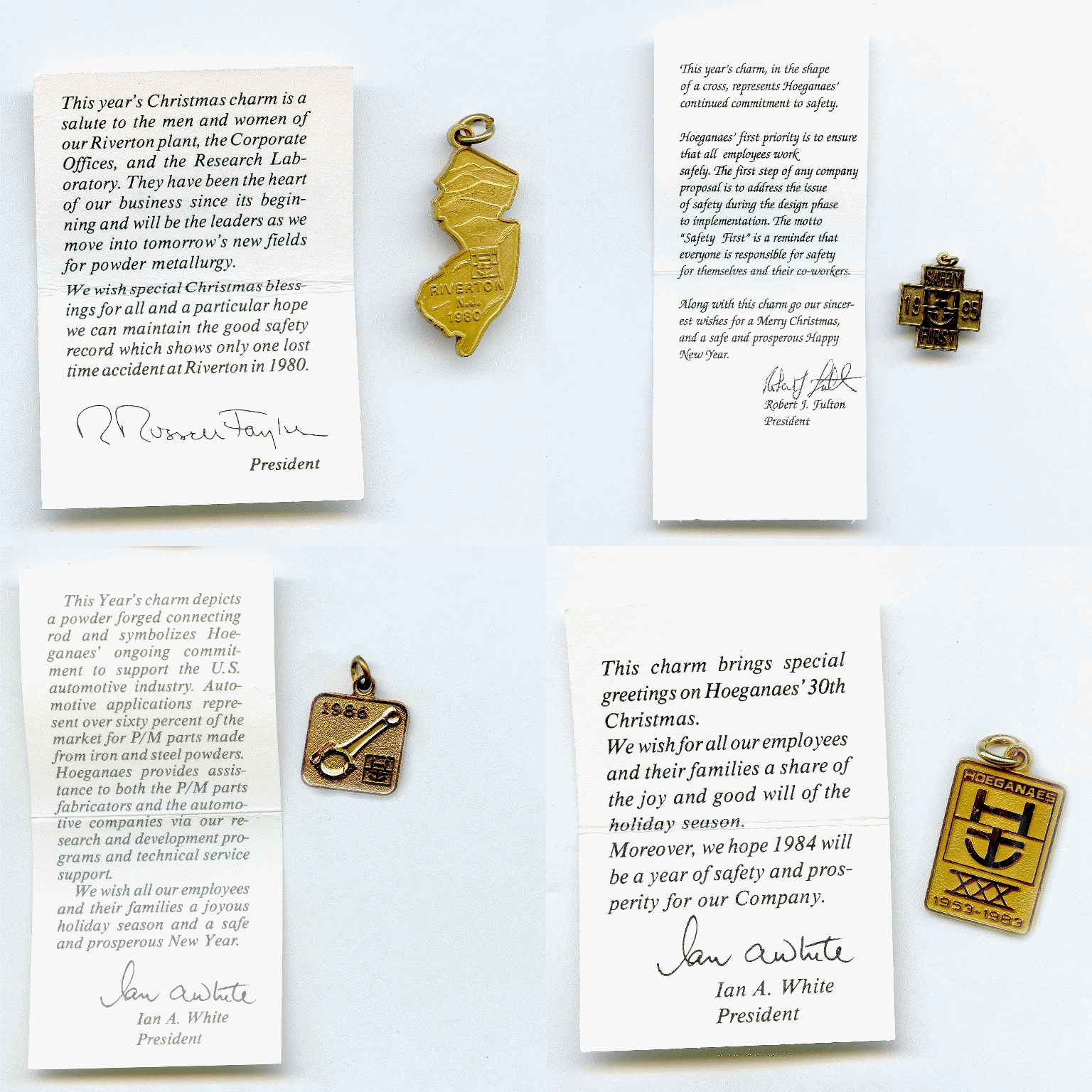
Hoeganaes Christmas Charms

Last summer I received an email from Ginny Wierski with this message:

I formerly worked at the Hoeganaes Corp. and have some pins from the company that they handed out each year to their employees. I was wondering if you would want them for your society? 

Would I??? I wrote back:

Yes, Ginny, we would like to take you up on your offer. Those items would be a great reminder of a business that was once such a big part of life here for so long. When I was teaching at Riverton School, I recall a few kids having parents who worked there.

In November I posted the above photo on Facebook and asked if anyone knew what they are.

Click on the image at left to see a 20-second animation that shows each charm along with the card that accompanied it.

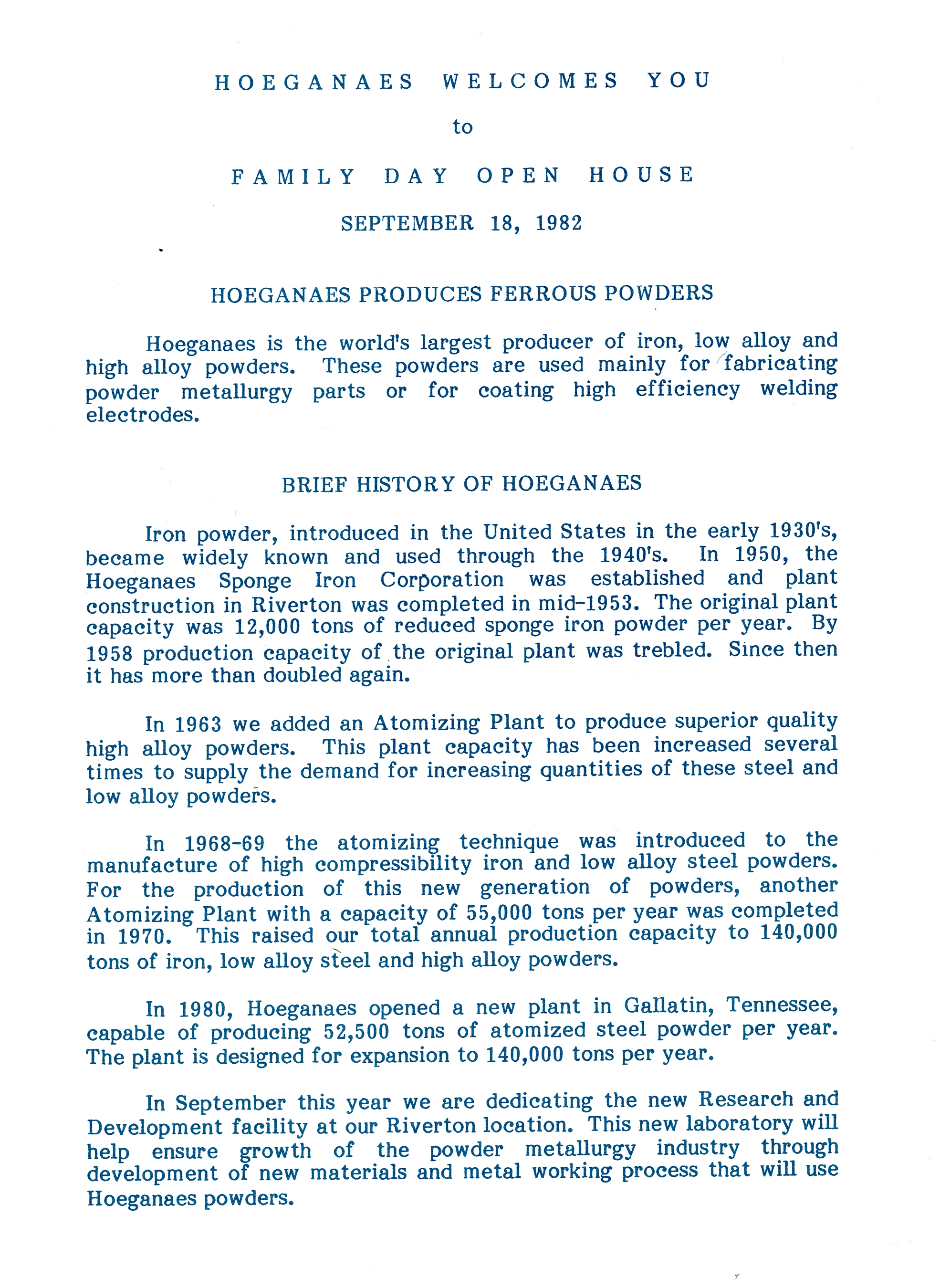
Brief History of Hoeganaes

Among the items Ginny donated were this 1982 Brief History of Hoeganaes and several company newsletters from Dorothy Armstrong, a forty-year employee of the company.

Aerial View of Hoeganaes Sponge Iron Corp. 1963

The sprawling Taylors Lane plant still manufactures sponge iron powders and is listed as “Headquarters” on the corporate website.

Hoeganaes is actually now GKN Hoeganaes, part of GKN Group, which is a global engineering business with locations in over thirty countries and has more than 58,000 employees. The company was formerly known as Guest, Keen and Nettlefolds and can trace its origins back to 1759 and the birth of the Industrial Revolution.

After browsing the GKN website I have a new appreciation of the amazing applications of powdered metallurgy. GKN Hoeganaes’ customers include GM, VW, Ford, Fiat Chrysler, Borg-Warner, Bosch, and many others. There is a good chance you have a smartphone, lawn mower, refrigerator, HVAC system, vehicle, electronic device, or another such consumer item that utilizes powdered metal components.

Coincidentally, GKN is in the news this week because the British registered company is fighting off a hostile takeover bid.

The Society strives to uncover such things to help connect members to their past experiences. Our memories and records of people, events, institutions, businesses, community groups, and traditions ultimately comprise our history.

Please contact us if you have a comment or something to add.  -JMc


Flu outbreaks then and now

It is known by many names: la grippe, grip, grippe, plague, influenza, or informally, the “flu.” Since ancient times influenza has struck human populations. Thought then to be spread more by celestial influence than by inhaling flu viruses as we know today, the word influenza comes the Latin influentia, meaning “influence of the stars.”

Jan 2018 Flu Map

The flu strain this year seems to have involved most of the country, according to the Center for Disease Control’s Weekly US Map: Influenza Summary Update.

The severity of flu seasons varies, but certainly one of the worst was the Influenza Pandemic of 1918-1919. History.com describes the outbreak as:

… the deadliest in modern history, infected an estimated 500 million people worldwide–about one-third of the planet’s population at the time–and killed an estimated 20 million to 50 million victims.

Palmyra Record, March 29, 1918, p1
Palmyra Record, March 22, 1918, p1

A century ago, when the flu laid low inhabitants of Riverton and Palmyra, news of their plight spread in the local newspapers.

Years earlier, Palmyra’s Weekly News reported in February 1897, at least nine instances of influenza, grip, or pneumonia.

Bridgeton Evening News, January 21, 1901 Bridgeton, NJ, p.3

In 1901, a Bridgeton paper reported, “One-third of the population of Riverton and Palmyra are suffering from the effects or just recovering from the grip.”

Weekly News, April 3, 1897, p4

Long before the invention of a flu vaccine in 1938, some folks around here depended upon sarsaparilla or Dr. Bull’s Cough Syrup for symptom relief.

Business Block North Broad, Palmyra, NJ

Palmyra Rexall Pharmacy sold its own proprietary remedy, Creighton’s Grippe Capsule.


Palmyra Record, Oct 6, 1916, p1

During the flu season of 1916, Riverton Free Library remained closed for six weeks to cut the spread of the disease.

(More recently, Riverton Public School shut down for a few days in January 1985 because of the flu.)

Last January’s post on phillyvoice.com, Philadelphia was epicenter of a deadly worldwide flu epidemic 99 years ago, pins part of the blame for what made the flu so devastating, especially in Philadelphia, on a September 28, 1918 event when sailors and soldiers returning from overseas mixed among citizens who turned out for a Liberty Loan Drive parade on Broad Street.

Perhaps it was during the later outbreak that Mrs. James T. Weart of Palmyra volunteered to serve with the Red Cross as a nurse at Ft. Dix.

Possibly, more family stories can tell of a local connection to the 1918-1919 influenza pandemic.  -JMc

For more perspective on the 1918 flu epidemic, see:

https://www.archives.gov/exhibits/influenza-epidemic/
https://www.smithsonianmag.com/history/journal-plague-year-180965222/
https://news.nationalgeographic.com/news/2014/04/140428-1918-flu-avian-swine-science-health-science/
http://www.pbs.org/wgbh/americanexperience/films/influenza/

Riverton Led Riverfront With First Telephone

Riverton led riverfront with first telephone

Following up on a January 4, 2018 post about telephone numbers, here is a scan of a New Era article, possibly from the 1939 Anniversary Issue,  which explains the early days of telecommunication in Riverton.  -JMc

1909 Christmas Issue, The New Era, p23.

rev. 2/4/2018: Rummaging through our records, I found this history of Riverton’s telephone service from The New Era.