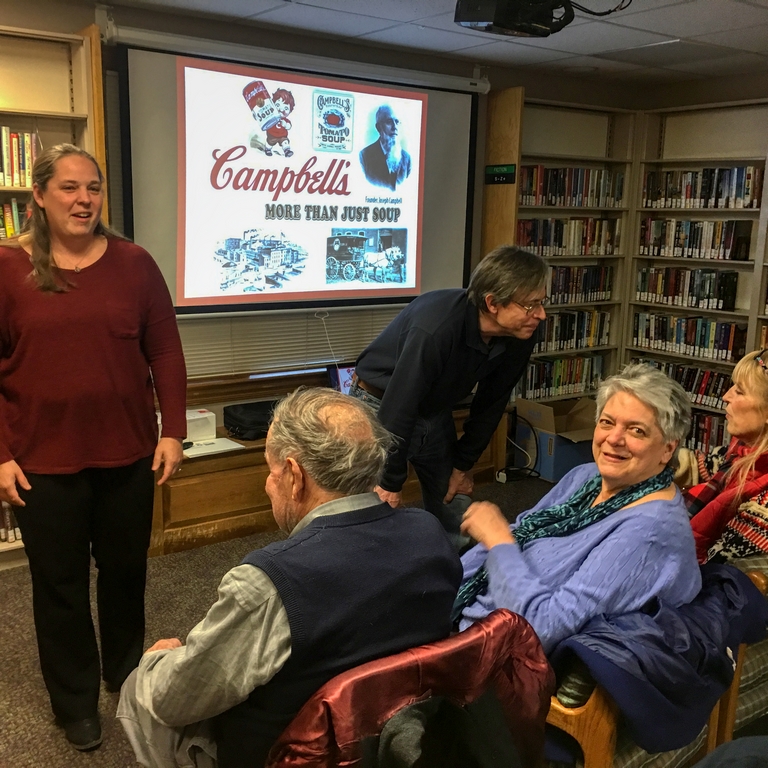
It was a S.R.O. crowd at Riverton Library for the Campbell’s Soup show

ACT I: “Campbell’s… more than just soup” slideshow
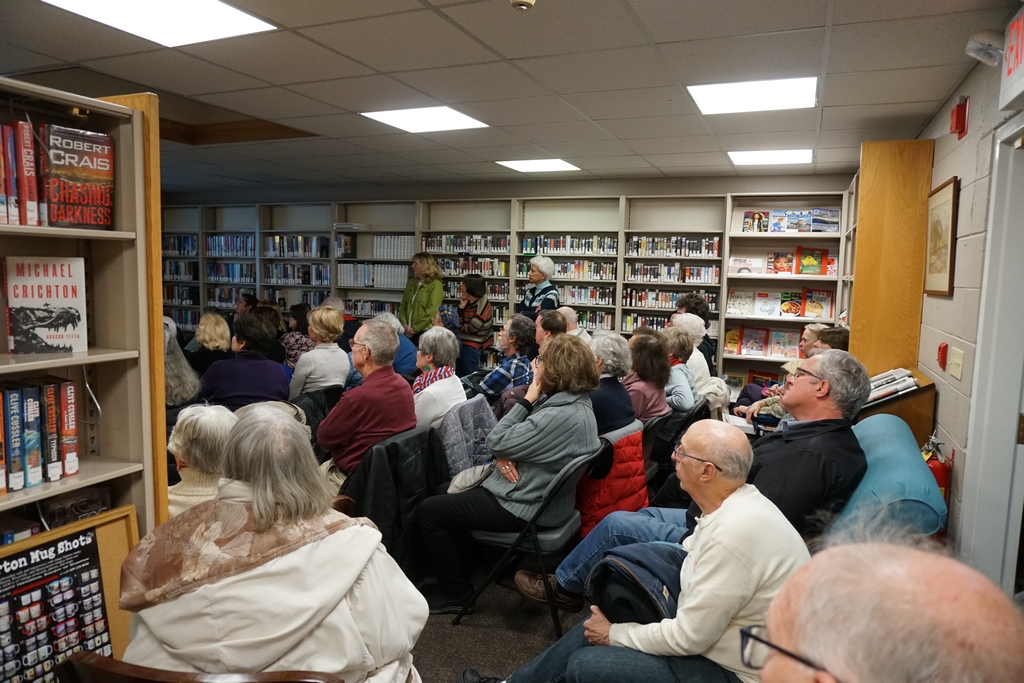
capacity crowd at the RFL PHOTO : JM
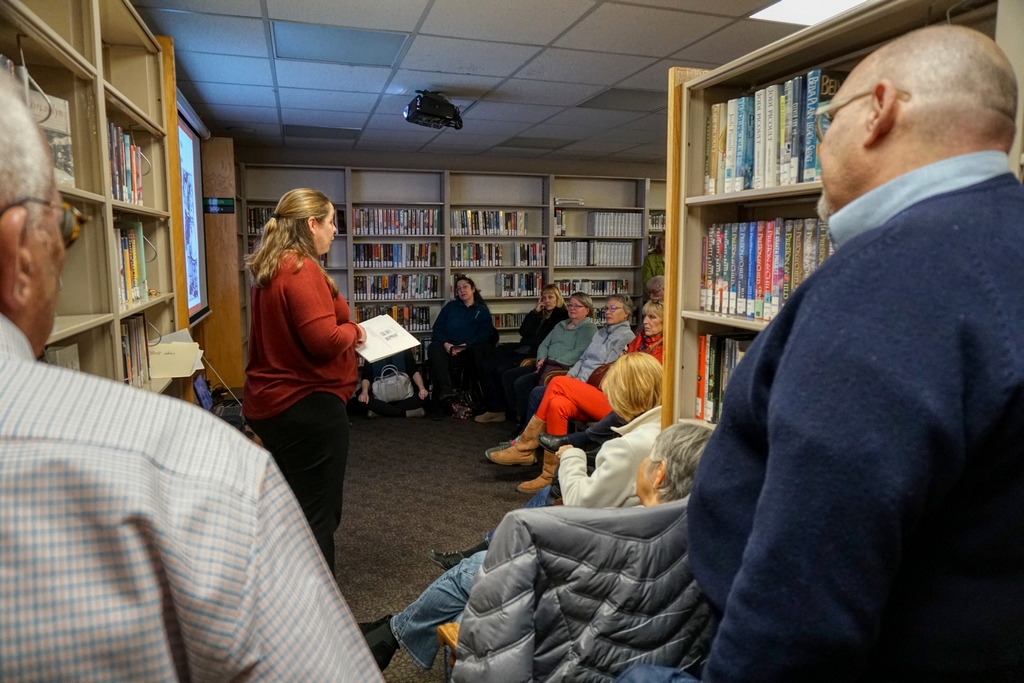
The audience needed every available space PHOTO: JMc

We sincerely thank the 80 or so hardy history buffs and lovers of Campbell’s Soup nostalgia who sat in chairs, sat on the floor, and stood (some with obstructed views), to hear Marisa Bozarth as she chronicled the history and development of Campbell’s Soup Company.

Even Jan DeVries, our reception hostess, stands PHOTO: JM
People spilled over to the next room PHOTO: SD

The turnout for Tuesday night’s program sponsored by the Historical Society of Riverton took us off-guard, so we apologize to several folks who looked at the overflow crowd and left.

ACT II: Reception at the former Campbell home

Some really good sports are sitting on the floor PHOTO: JM
Entryway PHOTO: JM

After the engrossing slide show, the meeting carried over next door to the home of Jan and Dennis DeVries who graciously showed us the former home of Joseph Campbell.
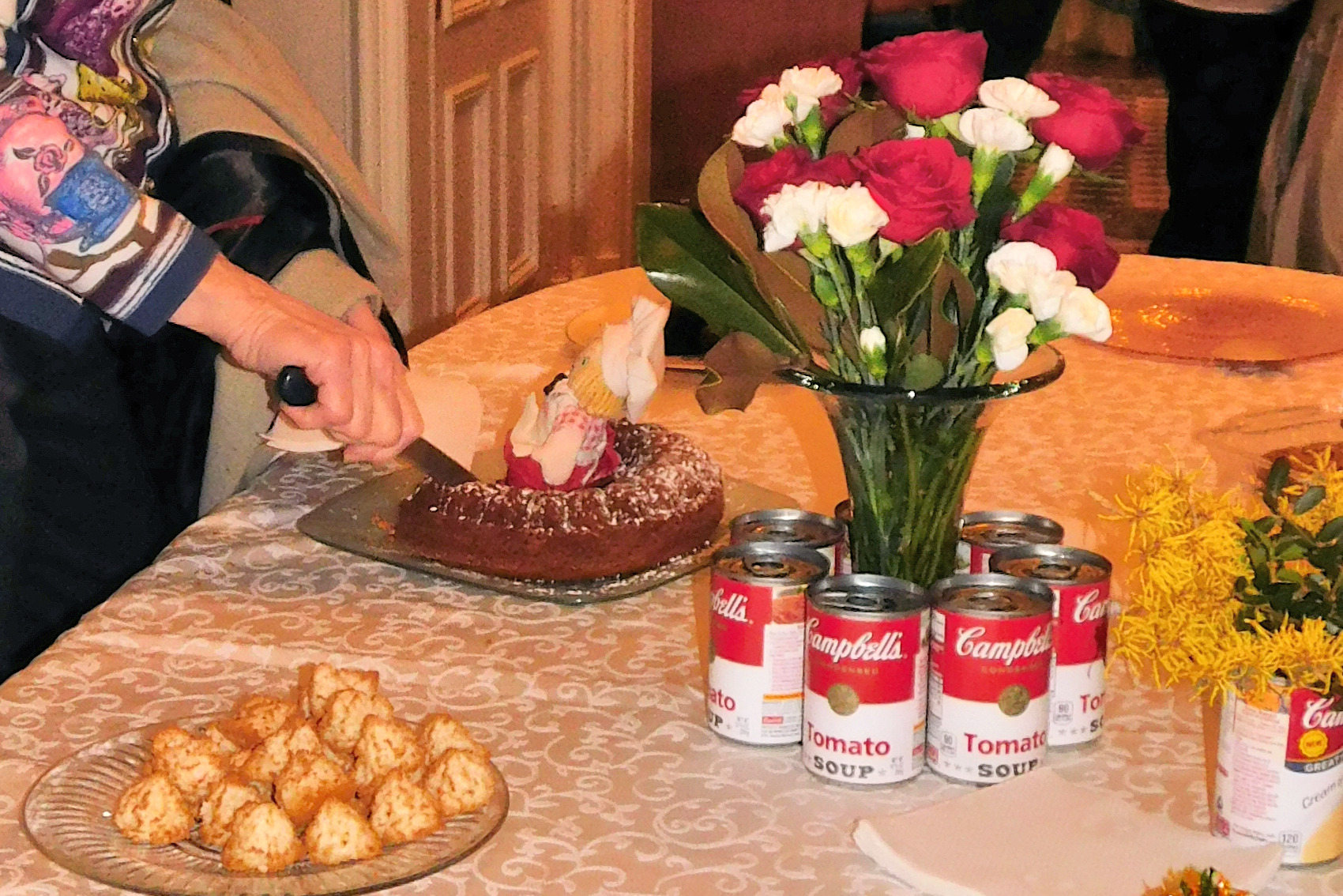


Pat Brunker cuts Susan Dechnik‘s Tomato Soup Cake PHOTO: SD
How serendipitous was it that the former Campbell is next to the Library? PHOTO: SD

A splendid dining room table centerpiece of carnelian-red and white flowers in a vase surrounded by cans of tomato soup reinforced the theme of the evening.


Mmmm…good! PHOTO: SD

The delicious desserts and confections arrayed there  fueled animated conversations about how much folks enjoyed the well-researched topic and Marisa’s buoyant delivery.

Framed Campbell’s embellish the pantry wall PHOTO: SD

Our hosts, Mr. and Mrs. DeVries, doubled-down on the evening’s refrain and carried out the Campbell’s Soup motif by hanging a portrait of the home’s early owner in the kitchen area next to a framed print of a soup can and an illustration of a Campbell’s Kid.

PHOTO: SD

A soup tureen filled with fresh tomatoes, a Campbell’s coffee table book, a Campbell’s recipe book (doesn’t everyone have at least one in their kitchen?) and actual cans of tomato soup consummated the theme.


HSR President Bill Brown presented Jan and Dennis with mugs that depict their home and information about Joseph Campbell PHOTO: SD

Marisa wrote later, “It was wonderful! Everyone was so welcoming and I loved getting the opportunity, not only share the Campbell’s story with everyone, but also to talk to so many people afterwards!”

She is so right.

This important aspect of our meeting helps to carry out the Society’s several-fold mission to bring together those people interested in history, to increase awareness of our heritage, and to continue to expand our knowledge of the history of the area.

Our current membership of fewer than 100 households is at a historic low. We need your support in the form of membership dues and donations to underwrite our efforts to bring such programs to the public. 

ACT III: History is the topic of conversation
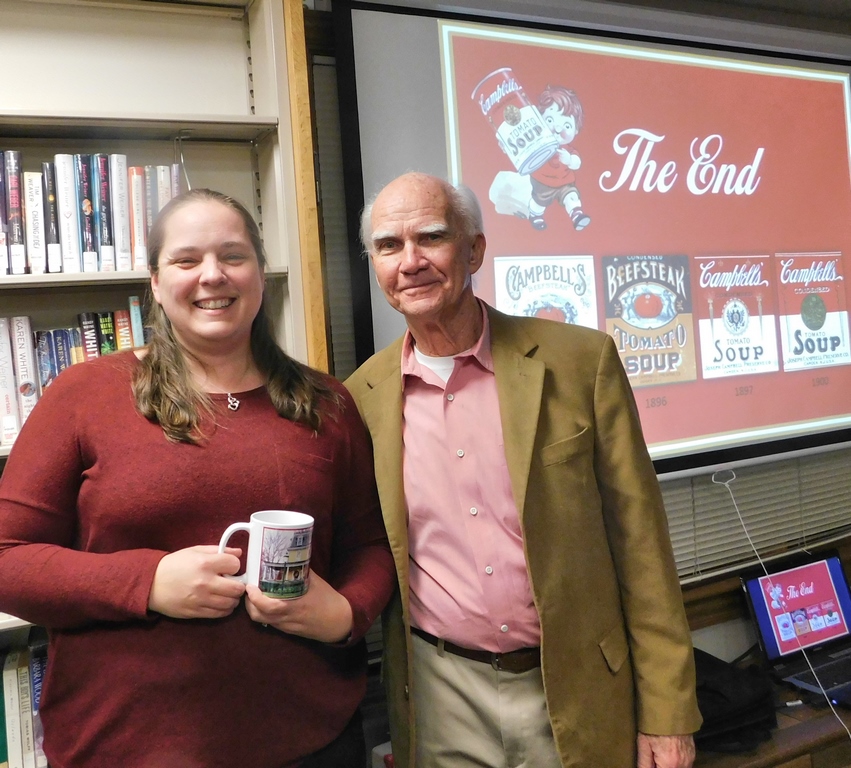
Marisa also has a Campbell themed mug as a memento of the evening PHOTO: SD
Bill Brown and Alice Smith, President of the Riverside Historical Society discuss cooperating on a future presentation PHOTO: SD

Another side benefit to having people with a common interest in history assemble together is the networking, or sharing of information, that often happens.

Given the thousands of local people over the years whose farm products supplied the plant or whose labor produced soup, it comes as no surprise that a few in the group either worked there themselves or had a family member employed.

One woman volunteered that she has photos of the old Campbell Experimental Farm in Cinnaminson I can scan.
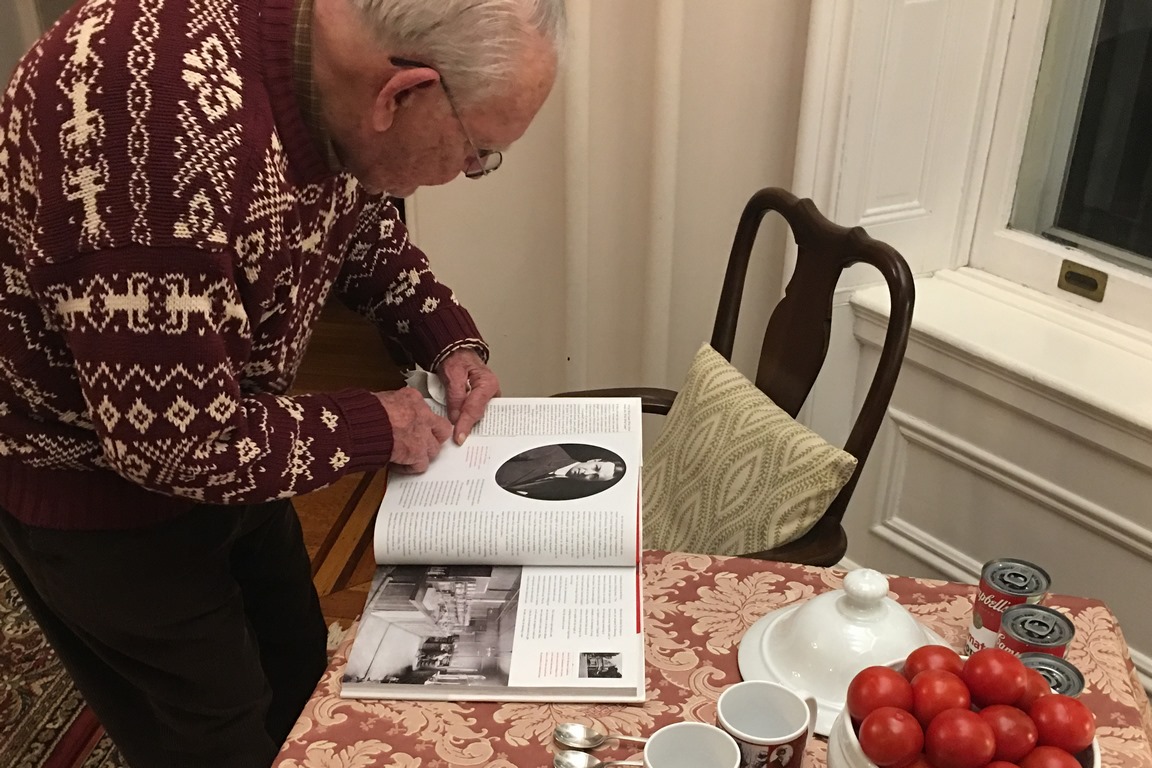
Bill Hall once worked on Taylor’s Farm and delivered tomatoes to the Camden plant PHOTO: JM

It turns out that one of our members had first-hand experience with working on local farms growing and delivering tomatoes, and another worked for a time in the Camden plant. Look for more about their anecdotes in another post if I can twist their arms to be interviewed.
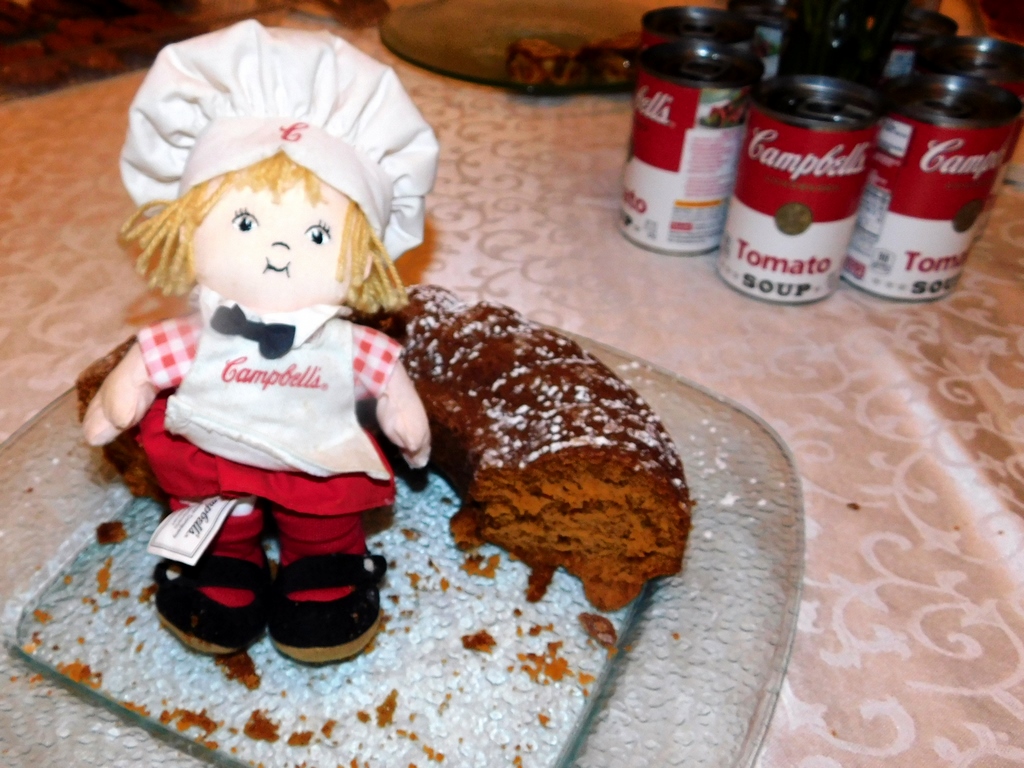
 

Tomato Soup Cake – Don’t say no until you try it PHOTO: SD

Maybe we can get Susan Dechnik to reveal the recipe for her Campbell’s Tomato Soup Cake.

Here’s a link to a Campbell’s Soup Company’s A SPICY HISTORY OF CAMPBELL’S TOMATO SOUP SPICE CAKE.


Epilogue: Please tell your Campbell’s story
Roger Prichard will have two more historic signs ready for Bank Avenue properties this spring PHOTO: JM

If you have another memory of Campbell’s from back in the day, please contact us through the form below so that we may add your voice to this collaborative effort that is rivertonhistory.com.

Marisa may have to add another slide or two to that PowerPoint. – JMc

PHOTOS BY SUSAN DECHNIK AND JOHN McCORMICK

See the Campbell’s Soup Company 9.78MB PDF slideshow here.

Stay tuned for the sequel

← Back

Thank you for your response. ✨

A Campbell’s presentation tonight with a side of nostalgia

Interest on social media in historian Marisa Bozarth’s Campbell Soup presentation tonight at Riverton Library at 7 o’clock has been high.

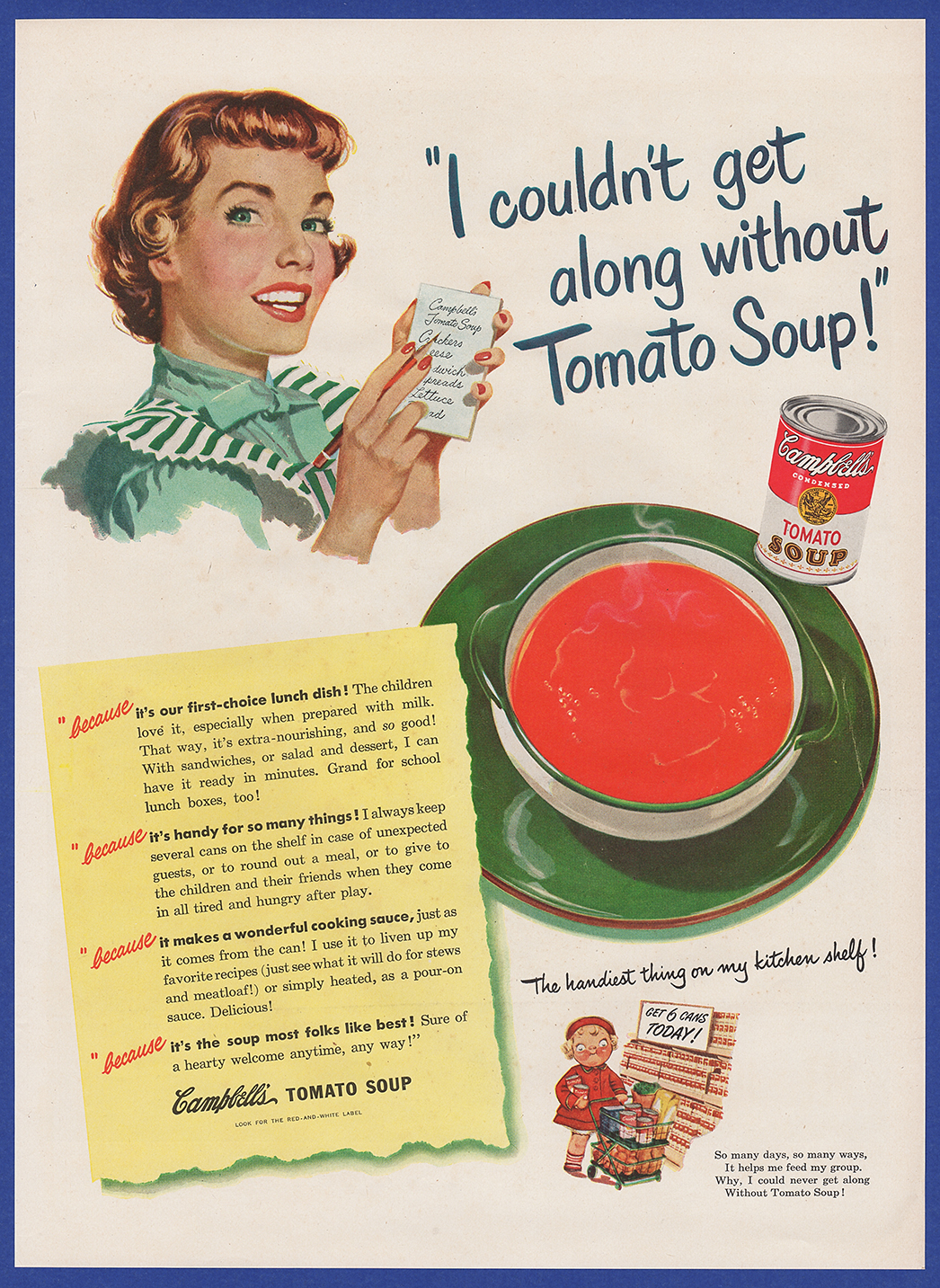
Just writing about it brought back a flood of memories for me about Campbell’s. Sure, everybody has a favorite. Mine is tomato soup made like my mom, Phyllis McCormick, made it with a half can of water and a half can of milk.

Congowall by Congoleum

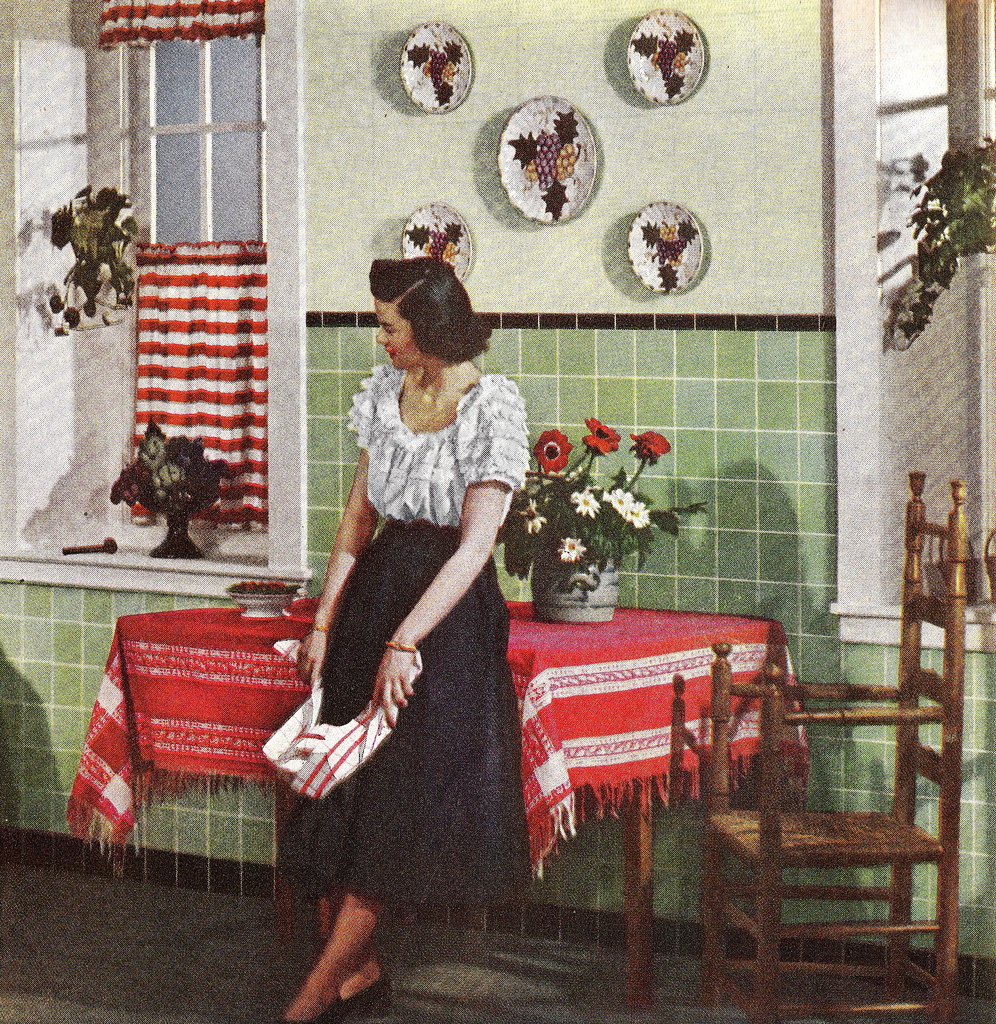
The height of gourmet eating was sitting at our Formica table in our Congowalled kitchen slurping tomato soup topped with a layer of crumbled Ritz crackers and, as a second course, a buttery grilled cheese sandwich.

You’d think I would be sick of the stuff. My mother brought home mass quantities of those dented silver cans with no labels, tied up with string that she bought from the employee store at Campbell’s Camden plant where she worked. It fell to me to write “TOM” on top of each can with a stub of a black grease marker she kept in a kitchen drawer.

When she was feeling really flush on payday, she sometimes brought home bags of my favorite Pepperidge Farm cookies and cans of Swanson’s Chicken à la King, products made by two companies Campbell’s acquired. At Christmas, my teachers always got the best presents from me – a small golden box of Godiva chocolates, available for half-price to Campbell’s employees.

Workers strike outside the Camden plant in 1952. PHOTO: Courier Post

I often waited for her at the Beideman Avenue bus stop, and when I was old enough, I drove to downtown Camden to pick her up when she worked night-shift, so I got to hear a lot about how her day went.

Tomato season brought longer hours and sweatshop conditions – literally – during the heat of many South Jersey summers. She knew all the recipes for those colossal cauldrons you’ll see in Marisa’s slide show. More than a few times she told me how a batch would be scuttled because it got double salt or worse.

She started out on the line sorting tomatoes and worked her way up to production, then quality control. The time/motion efficiency experts hired by Mr. Dorrance scrutinized and analyzed every task and dictated changes. She schooled the newly hired management “college boys” in soup making and they became her bosses.

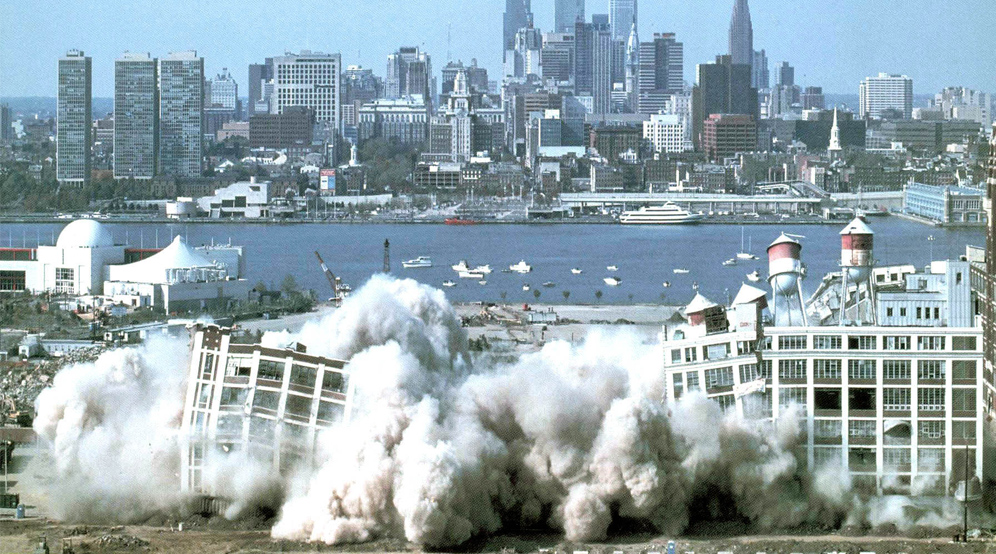
The end of an era: Campbell’s Soup Plant Implosion, Camden, N.J. – November 3, 1991 PHOTO: Langan.com

She saw the end coming as layoffs of production staff followed opening new plants elsewhere – was it South Carolina?

But she hung on because now she was an executive secretary for one of the big shots and therefore part of management.

She was proud of her achievements at the Camden plant and thankful for the job that enabled her to raise two kids in the 1950s and ’60s. When she retired from Campbell’s we attributed the closing of the Camden plant to her leaving.

I wish I had listened better  because I am sure she’d  know plenty about soup production if she were here.

Please leave a comment if you have a Campbell’s memory. -JMc

Explore the Campbell Soup/Riverton connection in 7 days

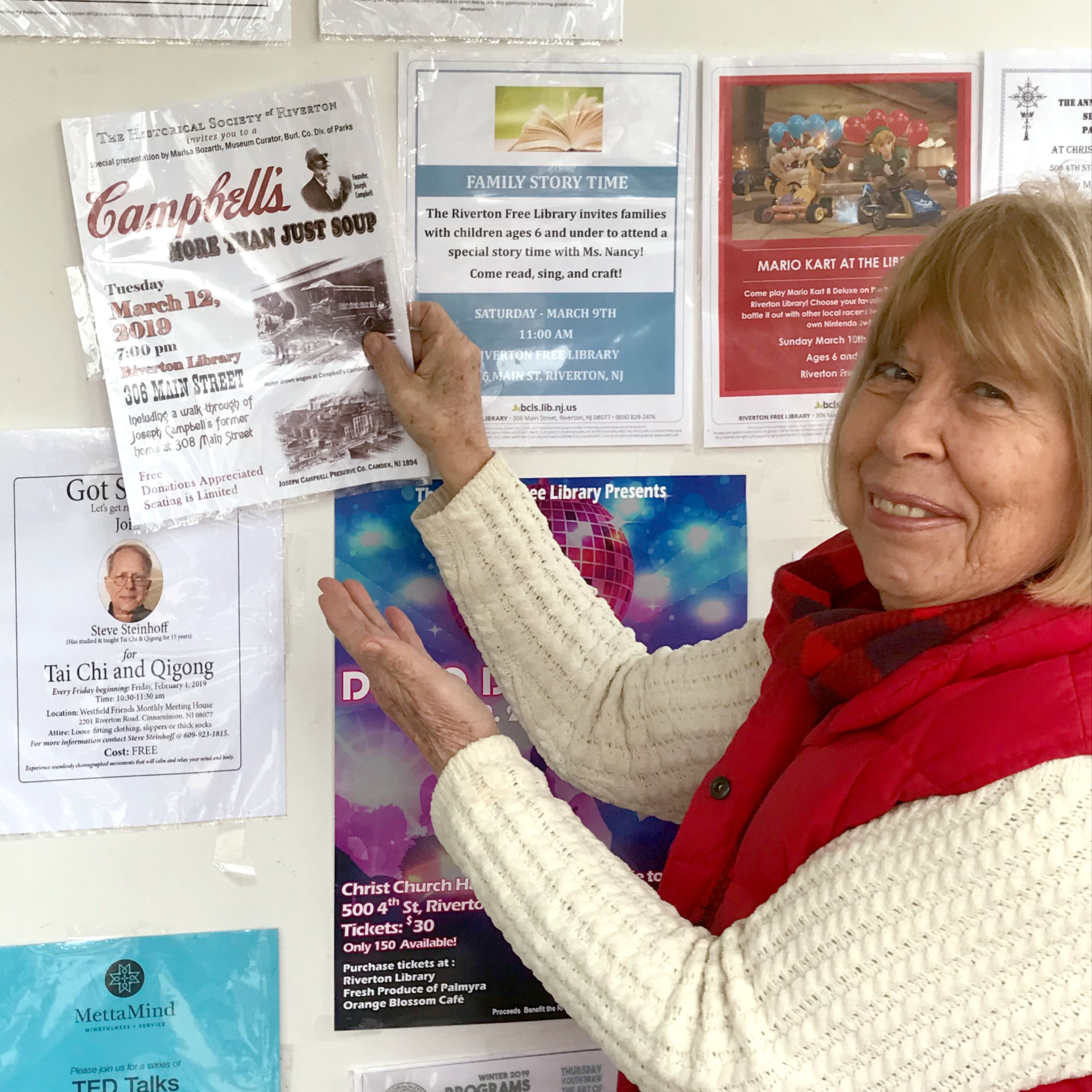
Susan Dechnik posts notice of our next meeting at Riverton Free Library.

Here we find HSR Board Member and publicity specialist Susan Dechnik posting our flyer at Riverton Free Library announcing Marisa Bozarth’s “Campbell’s: More Than Just Soup” presentation that takes place there in one week.

See our Upcoming Events link on the Main Page for more particulars on this special lecture about Joseph Campbell, founder of Campbell’s Soup and a past inhabitant of Riverton.

Summer Work at Beach Haven’s once lavish Hotel Baldwin in 1954

Despite the name, rivertonhistory.com, one realizes real fast that there is much more to this website than just Riverton history. A person across the miles who googles for Long Beach Island or Medford’s Camp Lenape may find that we rank as one of the top results for that topic simply because we display so many vintage images.

The Images/Stone Harbor page, for example, has collected an amazing (for us, anyway) 54 comments from folks who often leave a mini-memoir of their decades-old stay there.

If only a post about Riverton history would arouse such engagement from visitors.

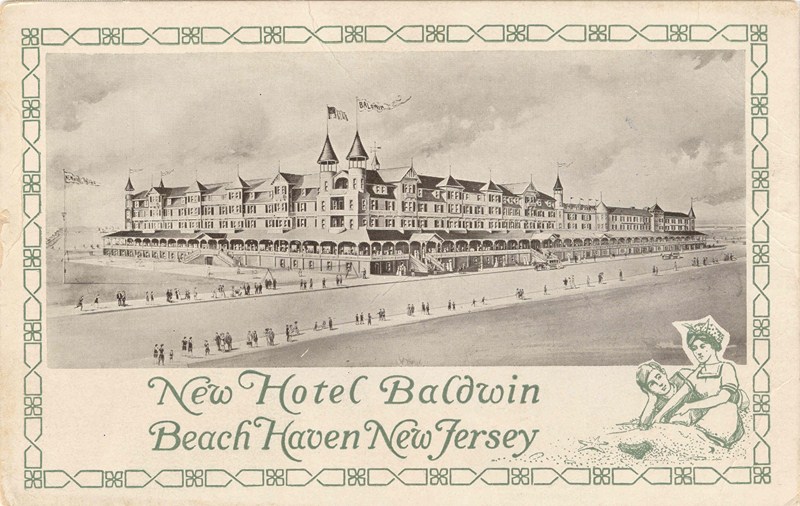
New Hotel Baldwin, Beach Haven, NJ

When Mary Wallis Gutmann sent in this vivid account of her college summer job working at Beach Haven’s long-gone Hotel Baldwin in 1954, I knew it deserved special mention.

Summer Work in 1954
The Baldwin Hotel

Design school was intense. I saw summer jobs as a respite from college work—not work themselves. Getting away from the pressure that was constant at Pratt was necessary. Surviving on my own was important. A live-in job was sometimes the answer: for summer at least.

I left the city between my second and third year at Pratt to work at the Baldwin Hotel on Long Beach Island in New Jersey. The Baldwin was a once grand, now run-down shingle affair with one hundred and fifty-five rooms, some with sweeping beach views. I ran the elevator: a four-sides-open, wrought-iron cage, with a velvet-pillowed bench across the back and a huge spring hidden underneath in case the operator forgot to stop. That was me a few distracted times, to the consternation of guests on board as we were vigorously jounced up and down.

The staircase trailed around the elevator to the top. The owner, Chuck Yokum, and his wife had an apartment in a turret on the top of the hotel. Guests stayed on the second floor, higher-up staff on the floor above, waitresses and other (mostly college) female employees such as me in a wing off the first floor; young male employees lived in another such wing. It was hot and sandy and perfect for summer.

Chuck Yokum loved to cook (or, think he cooked). He carried his ubiquitous can of beer around to sip while he sampled sauces and soups warming in the steam tables. Then he’d invariably add a big splash of his drink to each pot. Diners came from all over. They loved the food: they raved about his chef’s secret ingredient (a spurious name for beer made up by Chuck). They asked for the chef’s name, but Chuck told them that was a secret, too. “I don’t want him to leave…” he’d say.

Philadelphia Inquirer 31 Aug 1954, p16

We were given free room, board, and uniforms. My dress was a sort of liverish color, (ghastly on someone with a tan), a removable-for-washing white collar, and Peter Pan sleeves that were unflattering on a thin girl with scrawny arms. There was no regular pay, just a little weekly pocket money. Chuck kept our wages (he said) in a special Escrow Account so we would stay all summer and not “skip out.” We’d be paid at the end of August (he said).

On Labor Day, (the hotel closed the next day until the following Spring), Chuck and wife drove off to Mexico in the early hours with suitcases packed full of hundreds. Hundreds of dollars of our money. A major hurricane blew in immediately after they left. There had been a general evacuation called by the Coast Guard but we (the summer hotel staff) elected to stay. We averaged no more than nineteen years in age and believed we were impervious to injury. We had no place to go and no money to get there if we did. We sat up all night in the lobby, feeding driftwood and then broken bits of the porch furniture into the huge fireplace, drinking all the beer and eating all the food that was left. We had an uproarious time.

The next morning, after the hurricane had roared across the island and smashed windows and banged shutters and blown the wood shingles off the hotel roof all night, we went out to the beach to survey the damage. It was not yet light: the sea was still dark and the white, tumultuous surf was full of brilliantly-colored sparkles from iridescent plankton brought in by the storm. They glowed exquisitely against the white foam and the black water. As the sun rose, some sections of boardwalk, a pavilion, and several small houses appeared, floating gently beyond the surf line on a calm sea. We heard later that at the height of the storm, a rowdy teenager went for a walk and rode a section of boardwalk around the point and into the bay. They said he survived.

Chuck Yokum and his wife and the car and the money (our money), were nowhere to be seen. The police came to tell us where they suspected the Yokums were—or as near as the Police knew: the clues were Mexico vacation flyers in their apartment. Chuck’s car was gone and so was our all summers’ pay.

The policeman had the local bank president with him who was obviously concerned about being sued. Sue? We hadn’t any money to sue. Today I might feel differently. After all, the banker had given Chuck the wads of cash Chuck took with him. We reminded him they were our wads of cash.

Hotel Baldwin, Beach Haven, NJ 1948

The Baldwin Hotel was sold and six months later I got a check for $80 with a note saying the money was my share of the Escrow account for my summer-long elevator operator work (after the lawyers took their cut). I was happy with the unexpected loot and bought a used camera: a Rolleiflex with a pre-war, hand-ground lens. I never hear the term, ‘pre-war,’ today. I took sharp pictures with that camera for years—sometimes almost too sharp.

Copyright © Mary Wallis Gutmann 2019  Ms. Gutman has authored several books ready for consideration by a publisher – a youthful memoir, science fiction novel, light mystery and a murder mystery. We can forward any queries to her.

For more details about the Hotel Baldwin, see these two illustrated google books entries, or click on the covers to purchase at Barnes & Noble. -JMc

Beach Haven by Gretchen F. Coyle, Deborah C. Whitcraft 

Long Beach Island by George C. Hartnett, Kevin Hughes