Richards Restaurant-Caterer, Rt 130Aerial View of Hoeganaes Sponge Iron Corp. 1963
We have several old postcards that are over a century old, the accepted age of something that is an antique. However, these modern chrome postcards are getting up there.
Hoeganaes Sponge Iron Corp. is the only postcard that has a date.
Can a car buff date that Caddy at Roger Wilco or any of the autos at Richard’s Restaurant? The phone number for Roger Wilco listed on the back is RIverton 9-1400. – JMc
Farmers and Mechanics BankRoger Wilco Liquor Store, Palmyra, NJ
Rev. 10/2/16 Roger Prichard:Thanks! Richards Restaurant is today’s Whistler’s Inn, I’m guessing?
Thanks to HSR member Roger Prichard for his suggestion on our Facebook page that Richards Restaurant is today Whistlers Inn. Although enlarged and transformed, it sure looks like it. My mouth is watering for Whistlers’ Smoke House BBQ ribs. The postcard shows a Route 130, Riverton address, and Whistlers gives a 901 Route 130 Cinnaminson address.
Every artifact, photo, ephemera item, old newspaper clipping, etc. we get helps add another stitch to the fabric of Riverton history.
Recently, Colin Cattell, a Palmyra High School student who loves history, saw this single Kodachrome slide up for auction on eBay, bought it, then went to Phyllis Rodgers’ home and gave it to her for the Society. The HSR President reports that Colin was so proud of his find and would not take anything for it.
Classy, Colin.
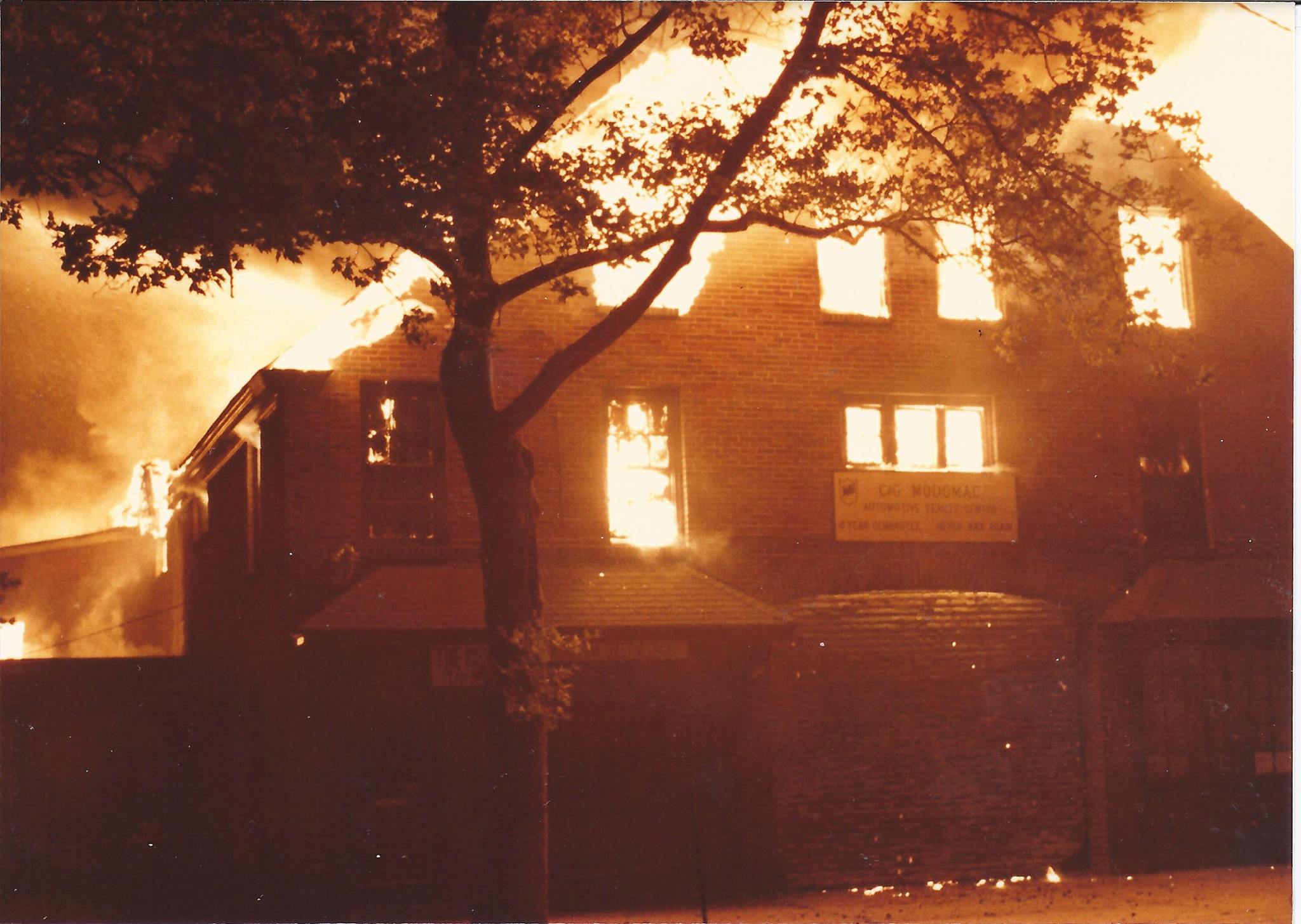
Collective Federal Savings fire 1979 scanned photo-edited slide image
According to the date stamp on the cardboard slide mount, photographer Bucky Reeves documented this 1979 Riverton fire that destroyed the Collective Federal Savings building that once stood next to Freddy’s Shoe Repair on Main Street.
008_1979-07-27 Huge Riverton Fire Trenton Evening Times p4
This dovetails nicely with a number of photos posted here in 2011 from Mary Yearly Flanagan’s family album. Among them was this newspaper clipping that summarized the event.
Can a firefighter or resident add any further context for that incident?
You may know Colin’s dad, Mike Cattell, as the author of those cool Then and Now videos that show a vintage image of a local landmark morphing into a modern scene, matching sizes and perspectives perfectly.
We thank Colin for his generous donation of this slide and appreciate the fresh perspective his dad, Mike Cattell has given to some vintage local images. – JMc
9/24/2016: Friend of the Society, John Hartnett, sends in these 3 pix of the 1979 fire mentioned above. He writes, “This photo was taken by George Mathis who, at the time, lived in the apartment above what is now Milanese Pizza.”
1979 Riverton fire photo by George Mathis1979 Riverton fire photo by George Mathis1979 Riverton fire photo by George Mathis
Those almost forgotten vintage postcards, family photos, and old newspaper clippings tucked away in attics and drawers still are the best sources for images about the Riverton of yesteryear.
If you have something you can find, please donate it or send us a scan. Recent requests for pictures include Klipple’s Bakery, The Sharon Shop, Woolston’s Esso, Palmyra’s bowling alley, Millside Farms, and others. – JMc
When World War I erupted in Europe in 1914, the majority of Americans favored neutrality. As German aggression developed, the U.S. later joined its allies –Britain, France, and Russia–on April 6, 1917, to fight in World War I.
As the anniversary of the US entry into the conflict approaches, the HSR is preparing a series of articles to honor the service of its armed forces, as well as to depict what life was like in Riverton during the war.
We are asking for your help. While we have access to online resources, we are hoping that you, our readers, may have photos that can be scanned, stories that we can share, and letters from those Rivertonians who were dedicated to the cause during those years.
Can you provide any additional information, especially on Riverton’s Gold Star Boys?
As Riverton’s recent July Fourth Parade attests, it’s not a parade without the fire engines and the fire fighters.
Riverton Children’s Parade c.1950’s
The purpose of this post is to consolidate some information and images from past posts on this subject.
Former Mayor Bruce Gunn provided the c.1950s Kodachrome slide for this fire engine (possibly Palmyra’s) from more than a half century earlier.
This past June, I posted this scan of a photo I bought on eBay to our Facebook page, and asked if anyone could identify the men. The only description for the small undated photo appears at the bottom – “192 American LaFrance, 750 GPM type 75, Riverton, NJ.”
American LaFrance, Riverton, NJ
A few days later, we received this response from Cara Vandy:
My mother, Mary Vandy, who was born in Riverton, says the driver is her uncle, Earnest “Ernie” Bishop and the other man is Jesse Perkins.
So now, can we assume that the photo was taken during a July Fourth Parade, or was it taken elsewhere, as was the case with this other photo I bought in 2013?
1956 photo 1926 RFD ALF 750 pumper in AC
The seller’s description reads: “A very nice old 1956 original B & W 4 by 6 inch photo of the Riverton NJ Fire Dept 1926 ALF 750 pumper. This photo was taken by me at the NJ State Firemen’s Parade in 1956 Atlantic City.”
If a reader can identify the driver, please advise.
See other fire apparatus photos which appeared in February andNovember 2011 posts.
image courtesy of Mike Nowacki, Jersey Shore Photography
We come full-circle to Riverton Borough’s newest fire apparatus, Riverton, NJ Engine 2412, a 2015 Pierce Impel 2000/750, which made its Children’s Parade debut in 2015.
Read more of the history of Riverton Fire Company, which celebrated its 125th anniversary in 2015, in a series of articles written by former Town Historian Betty B. Hahle reprinted from July Fourth Program booklets in this June 2013 post.
Let this post serve as an invitation to readers to exhibit more photos of RFCo apparatus, old or new.
RFC1927ALF and chief’s auto by DGusky
David Gusky, an avid model builder uses such photos to create incredibly detailed miniature duplicates of Riverton Fire Company vehicles.
And just maybe someone else will recognize an ancestor or acquaintance in this tribute to Riverton Fire Company equipment and fire fighters.
L-R. John McCormick, Carlos Rogers, Phyllis Rodgers
HSR President Phyllis Rodgers and newsletter editor John McCormick verrry gratefully accepted a check this afternoon on behalf of the Society from Carlos Rogers, creator of the Historic Riverton Criterium– our biggest contribution ever!
THANK YOU, Carlos!!
This evening, Phyllis messaged her fellow Board members the awesome news:
Hello Board Members,
Carlos just brought a check for his Criterium Donation—-$4,000!!!
Many thanks to Carlos for all his efforts.
The HSR is so lucky. Life is good in Riverton!
Best to all,
Phyllis
Yes, it is good, and Carlos Rogers is one citizen who helps makes this town the great hometown it is.
Carlos Rogers directs the action at the 6th Annual HRCriterium
He has devoted hundreds of hours over the past year to stage and promote the biggest and best Historic Riverton Criterium yet, drawing competitors and spectators from all over.
The Historical Society of Riverton is pleased to have again supported the event this year and truly honored to benefit from Criterium proceeds.
Thank you, Carlos, for your tireless efforts in continuing to bring such an exciting cycling event to our town. Your incredible generosity toward the many individuals and local organizations you have given to since its inception has just been a bonus! – JMc
FamilySearch, the genealogy research part of the Church of Jesus Christ of Latter Day Saints is a wonderful, free resource for those who are looking for family tree documents. I have used the site and found information not otherwise available, so I have decided to do a bit of volunteer work for them in their upcoming Indexing Project.
I downloaded the software to my desktop, and completed the tutorial, both of which were simple.
The organization is looking for 72,000 volunteers to complete indexing, in English or other languages, for documents in the US or other countries, from July 15-17 (your choice of country and language). You can index as much or as little as you like, but I think it could be addicting once you get started — not just for former librarians like me, but all who love to search and learn from historical documents.
With all of those backyards, the former grounds of Dreer’s Nursery, and the banks of the Pompeston Creek and Delaware River at Riverton’s doorstep, an afternoon spent digging often yields treasures of all sorts – Indian arrowheads, milk and patent medicine bottles, flower pots, and such.
Last December, Jennifer Chapman exhibited treasures she found on the Delaware River along with graphic compositions that shed light on their history at Palmyra Nature Cove. Here are some pix I took of that incredible display of locally dug artifacts.
More recently, Matt Mlynarczyk, a Riverton ex expatriate now residing in Alexandria, VA sent in this information about a dug bottle. Gone from this area for over 25 years, he presumably found us online and presents this mystery. He writes:
Hello Friends,
I grew up in Cinnaminson and began collecting old bottles and beer cans in 1976; I left for college in 1984 and have lived in Alexandria, Va. since 1990.
I’ve attached a photo of a Riverton milk bottle that I have never able to find any information about; perhaps you know something about it.
It’s 7″ tall, with a slight hint of amethyst in the glass, marked ONE PINT, and the slug plate reads, MACMULLIN RIVERTON, N.J.; the base is marked T. MFG. C.
I dug this bottle during the summer of 1978 it in Riverton, N.J. where Broad St./River Rd. crosses the Pompeston Creek. There was construction there, and another friend/collector dug for about a week and came upon a treasure trove of Burlington County bottles; most dated from 1880-1910.
I would be happy to provide you with a more detailed photo for Gaslight News if you would like to publish it to begin a dialogue.
Best regards, Matt Mlynarczyk
OK, kids. Any ideas on the story behind this MacMullin dairy bottle? Tell us about your dug finds. – JMc
Added 7/6/2016, sent in by Mrs. Pat Smith Solin, former Riverton School librarian who loves a puzzle:
I have not been able to locate the dairy, not in NJ nor in PA, but I think I found the manufacturer of the bottle.
Thatcher Glass Manufacturing Company (T. MFG. C) was in operation c.1904-1985, but “sold dairy-related products including milk bottles that were actually made by other glass companies (1889-c.1904).” See this link.
Found Cole Dairy (of course), Bishop, and Harding, in Riverton, but no Macmullin Dairy, anywhere — not in NJ or PA. I checked the US Census, and there were Macmullins’ in Riverton, and some in Philly, but none of the occupations corresponded to a dairy, or similar.
BURLINGTON COUNTY BOY SCOUTS: CAMP LENAPE – 1943 to 1988
By Harlan B. Radford, Jr.
An official Camp Lenape patch that would generally be sewn on the uniform and worn on the front right pocket of the scout’s shirt.
The passage of time has not diminished my memories of the now-gone Boy Scout camp known as Camp Lenape in the Pinelands of Medford Township, Burlington County, New Jersey.
This personal narrative presents a blend of historical information along with my own recollections. Doubtless, during its forty-five year existence, the Camp Lenape experience helped shape the lives of the men they were to become for thousands of young scouts. One wonders where they are now.
detail, Medford Lakes quad mid-1950s
Founded in 1943, the very year I was born, the Burlington County Boy Scout Council in Mount Holly acquired a 419-acre tract of land primarily for providing a site for area Boy Scouts to attend a summer camp in a somewhat wilderness setting.
Designated as the Camp Lenape Reservation, it was named after the historical local Lenni-Lenape Indian Tribe of the Delaware Nation. Camp Lenape was generally open for 6 to 8 weeks each summer.
In general, camping was considered an essential experience in order for boys to learn, develop, and embrace the key elements of the Scouting movement. Consequently, for the better part of three years, volunteers devoted their time, energy and resources to creating a scenic camp that would feature many important program areas.
Camp Lenape would soon proudly boast some eleven separate campsites, each bearing the name of a particular type of tree such as tupelo, oak, and birch. Each campsite provided the following amenities: raised wooden platforms with spacious World War II canvas style wall-tents and cots set up for shelter and sleeping, facilities for washing and showering (cold water only), and latrines.
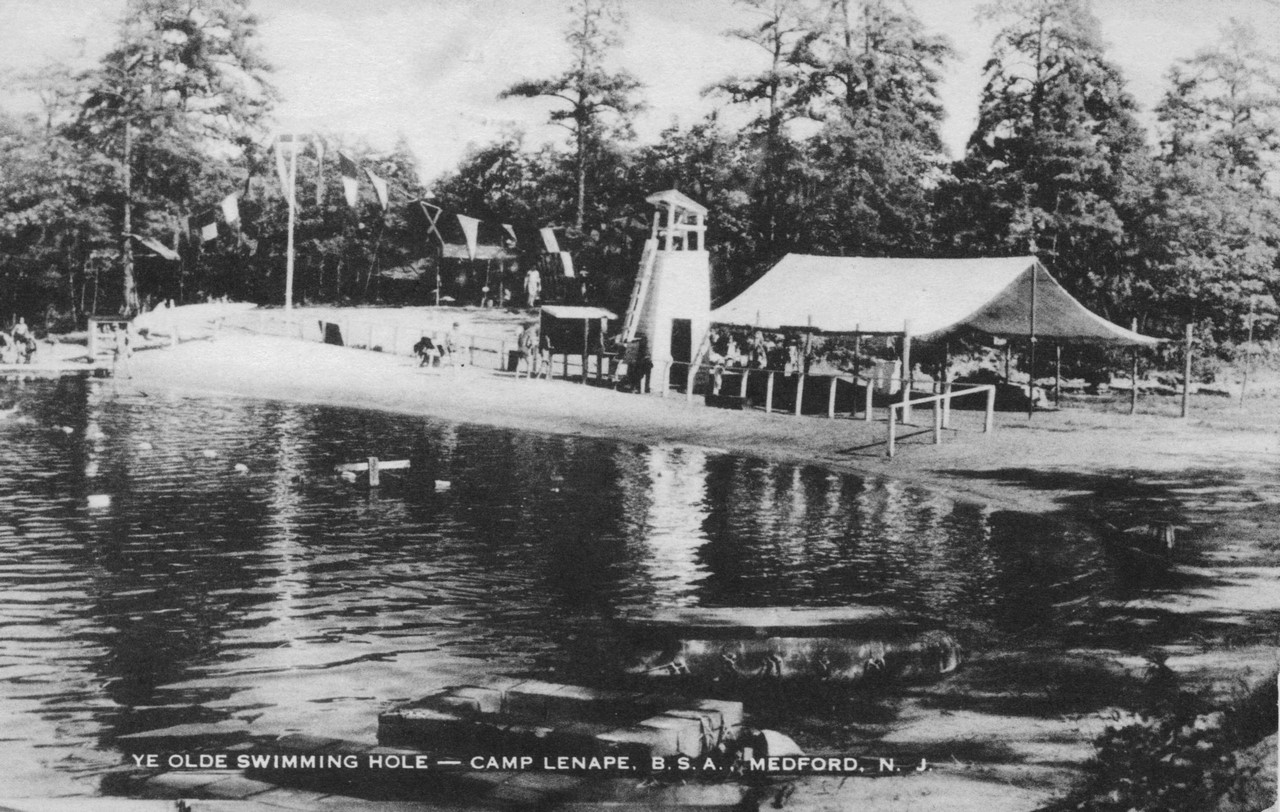
Ye Olde Swimming Hole, Camp Lenape, postmark 1954
Several man-made lakes included a splendid waterfront for swimming, boating and canoeing. The cedar water bore a distinctive dark brown hue typical of lakes and rivers in the South Jersey Pine Barrens.
On a hot summer’s day, scouts enjoyed a refreshing swim at “Ye Olde Swimming Hole,” pictured in this post card postmarked JUL 13, 1954. There were designated areas for the non-swimmers, the beginners, and the swimmers, and each scout received tests to determine their swimming ability.
The message to my parents in Moorestown I included on the above postcard in 1954, specifies one prized perk in passing such tests:
I sure am having a good time. Guess what. I just passed my swimmer’s test. Now I can dive off the diving board.
In 1955, my letter home from camp announced news of my passing “the ordeal” of the Boy Scout swimming merit badge, while my 1958 dispatch reported that I was working on the Lifeguard Merit Badge.
Little did I realize it then, but achieving these childhood aquatic milestones would be the origin of my lifelong passion for the sport and eventually lead to participating in my high school swim team.
During the course of their week at camp, scouts received swimming instruction to learn to swim or improve their swimming. Water safety at this waterfront was paramount as there were lifeguards on duty and they used the so-called “buddy system.” Each swimmer would “check-in” with his buddy and together they placed their personal tags bearing their names on a Buddy Board upon entering the swimming area.
During each swimming session, the lifeguards would periodically blow their whistles whereupon all scouts had to immediately get with their partner in their designated ability area and hold their joined hands up in the air to be counted. Each scout was expected to be aware of, watch their respective companion, and keep in near to one another for safety sake. The paired scouts were then counted and checked against the Buddy Board and the corresponding number of paired buddy tags. Once lifeguards accounted for everyone, they allowed the campers to resume their swimming.
This great system fostered safety in the water. Should a scout ever be in need of help or assistance for some emergency, certified life guards each with long bamboo poles or other lifesaving equipment could respond, act quickly, and reach the swimmer.
In addition to swimming, there were also opportunities scheduled for supervised boating (using rowboats) and canoeing. Again, all scouts took tests in the proper and safe use of such watercraft. No wonder the waterfront was such an important activity focal point for the young scouts at Camp Lenape.
Memorial Dining Hall, Camp Lenape, postmark 1954
Another focal point was a large dining hall, which could accommodate some 260 scouts and their leaders. The dining hall boasted an impressive indoor fireplace as well as an outdoor fireplace.
This postcard from camp mailed by me on JUL 20, 1954, depicts the massive fireplace inside the “Edward A. Mechling Memorial Lodge.” Built in 1943, this so-called “lodge” became the very first building, which served as the camp dining hall. The rocks used to build this fireplace came from the Delaware River.
Nature Island, Camp Lenape, postmark 1954
Another camp feature included an informative Nature Island with cages containing many small animals and even terrariums for growing plants. An area provided a rifle range and archery practice area.
Postmarked JUL 14, 1954, this postcard shows the popular “Nature Island” at Camp Lenape. A young scout looks at some of the visual displays, posters and exhibits about plants and animals. Today, we might refer to such an open-air facility as a “learning center.”
At the Trading Post, one could buy necessities and postcards to send home. Minor medical treatment was available at the first-aid station.
Salute to Old Glory, Camp Lenape, postmark 1954
A general assembly area with flagpole, an outdoor campfire assembly arena with seating overlooking a lake, and a parking area somewhat removed from the camp itself completed the rustic setting.
“Salute to Old Glory,” postmarked JUL 21, 1954, shows scouts assembled and standing at attention for the lowering and folding of the colors at the end of the day. Scouts also assembled early each morning to pay their respects and salute the raising of the American Flag.
Prior to dismissal, leaders gave important announcements to the scouts at these times. The sound of “reveille” from the camp bugler roused the Scouts in the morning, and at the end of each day, the horn played “taps,” meaning day was done, lights out and it’s time to go to bed!
Camp Lenape, Troop 44, 1957
This photograph shows my Boy Scout Troop 44 of Moorestown during our stay at Camp Lenape in the summer of 1957.
My dad was Scoutmaster. I am in my green explorer uniform and wear a National Jamboree Patch received upon attending the National Jamboree held at Valley Forge earlier that summer – one of many that my mother stitched on my uniform.
Here are the names of people as I recall: (back row from left to right) – RICHARD PAOLETTI, ___unknown___, JOHN SCHANZ, HARLAN RADFORD, JR., RICHARD KALYN, AND HARLAN RADFORD, SR.; (front row from left to right) – ___unknown___, TERRY DAVIS, ___unknown___, RICHARD BARTHOLD, ROBERT PATTERSON, JOHN PATTERSON.
I attended Camp Lenape summers 1954 -1960, often staying two weeks at a time. Upon graduation from college and no longer a scout, in the summer of 1966, I served on the Staff at Camp Lenape as the Aquatic Director for all programs and activities at the waterfront. It would be the last time that I would be able to enjoy this wonderful camp.
In addition to summer camp, there were spring and fall Camporee events that generally lasted a week-end. Scouts learned to sharpen their pioneering skills such as cooking, knot tying, rope bridge building, plant identification, first aid, and hiking. Somewhat akin to the military, scouting had requirements for incremental advancement in rank. The names associated with those ranks start with Tenderfoot, then Second Class, First Class, followed by Star, and then Life, until one reached the highest and most esteemed rank in Boy Scouts, namely Eagle Scout.
There were many different kinds of planned activities and scouts were usually quite exhausted at the end of these busy camping experiences. In my view, the scouting movement was instrumental in fostering core values and life lessons regarding character development, leadership, doing service and good for others, and focusing on becoming better citizens!
Ironically, in the end, the very wilderness setting of lakes and natural pinelands that made Camp Lenape the extraordinary refuge it was, proved to be its undoing when it became a victim of urban sprawl during rapid land development in the 1980s.
Finally, let us fast-forward to today, 2016! You will be hard-pressed to find any vestige of Camp Lenape.
Gone are the waterfront as we knew it, Nature Island, the original dining hall, and campsites – replaced with luxury homes on cul-de-sacs, with amenities including a clubhouse, tennis courts, and fitness trails. Today, a drive down Jackson Road to the former Camp Lenape site reveals the transformation of the once rustic site into prestigious suburban addresses now commanding half-million-dollar price tags. (Zillow)
What do you recall about Camp Lenape? We welcome comments, first-hand memories, photos, or relevant maps, particularly of the layout of Camp Lenape. Kindly contact the Historical Society of Riverton.
Oct. 22, 2016, Ralph Shrom writes: I attended the camp twice in the early 1960’s. A wonderful experience. Sad the camp is no more.
Nov. 3, Larry Cohen writes: Camp Lenape aka Lenape Scout Reservation, was a fantastic experience for many Scouts in rapidly growing Burlington County. I was fortunate to have had the opportunity to visit the Cub Camp in 1959, attend the Cub Scout Jubilee and later as a Scout, camped frequently in the Wilderness Area with my troop, attended Camporees, attended Junior Leader Training and served on the Staff at Camp. I was inducted into Hunnikick Lodge of the Order of the Arrow and always considered the camp to be a very special, sacred place. The camp of my youth is gone now, but the memories will remain forever.
Apr. 13, 2017, Steve Collins writes: I attended Camp Lenape 1967-69; Counselor in training 1970, Nature & Conservation Counselor (lived on Nature Island) 1972; Went through my Order of the Arrow Vigil Ceremony at Camp Lenape in 1972. What great Memories!
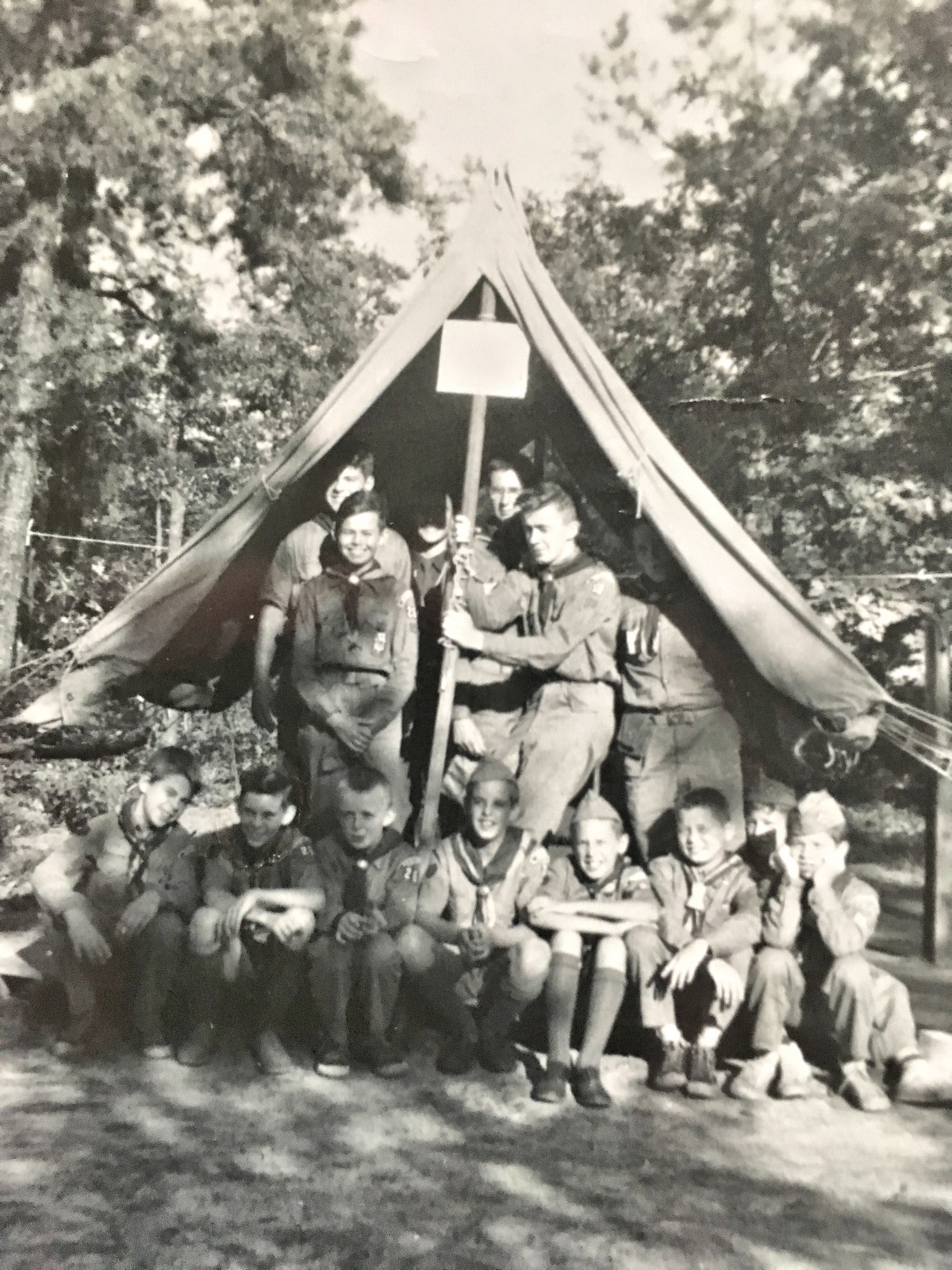
September 24, 2017, Leslie Rogers writes: Troop 26 Medford at Camp Lenape about 1957, 58, or 59.
c1957 Medford Troop 26 Camp Lenape
Standing left, William Bisignano (Medford dentist), who became Eagle Scout. In front of him, Alfred (Butch) Bogie (Vietnam veteran US Marines, now deceased); holding tent pole, E. John Foulk (former Medford police chief); seated second from left, Terry Bingeman, Medford.
My father, Alfred Bogie, Sr., was the Scout Master. My mother, Dorothy, was quite involved with the Troop as well with snacks for the Scouts and assistance with any trips taken, one of which was to NYC shipyard to witness a ship launch.
Sept. 12, 2017, Ron Rudderow writes: Thank you for preserving the history and some memories from Camp Lenape. I was a staff member in the early 1950s (Program Director in 1954) and Chief of the Hunnikick Lodge #76 in 1952. The one-night canoe trips for the stay-over campers at Lenape left me with some of the best memories. By providing this activity, the remaining camp staff could all enjoy a day off each weekend. Fortunately, most of the canoes were aluminum but we did have repair opportunities on a canvas canoe every so often. The Wading River was especially shallow and caused most of the damage. They were fun times!
NEWS FLASH! See this January 3, 2018 post about a scan of map of Camp Lenape sent in by Michael Abbott.
Aug. 7, 2018, John Schlosser writes: Was staff/camper in late 50’s . Staff tent mate Rich Kayln, of Moorestown are still buddies. Memories of Fri nite campfire skits and theater from horses (Ron R.) and arrows (tp lighter fluid!)on zip wire to light fire.
Singing in mess hall; “viva la company” & “Six Pence”. Getting sweaty and rough playing Capture Flag. Fishing Arrowhead Lk., Fighting fires in pines!
Nervous end of season Staff Dance. Great leaders like Al Pennel. Flirting w/ Mtalonquay staff at Lucky 7! Working into maturity in spite of ourselves!
April 23, 2019, Mitchell Weiss writes:
Spent weekends there as a Scout in Troop 85 from Willingboro in the late 60s and early 70s. Helped build an amphitheater on a speechless weekend while becoming part of the Order of the Arrow. Never went on a hike without a compass. My first camp out in 1968 was a very rainy weekend. I had a cold and my folks didn’t want me to go. Our tent was soaked as was my sleeping bag, but I came home healthy. My folks were amazed that I had survived! I also remember passing a Mental institution on the way there. It was fun to see the crazy folks at the time, looking back and seeing what life does to some folks is kind of sobering
Sept. 12, 2020, Joseph Hackett writes:
I attended Camp Lenape 1952-54. The post cards pictured in the article brought back many memories. While the article mentions sleeping in wall tents I remember sleeping in a lean to which had two sides, a back and a slanted roof. The front was open and there was a floor. Like some of the others who have commented I also went through the speechless weekend being initiated into the Order of the Arrow. Had to sleep “under the stars” in my sleeping bag. Woke up in a huge puddle of water as it rained most of the night. Many of my memories of Camp Lenape have faded but some are vivid. We had the luck to grow up during the best of times.
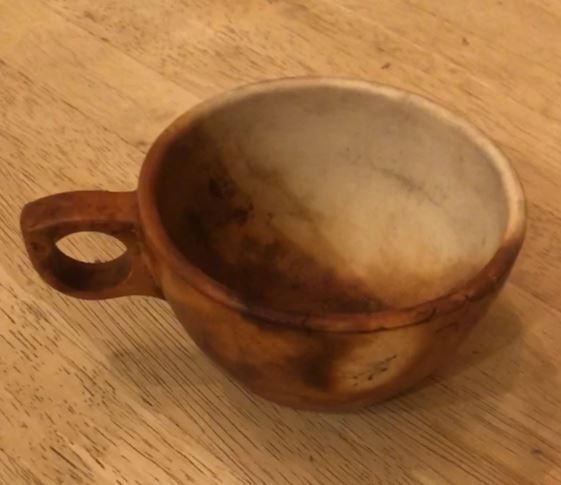
cup found at former location of Camp Lenape
Sept. 15, 2020, Natalie Westfall writes: Thought you would enjoy this.. a cup my kids dug up in our backwoods. It’s a gem to me! It was partially sticking out and you can see the sun bleached it on one side. I love it and I am excited to add it to our Camp Lenape collection!
Editor: Wait- What?? There’s a Camp Lenape Collection?
Sept. 15, 2020, Harlan Radford writes: That is definitely one of the cups we used, brown, Thick-sturdy, virtually indestructible plastic cups we used in the mess hall. …I remembered and knew exactly the color. They also had and used the same style cup but it was a light or bleached out looking green. The plates and bowls were also that same brownish color.
Jan. 24, 2021, Michael Ream writes: I attended Camp at Lenape starting in 1969. In 1972 I became a counselor at the camp. I taught scoutcraft and wilderness survival for merit badges. In 73 & 74. I was Bill Gibson’s (the ranger) assistant. My fondest memory is traveling the trails with him to adjust the sluice gate that managed the level in the lakes. My time there was [a] very large influence on my life as was the people who shared it with me.
Jan. 25, 2021, King Neptune alias Blackbeard writes: served on staff 1972,woodbadge 1972 staff development for TLDC 1972. Vigil 1977 near lost lake. and hidden lake. built cub life guard stand with, Mitch Crammer, and Gene McMillan. But Saturday 1/23/2021 ate lunch with Bill Dillingham and Gene McMillan to return to the family the picture of Bill Gibson’s scout history presented for his 60th year in scouting. Multiple training courses, week end camping Camporees and ordeals. Part time Ranger with the five. who still meet irregularly. Great times Great memories
Jan. 25, 2021, Mike (Ging Gang Goolie) Fine writes: Spent many a year at Lenape. Went in Spring and fall camp outs as well as at least 2 weeks each summer until I was in staff. One year as CIT and two on the waterfront. I went one week with Troop 44! Cal Neubert was the Scoutmaster. He and my father worked together! Worked the waterfront with Doug Dickel (I’m telling you!) Gary Robert’s. Wade Lawrence Chris Duvally and Eric Osterlind! Got my Life Saving merit badge after holding on and controlling Doug in his version of an alligator death roll! Was accused of streaking and swimming naked from the mess hall to nature island although no pictures are known to exist. Somewhere there is a picture of Wade pooping from the tree at the Waterfront! Was involved in the shooting of the water moccasin in the mess hall. I did the loading not the shooting. Rich Ballou was the marksman!
Jan. 26, 2021, David Zimmerman adds: I was a counselor for three years in the mid to late Eighties and ran the trading post for the last two. Loved that time in my life, to this day I keep in touch with several friends I made back then.
March 17, 2021, Mark Dolezar writes: Camp Lenape was a special place for me. I camped as a camper in 72 & 73. I worked on Camp staff as the Waterfront Director the Summers of 1978,79 & 80. I was Program Director for 1983 & 84 and I was the Second to last Camp Director for Summers 1985,86 & 87. I have so many great memories.
Indeed, memories are all that is left of Camp Lenape today. The Society welcomes your recollections and especially hopes to display here your additional photos, souvenirs, campground literature, maps, or other memorabilia.