Special Delivery – Riverton’s United States Post Office

By Mrs. Patricia Solin and John McCormick with research and editorial assistance by Paul W. Schopp

Note: This is an extended-play version of the article that appeared in the February 2012 Gaslight News. This column provides more space for explaining additional details and display of illustrations, photos, maps, etc, which the newsletter could not. We welcome your comments, anecdotes, photos, or corrections, to this article.

Riverton mail carrier and future postmaster Joseph L. Yearly with his nephew Joseph B. Yearly, 1938. PHOTO CREDIT:  JOSEPH F. YEARLY PHOTO ALBUM

On July 30, 2009, the United States Post Office announced that 677 facilities would be considered for closing or consolidation, with 200 “most likely” to be actually closed.  The Riverton branch of the U.S. Post Office escaped inclusion in that closure list and in several subsequent lists published since. We look back at the many changes to the borough’s postal service over 140 years as it operated from eight different locations.

Riverton’s first railroad station opened in 1863 and once stood facing the tracks, close to today’s site of the Riverton War Memorial. Railroad agent Charles Mattis lived in the house adjacent to the station and served as Riverton’s first postmaster when the first Riverton Post Office was established in 1871. PHOTO CREDIT:  The New Era, 1909 Christmas Issue, p.23

According to the Historian of the United States Post Office, free mail delivery began nationally July 1, 1863.  As long as postage would cover all the expenses of the service, the government established a post office in a community. By 1864,  salaried letter carriers delivered mail in 65 US cities, although it only went only from post office to post office.  Riverton, established in 1851, did not yet have its own post office in 1864. Rather, residents had either to pick up their mail in Palmyra or, as in other cities, pay an extra two-cent fee to a private local carrier for letter delivery.

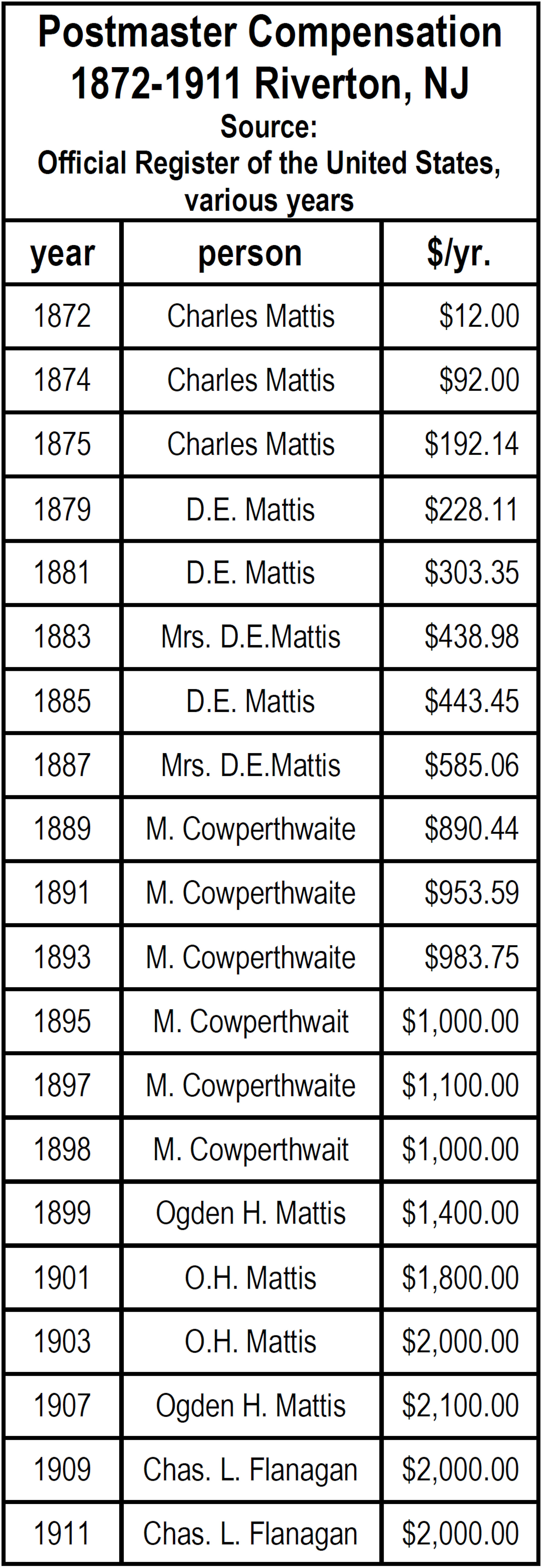
Riverton’s first railroad station opened in 1863 and once stood facing the tracks near Main and Broad, close to today’s site of the Riverton War Memorial. Charles Mattis, the railroad agent, lived in the house adjacent to the station at 601 Main, and served as Riverton’s first postmaster when the Riverton Post Office was established in 1871. However, borough residents still had to trek to the post office to pick up or to drop off mail. Mattis’ postmaster annual salary in 1872: a whopping $12.00! The house was razed in 1940 to provide space for the Riverton War Memorial.

The job of postmaster was an important one–candidates for the job were proposed by the outgoing postmaster, the local community, or local congressional representatives. Beginning in 1836, the President appointed postmasters at larger post offices like Riverton’s as part of a spoils system. Often the position of postmaster was a sideline to their primary occupation, such as storekeeper.

Those early days of Riverton were times of development and expansion, marked by population growth with each successive census, from its founding through 1930, and that certainly added to the volume of mail. No longer simply a summer refuge for wealthy Philadelphians, it had become a year-round community in need of a post office upgrade. Post office services over the years operated out of no less than eight locations along Main Street, including the railroad station, a drug store, shared space with an insurance office, what later became the office of The New Era newspaper, and a former bank.

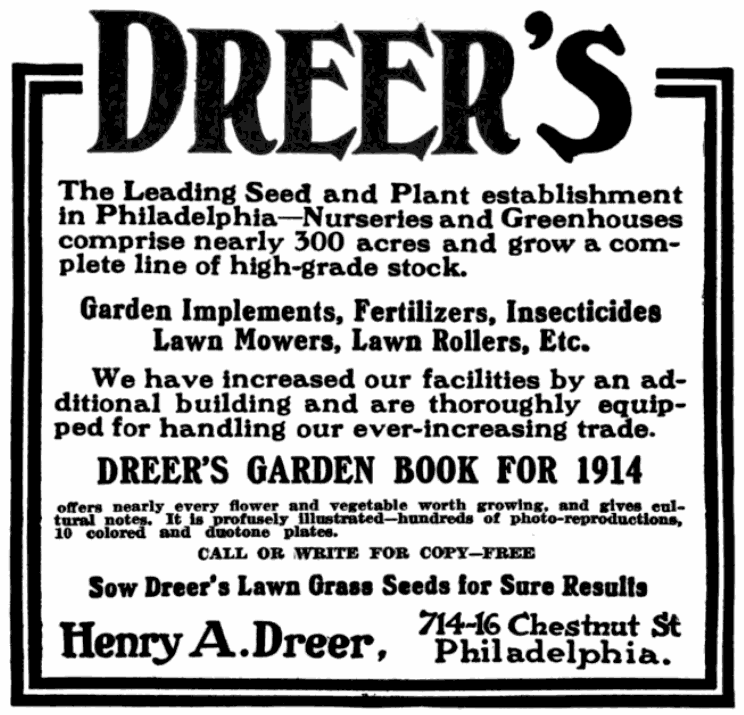
It is also quite possible, as some longtime Riverton residents attest, that post office capacity was influenced through a literally growing business: Dreer’s Nursery. In 1873, Henry Dreer moved his nursery business from Philadelphia to Riverton. Employing over two hundred workers in-season, the company was the largest employer in town.  Comprising about 100 acres of seeds and plants, and eight acres of greenhouses, the highly regarded House of Dreer demanded a quick and efficient way to mail their delicate products nationally and internationally. The thriving business eventually expanded to 295 acres with a water garden and 14 greenhouses with palms, ferns, bamboo, irises, and hybrid waterlilies.

1905 Dreer Garden Book cover

In a paper presented at a symposium at the Smithsonian National Postal Museum in 2006, author Dr. Cheryl Lyon-Jenness credits improvements in the postal service that accommodated industrial needs for fueling the horticultural boom during the nineteenth century. The fortunes of many prominent nurseries and seed companies benefited from their close proximity to population centers and transportation hubs, the firm of Henry A. Dreer among them.

However, to what degree the Dreer mail-order business affected the post office and mail volume cannot be determined. Numerous periodical advertisements over many years always required the respondent to address their request to Philadelphia headquarters, not Riverton.  A 1916 Dreer’s Garden Book promised, “We deliver postpaid to any Post Office in the United States, Vegetable and Flower Seeds…”  It also boasted of  “… an eight-story warehouse at 710 South Washington Square, which affords ample storage facilities and room for the careful and prompt filling of orders.”

Dreer Building,1306 Spring Garden, Phila., PA

The 1938 Hundredth Anniversary Edition of Dreer’s Garden Book displays photos of an order-filling department and a mailing department, which appear to be housed in the even larger 1306 Spring Garden Street address, which the business had occupied since 1924. Further, of twenty-two examples of postmarked Dreer postcards and one letter in our collection, seven have Riverton postmarks, and the rest are from Philadelphia. The assertion of our forebearers notwithstanding, lacking figures that would break down what goods or correspondence were dispatched from where we cannot determine the impact that the Dreer’s seed and plant mail-order business had on the Riverton Post Office.

Dreer ceased operations in Riverton almost ten years before this headline appeared in the Trenton Evening Times, April 10, 1953.

In 1887, when the first railroad station had proved inadequate, a larger brick structure at Broad and Main replaced it, across from where Zena’s Patisserie shop is today.  Apparently, the post office remained in the house at 601 Main, where Dorothy Mattis had already assumed the duties of postmaster beginning in 1876. In 1888, the post office moved to Cowperthwaite’s Drug Store at 304 Main, where proprietor Milton Cowperthwaite doubled as postmaster. There was still no home delivery for Riverton, however. Postmaster Cowperthwaite’s pay, which was based on volume, had jumped to an even $1000.

Postcard detail: Riverton’s second railroad station opened 1887, replacing the first one that once stood on the lot now occupied by the Riverton War Memorial. Note Roberts Store, built 1891 on point. View is toward the river at Broad & Main.
The Historical house plaque by the front door reads: RIVERTON’S FIRST DRUGSTORE c. 1855. Proprietor Milton Cowperthwaite also doubled as postmaster there for ten years from 1888—1898. PHOTO CREDIT:  JM 2008

Realize that in those early days of Riverton’s development, the railroad station was on the edge of town, making it inconvenient for those who walked to pick up their mail. The move to Cowperthwaite’s in the 300 block of Main made it a more centrally located post office.

RIVERTON POST OFFICE as it appeared when Ogden Mattis (inset) was postmaster. The office reached second-class status in 1901. The New Era, July 1, 1965, pg. 16

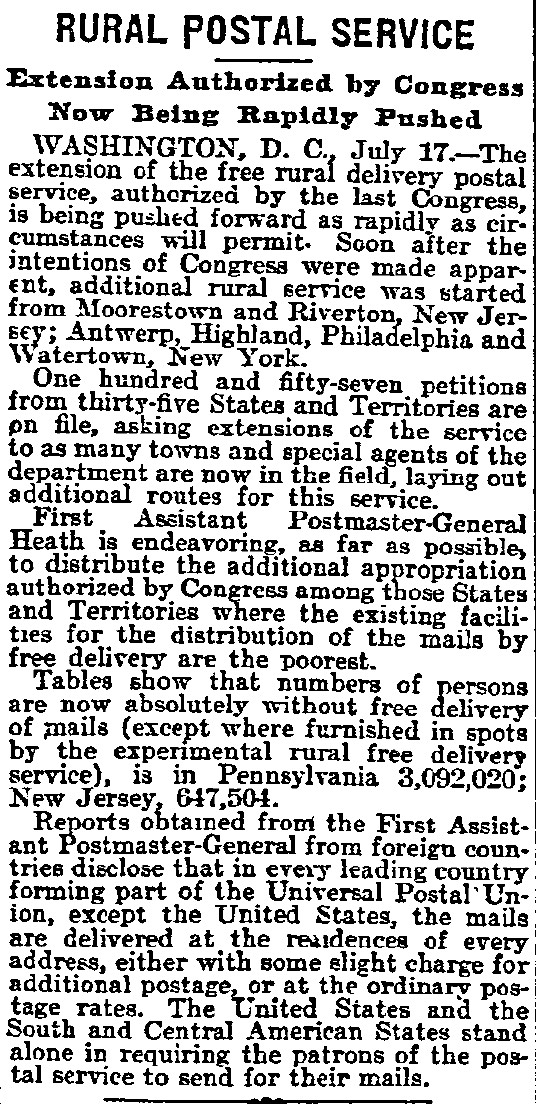
Oddly, rural families living in the area enjoyed home delivery of the mails even before homes within the borough did. An experiment in delivering mail to rural districts commenced in February 1898. Twice a day, carriers picked up incoming mails from Cinnaminson and Riverton and traveled two routes along New Albany, Parry and Lenola roads, and old Burlington Turnpike, now U.S. Route 130.

In March of that same year, the U.S. Senate recorded President William McKinley’s nomination for the postmaster position. Stewardship of the post office then passed to Ogden Mattis, son of Dorothy and Charles Mattis, and the venue for postal operations moved to 520 Main Street (now the Presbyterian Thrift Shop). The Rural Free Delivery service became permanent in July 1898.

The diligent postmaster reported on the situation of the new rural delivery service to the United States Postmaster General in October 1898:

The general sentiment of the people is of extreme satisfaction, and they are unanimous in desiring its continuance. There are two other communities in this vicinity that desire the establishment of rural free delivery. The amount of mail matter handled by the rural carriers has increased each month.

Philadelphia Inquirer, July. 18, 1898

R. M. Brock, a local beneficiary of the improved service who lived two miles from the post office wrote, “I do not know how to express myself for the benefit that I have already received.”

E.S. Holmes concurred:

My neighbors, as well as myself, regard rural mail delivery as the greatest privilege we enjoy. I have not heard anything but praise for the service and would be very sorry to see it discontinued. Before it was started here, to mail a card even, I had to hitch a horse and drive a round trip of 4 miles to the nearest post office.

Clayton Conrow of Cinnaminson added his praise in a letter:

I know of no act of the present  Administration which has so warmed the hearts of the people who receive the benefits of it, irrespective of political affiliations, as this free rural mail delivery.

Due to the increase in daily mail volume and stamp revenue generated by the facility, Riverton Post Office advanced from third class to second class in 1901. The US Postmaster General’s Report for that year recorded $1,800 for the Riverton postmaster’s salary. Since the volume of mail helped to determine the postmaster’s pay, enlarging the postal service area and accommodating customers was a win-win for the local postmaster.

PRES. WM. MCKINLEY NOMINATES O.H. MATTIS Journal of the proceedings of the Senate of the United States in executive session. (Fifty-fifth Congress, second session, commencing Monday, December 6, 1897)

During the ten-year tenure of Ogden Mattis, the post office again outgrew its space at 520 Main and leapfrogged over to a new building at 528 Main Street, which opened on February 19, 1903.  That day’s Philadelphia Inquirer proclaimed:

For the first time in its history, Riverton has a post office building. The office has been at various times in the station, grocery store, and a shoe store. The great increase of business in the last four years has made it necessary to provide a building specially adapted for post office purposes.

Philadelphia Inquirer, July 27, 1904
Real 1904 Liberty head nickel. PHOTO CREDIT:  www.coinpage.com/

While postmaster, Ogden Mattis found himself on both sides of the law in Riverton, and by all contemporary accounts, his standing in the community likely improved in both cases. In July 1904, the Philadelphia Inquirer reported that he had helped foil a ring of tramps staying at a farm near Riverside who were passing counterfeit nickels. The cost of the newspaper that day: one cent.

Normally, taking a few sick days would not make the newspaper, but one Riverton rural mail route carrier made the pages of the Philadelphia Inquirer when he fell ill and needed a substitute to handle his appointed rounds. The headline read, “Wife Took Husband’s Mail Route.” Whatta gal!

Philadelphia Inquirer, August 21, 1905

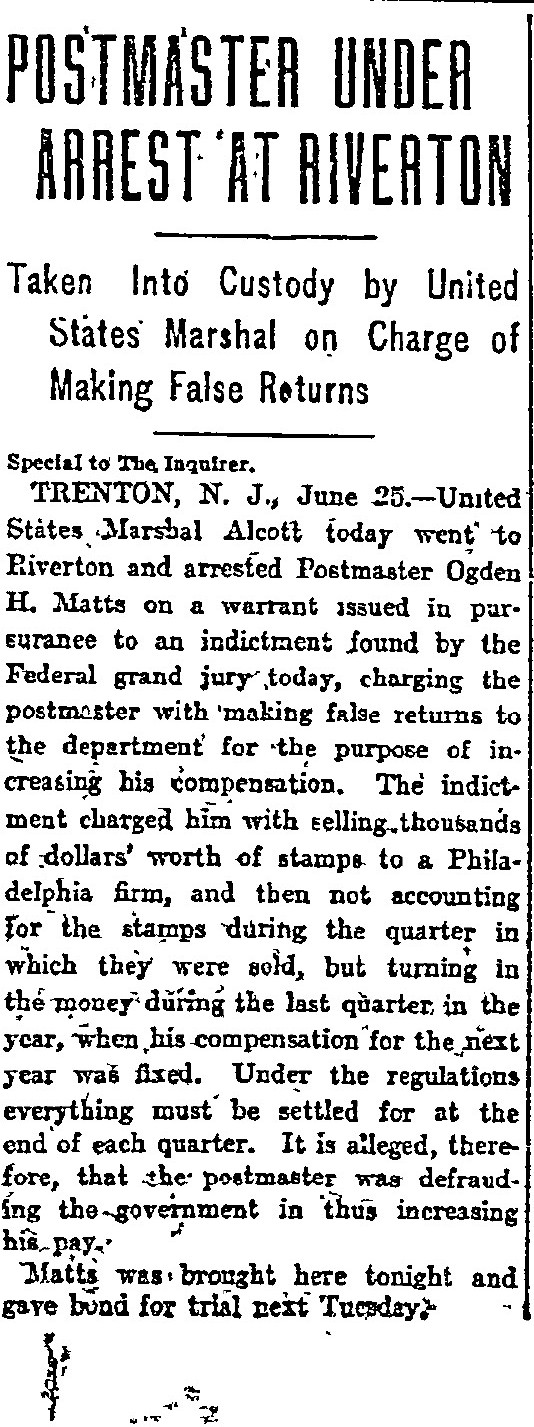
Riverton citizenry must have been shocked indeed in June 1906, when a   federal grand jury indicted their crime-busting postmaster for “…making false returns in 1904 and 1905 to the department for the purpose of increasing his compensation.” It found that he had violated postal regulations by selling  thousands of dollars’ worth of stamps “to a Philadelphia firm” and then not turning in the money for them until the last calendar quarter—the one which determined his pay for the next year.

Trenton Evening Times, June 26, 1906

The Philadelphia firm, of course, was that of Henry A. Dreer. Mattis pleaded “not guilty.” The Philadelphia Inquirer reported on June 25, 1906, “…he was brought here tonight and gave bond for trial next Tuesday.” Perhaps in support of his cause, the editorial page of the Philadelphia Inquirer quipped on June 26:

Postmaster Mattes (sic), of Riverton, has come to grief doing too much business for Uncle Sam; which teaches that a good businessman should not waste his energies in a postoffice.”

Official register of the United States Volume 2, United States Civil Service Commission, U.S. Govt. Print. Off., 1907, pg. 311 Riverton Postal Employees with compensation

A July news dispatch pushed the trial into September, but it appears that the trial may have had further delays. Despite being under indictment for fraud, his postmaster’s salary rose to $2,100 in 1907. Inexplicably, the matter was not resolved until May 1908, as his commission was nearing its end.

As described in the May 14, 1908, Trenton Evening Times newspaper account, when two US District Court judges passed sentence of a $400 fine on Postmaster Mattis, “…at least 50 friends of Mr. Mattis who were in the courtroom to testify as to his   character, gathered around him, and practically all of them offered to pay the fine.” Presumably, some of these were buddies from the Riverton Firehouse, Riverton Gun Club, Republican Club, Masons, or Riverton Yacht Club—all organizations with which he had ties–or perhaps even some employees from Dreer’s.

Philadelphia Inquirer, May 15, 1908

The real head-scratcher is that the one who ultimately wrote out his personal check to cover the fine was Thomas J. Alcott, the very United States Marshal in whose custody Mattis had been. Central to Mattis’ defense was his argument that he had made the false returns to keep his post office out of the carrier class, not for personal gain. Another factor that helped him in receiving the relatively mild sentence was that he had deposited the money in the post office account at the bank. In this light, an inclination to ascribe the best motives to his alteration of the office’s gross receipts is understandable.

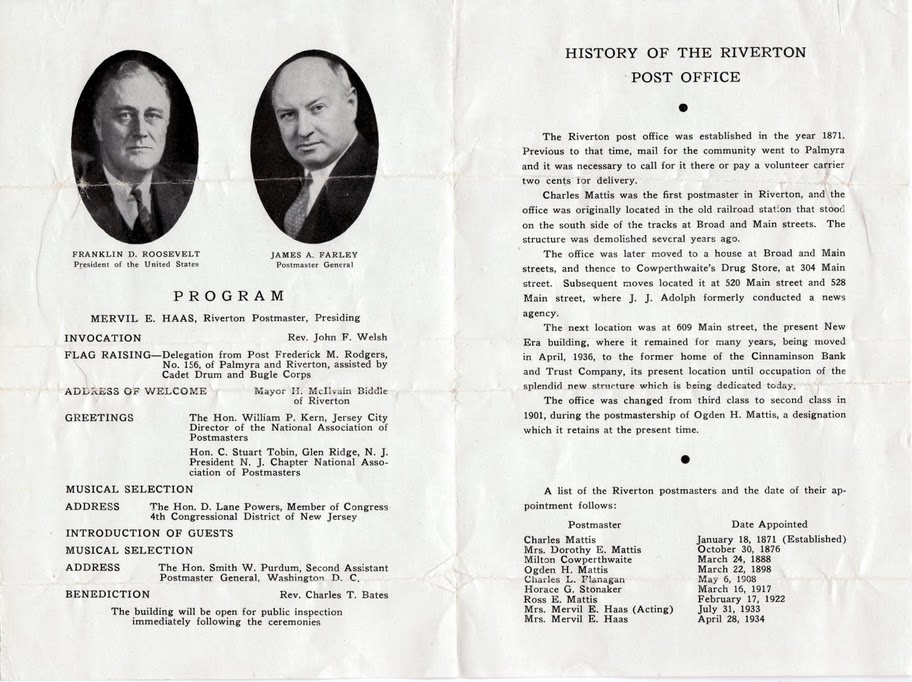
Charles L. Flanagan assumed postmaster’s duties in May 1908, right before another upsizing. In 1909, the post office service migrated back across the tracks, this time to 609 Main Street (the current place of business for Freddy’s Shoe Repair), a small frame building, next to what was then the Cinnaminson Trust Bank.  In addition to Charles L. Flanagan, three more postmasters each served terms as postmaster there: Horace G. Stonaker (March 1917), Ross E. Mattis (Feb. 1922), and Mrs. Mervil E. Haas (June 1934).
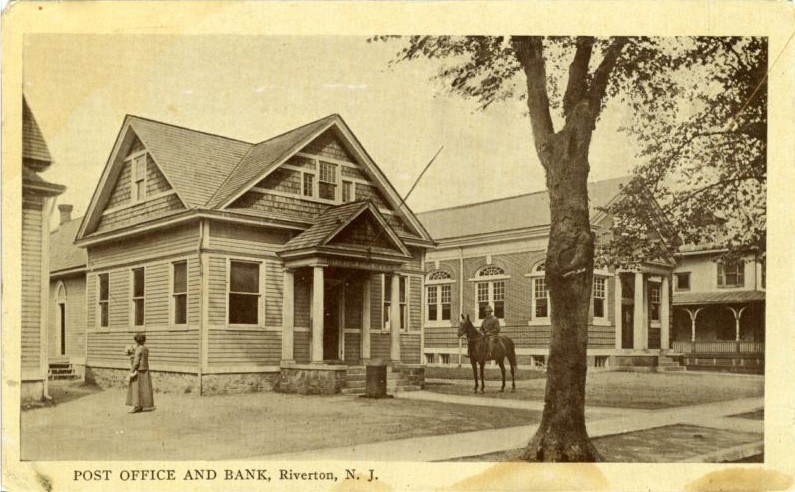
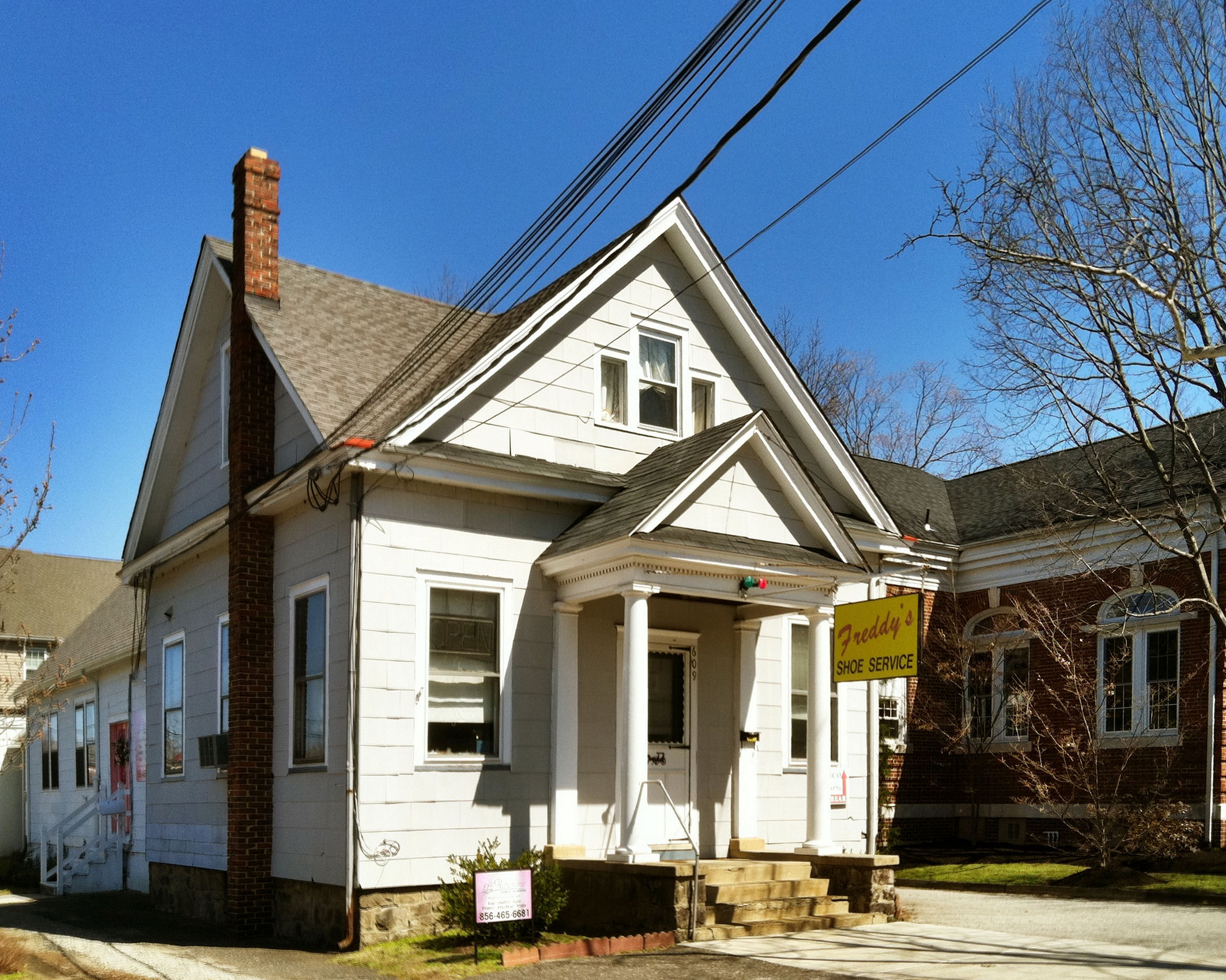
—THEN and NOW—    AT LEFT: 609 Main Street, fifth location for the Riverton Post Office, operated under three postmasters. ABOVE: Freddy’s Shoe Repair PHOTO CREDIT:  JM

Nine thousand pieces of mail passed through the post office per day in 1909. Two postal carriers covered about twenty miles on their rural routes, twice each day (except on Sunday) to over 210 families, delivering 800 pieces daily. Riverton had the only post office between Burlington and Camden open on Sundays, with nine mail shipments arriving and departing daily by train. However, Riverton residents still had to trek to the post office to pick up their mail.

Trenton Evening Times, Aug. 9, 1922

Home delivery in Riverton finally debuted November 1, 1922, as it cleared the last obstacle that had blocked it for so long—the establishment of standard house numbers within the borough. Riverton had long before satisfied the other requirements of the 1863 Act of Congress that provided for free mail delivery such as providing sidewalks, named streets, and street lighting.

—THEN AND NOW— ABOVE: Original site of Cinnaminson Nat’l Bank of Riverton from 1907-1928. The building served as a US Post Office from 1936-1940. BELOW: Now, the historic building houses the full-service graphic artist staff of Jean Pettine Graphic Design. PHOTO CREDIT:  JM

Meanwhile, in 1928, the Cinnaminson Bank moved across the street to their new larger quarters on the corner of Main and Harrison Street (now the location The Bank on Main, an event venue owned by the Antonucci Family). In April 1936, the old bank at 611 Main served as the next location in this growing succession list of Riverton Post Office sites, with the former post office at 609 Main becoming the new office of Riverton’s hometown newspaper, The New Era. Riverton resident Joseph Yearly started his 37-year postal career in 1936 at 611 Main under Postmaster Haas. He recalled that the office employed eight men servicing two deliveries a day in town.  A Model A Ford was used for the rural route into Cinnaminson.

Mrs. Mervil E. Haas—the longest-serving Riverton postmaster IMAGE CREDIT:  HSR Archives

Postmaster Mrs. Mervil E. Haas holds the Riverton record, discharging her postmaster’s duties from three different Main Street locations spanning the years 1933-1959.  She served the greater part of her career in the next and most ambitious upgrade of all Riverton Post Offices.

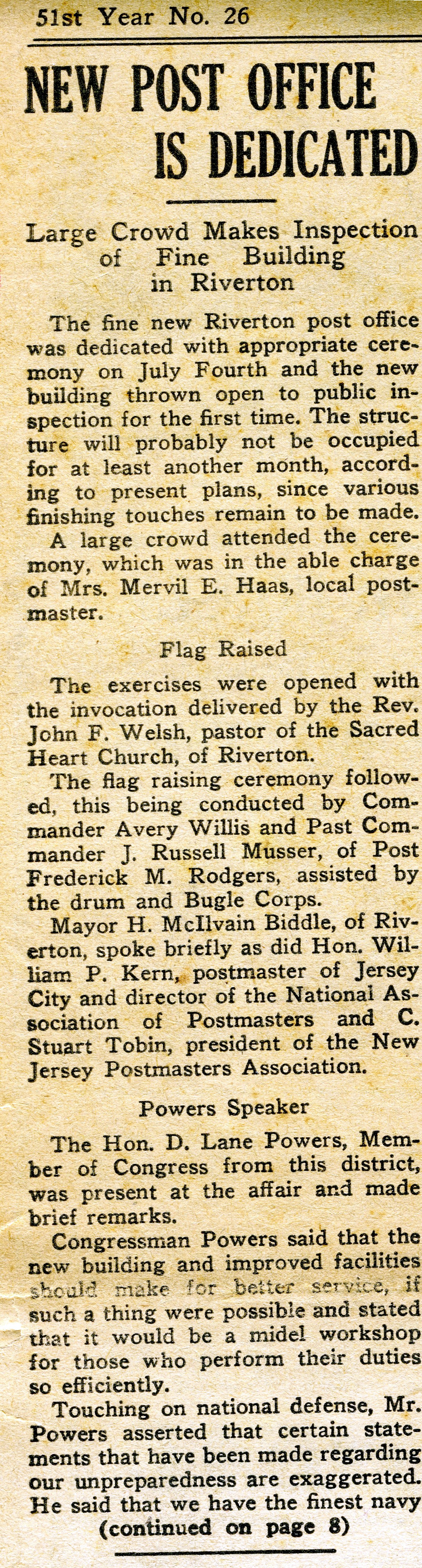
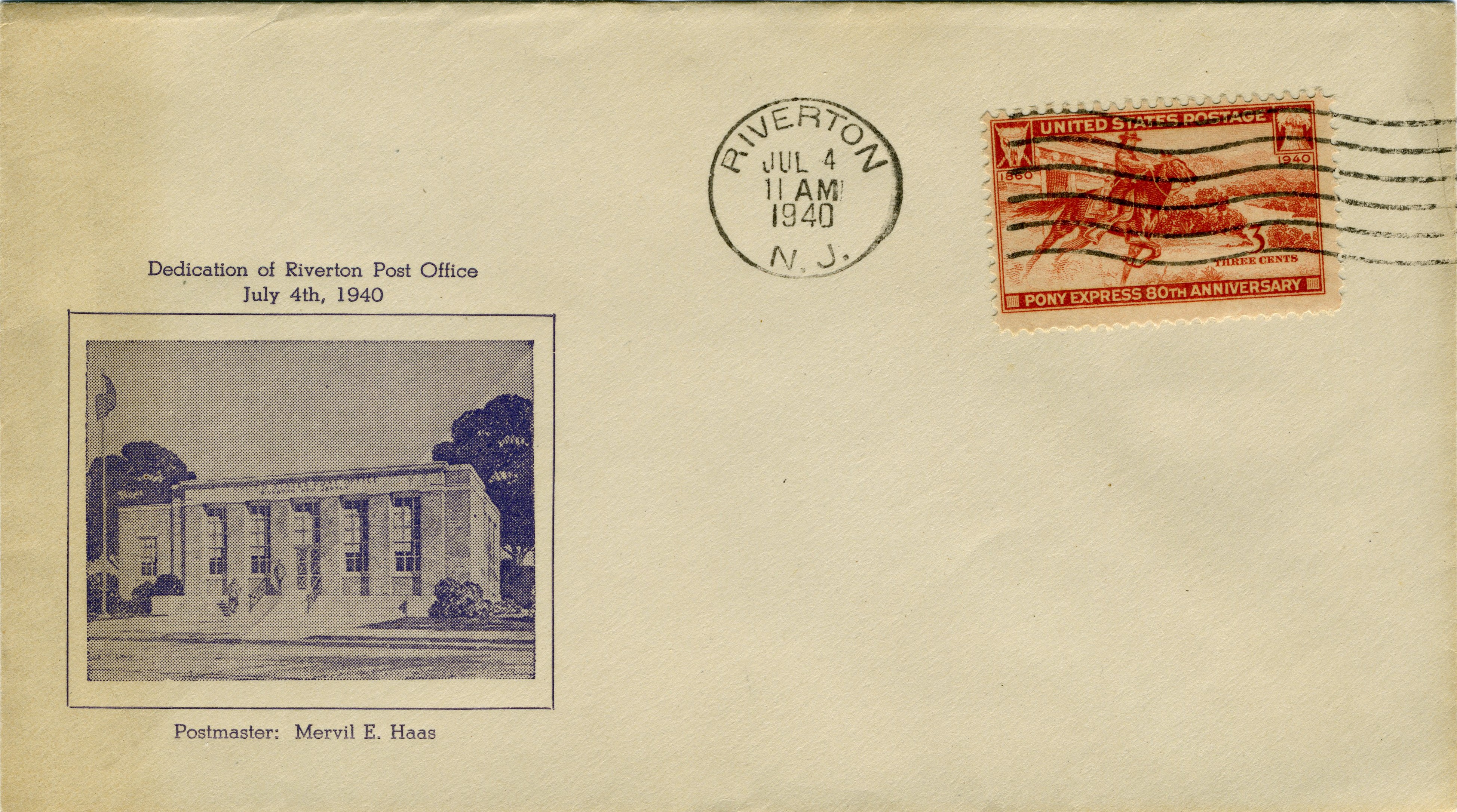
The Riverton Post Office at 613 Main was one of 29 building projects authorized by the Postmaster General and the Secretary of the Treasury for construction in the State of New Jersey by the Emergency Relief and Construction Act of 1932. The Riverton July Fourth festivities agenda in 1940 included a dedication ceremony for the long-anticipated new post office facility built expressly for the United States Post Office Department by the Federal Works Agency at 613 Main Street. This new building was one of over 1,100 post offices that the federal government built during the New Deal.
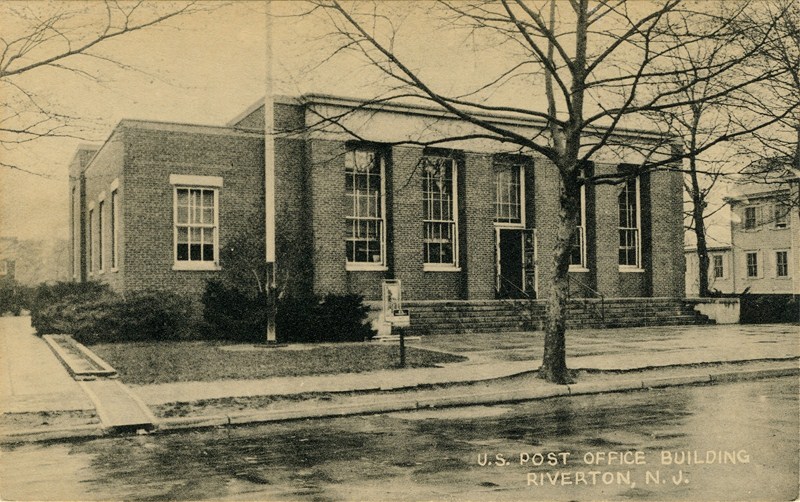
Vintage postcard of the 1940 Riverton Post Office built by the federal government during the New Deal at 613 Main Street. PHOTO CREDIT:  WILLIAM DOWNS

World War Two intervened and interrupted Mr. Yearly’s postal career from 1942-1945. With the return of GIs after the war, population growth in post-war Riverton and elsewhere created the Baby Boomer demographic, and in 1947 the Riverton Post Office was hiring to fill new substitute clerk-carrier vacancies. Starting pay: $1.04 an hour.

Trenton Evening Times, Sept. 5, 1961

Joseph Yearly eventually rose through the ranks to become Assistant Postmaster and succeeded Postmaster Haas in 1961.  Over the years, he had seen the cost of mailing a letter increase from three cents to ten cents, and the office grow to service 17 routes.

Mr. Yearly was at the helm when safecracking thieves twice broke into the Riverton Post Office at 613 Main Street. The first time, in February 1964, netted the burglars nothing, but they damaged a vault that held street letter box keys, so the headline read, “Not Rain Nor Sleet But Key Stays Mail.”

Courier-Post, Feb. 20, 1964 IMAGE CREDIT:  MARY FLANAGAN

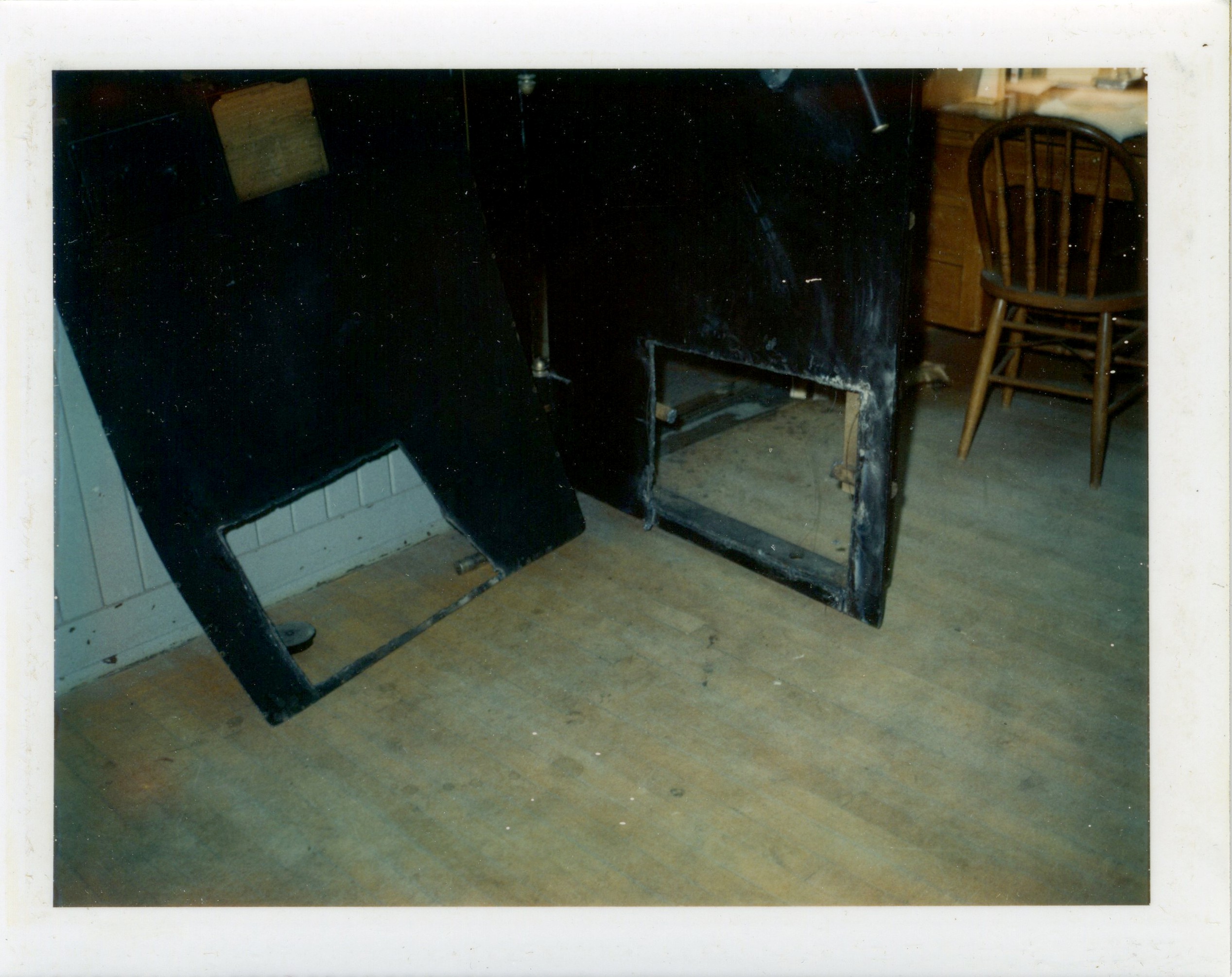
Four years later, a safe now fortified with tear gas did not deter another thief from cutting a 24-by-30-inch hole through the door of the safe with an acetylene torch and fleeing with $25,000 in stamps.

Joseph Yearly retired in 1974. What he did not know then was that Riverton’s years of growth and development were largely behind it, that declining population was in store ahead and downsizing was all but inevitable.

Courier-Post, Jan. 25, 1991

In November 1991, all offices and carrier services transferred to the newly constructed “state of the art” Cinnaminson facility, just off Route 130 on Andover Road. In an unusual turn of events, the Cinnaminson Post Office remained a branch of the parent Riverton Post Office. The Riverton site continued to maintain counter services and 250 boxes.

This transfer of carrier operations to Cinnaminson only foreshadowed further reduction of services for the post office. Finally, over Memorial Day Weekend 2009, Riverton’s stately post office at 613 Main relinquished all mail services to a diminutive postal facility that opened at 605 Main Street, part of Riverton Square, LLC.
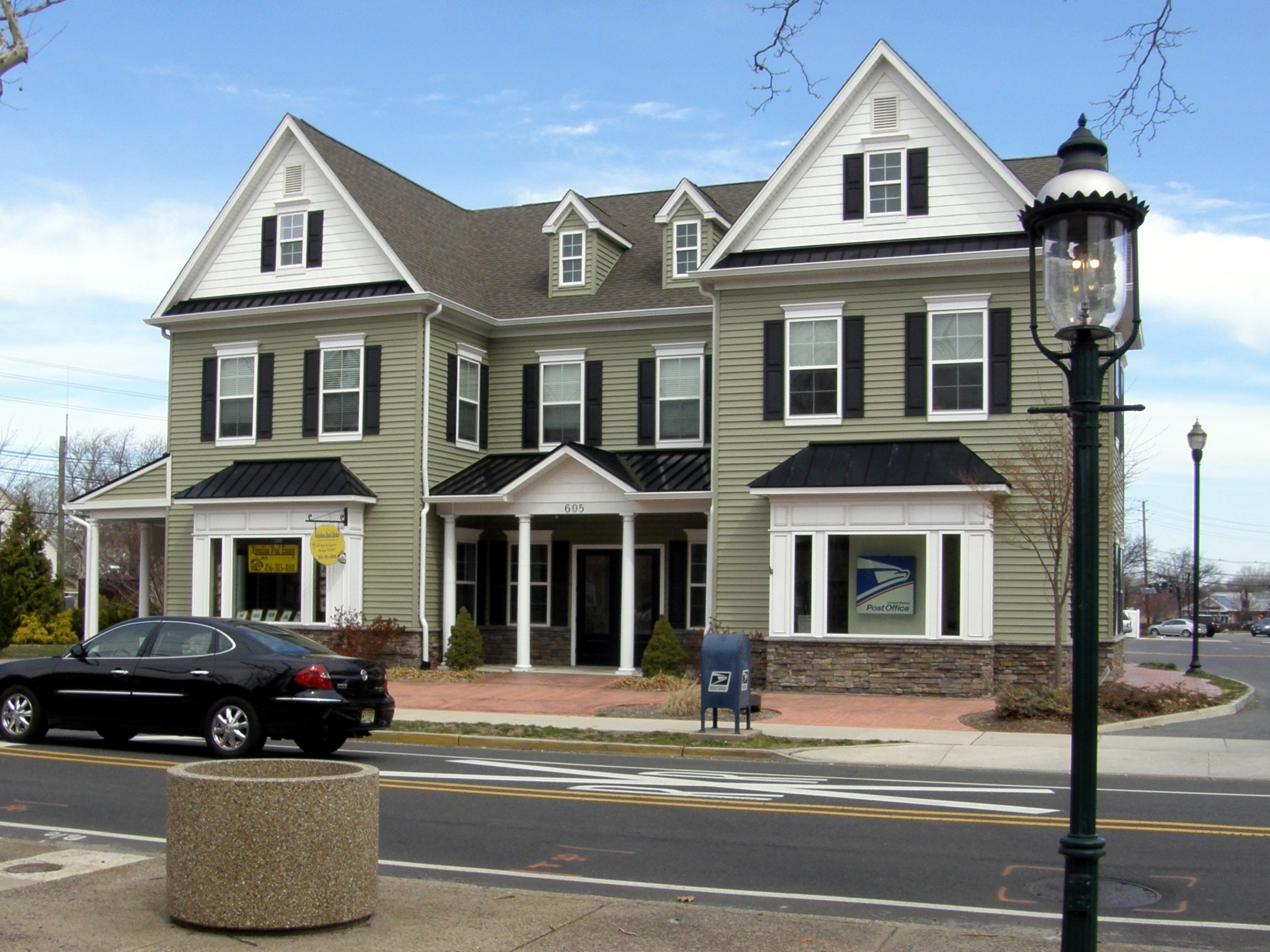
Riverton Post Office, lower right, since 2009 – 605 Main Street HOURS: MON-FRI 8:45 am – 2:15 pm SAT 8:30 am – 12:30 pm PHOTO CREDIT:  JM 2011

That imposing edifice (below) that dominates Main Street is the Riverton Post Office that is familiar to the memories of most Rivertonians, operating for almost seven decades. Many consider its closure a loss, representing more than merely a cutback in services. The shuttered federal building was a blow to Riverton’s civic identity that they did not see coming until it was too late.

The sun sets on the vacant former Riverton Post Office, Jan. 2011. The sign advertises for “NEW CONSTRUCTION 3 New single-family homes” built facing Cinnaminson Ave. on the large parking lot in the rear of the building. PHOTO CREDIT:  JM

Riverton officials, anxious to move municipal offices from their cramped location in the Borough Hall to a larger building, considered the possibility for a time but abandoned the idea as impractical. The property languished for months in the doldrums of the commercial real estate listings. Ultimately, a local developer rehabbed the vacant building and it subsequently became the place of business for Tristate HVAC.

Tristate Hvac Branch Office Manager James R. McQuaide is the person behind the postmaster’s door now.

Manager James R. McQuaide now conducts business from the postmaster’s office. Still not settled into his new digs, he explained during an impromptu tour how postal supervisors could look down on the sorting area undetected through viewing slots accessible from an upper-level room. Mr. McQuaide seems elated at the opportunity to base his company’s operations in such a spacious and historic building.

WHEN BIG BROTHER WAS WATCHING James R. McQuaide gestures to the spot where supervisors stood to surreptitiously observe the sorting area on the floor below through viewing slits in the wall. PHOTO CREDIT:  John McCormick

Out in the back of the old post office, even the huge parking lot where mail trucks once pulled up to the loading dock has been downsized. BWC Realty Associates, LLC carved out three building lots for residences at 608, 610, 612 Cinnaminson Street, still leaving Tristate HVAC ample parking and loading access.

The contrasts between the post offices at 613 Main and 605 Main are astonishing and give some residents pause to wonder what further cost-cutting measures will bring. Will twenty-first-century downsizing threaten to return our post office from whence it came–relegated to being a sideline business for a storekeeper.
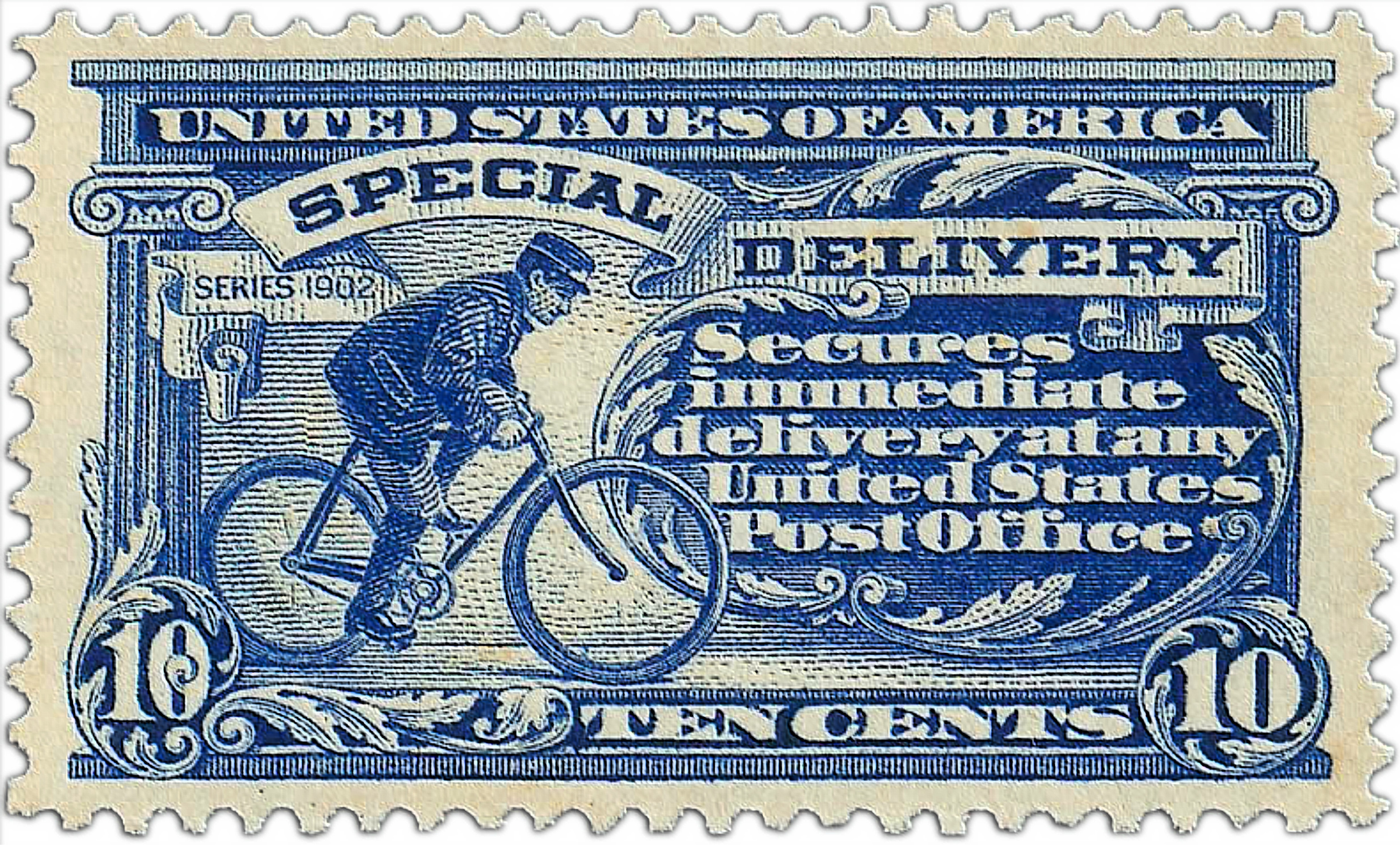
1902 USPO special delivery 10 cents

Over the past two years, hundreds of post offices have closed across the nation as the Postal Service system shrinks in an effort to cut costs. We shall not debate here the many complex reasons for the postal service’s financial crisis. Clearly, the universal postal service envisioned by Benjamin Franklin is in jeopardy as events play out which threaten the very “special delivery” that we have enjoyed from our many post offices over the years.

Special thanks to Mrs. Mary Yearly Flanagan for making available her family albums and files of newspaper clipping, photos, and information, without which the story of Riverton Post Office would have been incomplete.

We welcome your comments, contributions, and corrections.

Please contact: John McCormick, Editor

The Historical Society of Riverton

Post Office Box # 112

Riverton, NJ 08077

E-mail:rivertonhistory@usa.com   Web: rivertonhistory.com/

Evan Kalish has been GOING POSTAL since 2008,  but in a good way, visiting over 3,000 USPS facilities  and writing a blog that has drawn international attention. In January 2012, he visited post offices at Palmyra, Riverton, Cinnaminson, and Riverside one afternoon. Go along for the ride at –  colossus-of-roads.blogspot.com
Staying after school paid off in historic photos and a 1904 history of Sacred Heart

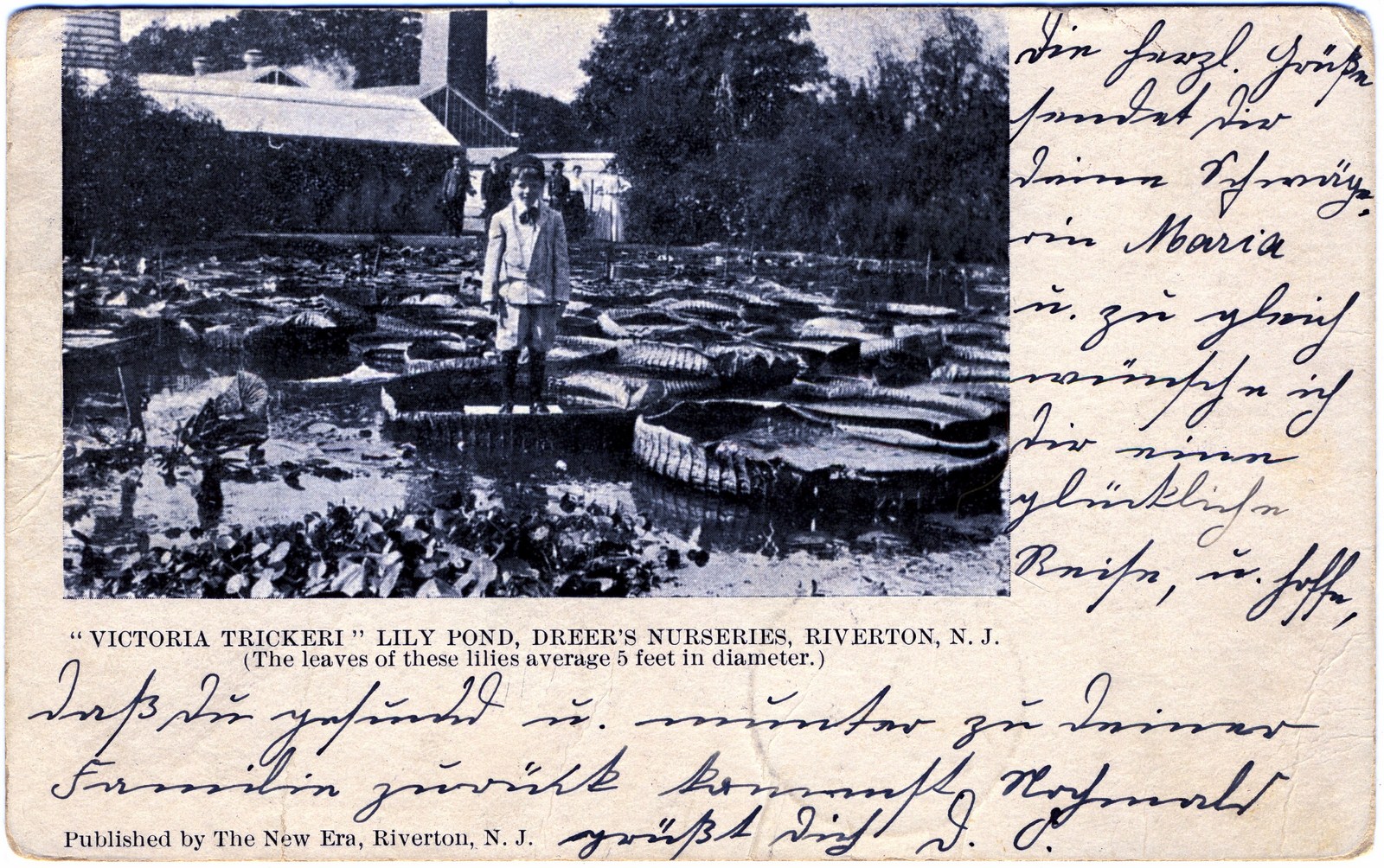
Dreer’s Lilly Pads – John Strohlein
I worked with John Strohlein when I was a teacher at Riverton School. He is a maintenance man there, and we often chatted about history at the end of the day when he came by my classroom. He always took an interest in the American and ancient history lessons and he turned out to be a rich source of information about Riverton history. 

Riverton Fire Dept. – unknown date – John Strohlein

John Strohlein is a descendant of a Dreer Nursery executive and he also had some relatives in the Riverton Fire Company, two circumstances which resulted in my restoring some old photos for the Society and the fire company.

At right is one of two group photos of firefighters I restored. See what I mean about photos you loan do not have to be perfect?

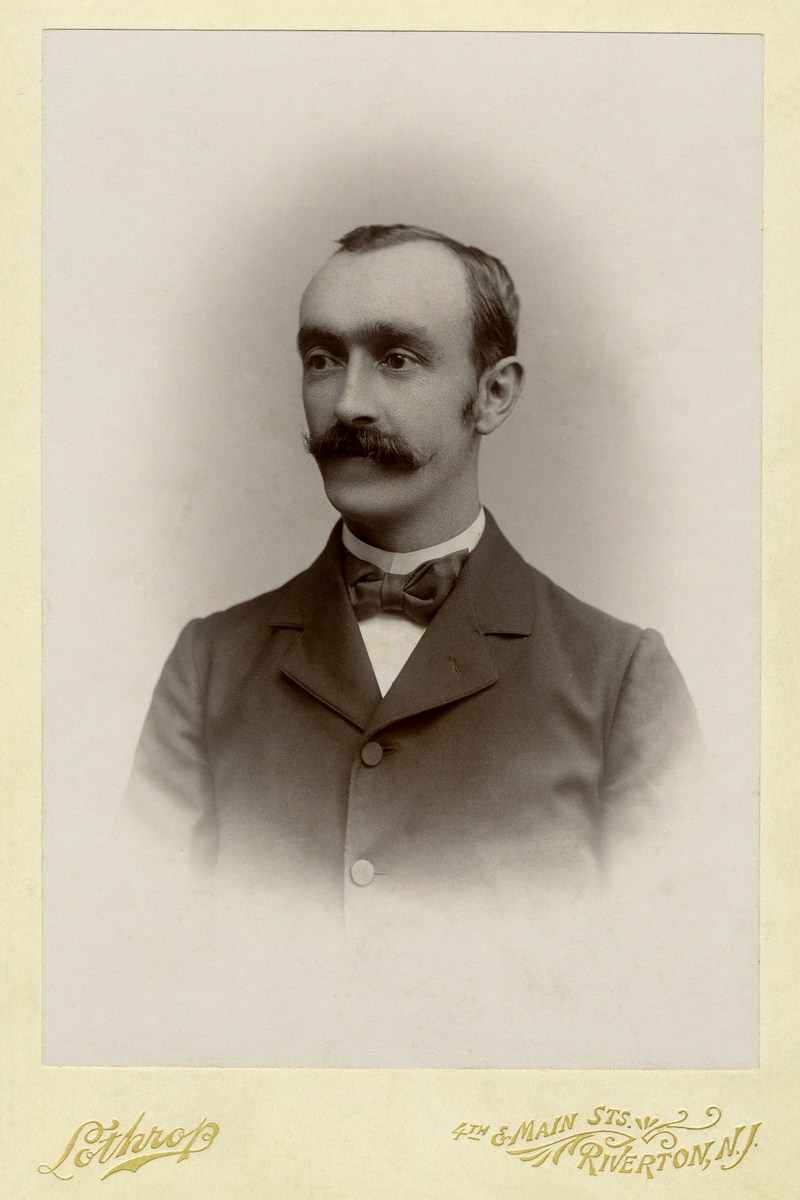
George Strohlein by Lothrop Photography

You can see the framed enlargements on display upstairs at the firehouse. John also had some Dreer’s Nursery postcards and a cabinet card of George Strohlein taken by Lothrop Photographers who, I believe, operated out of the Lyceum that once stood at Fourth and Main. (revised – see below)

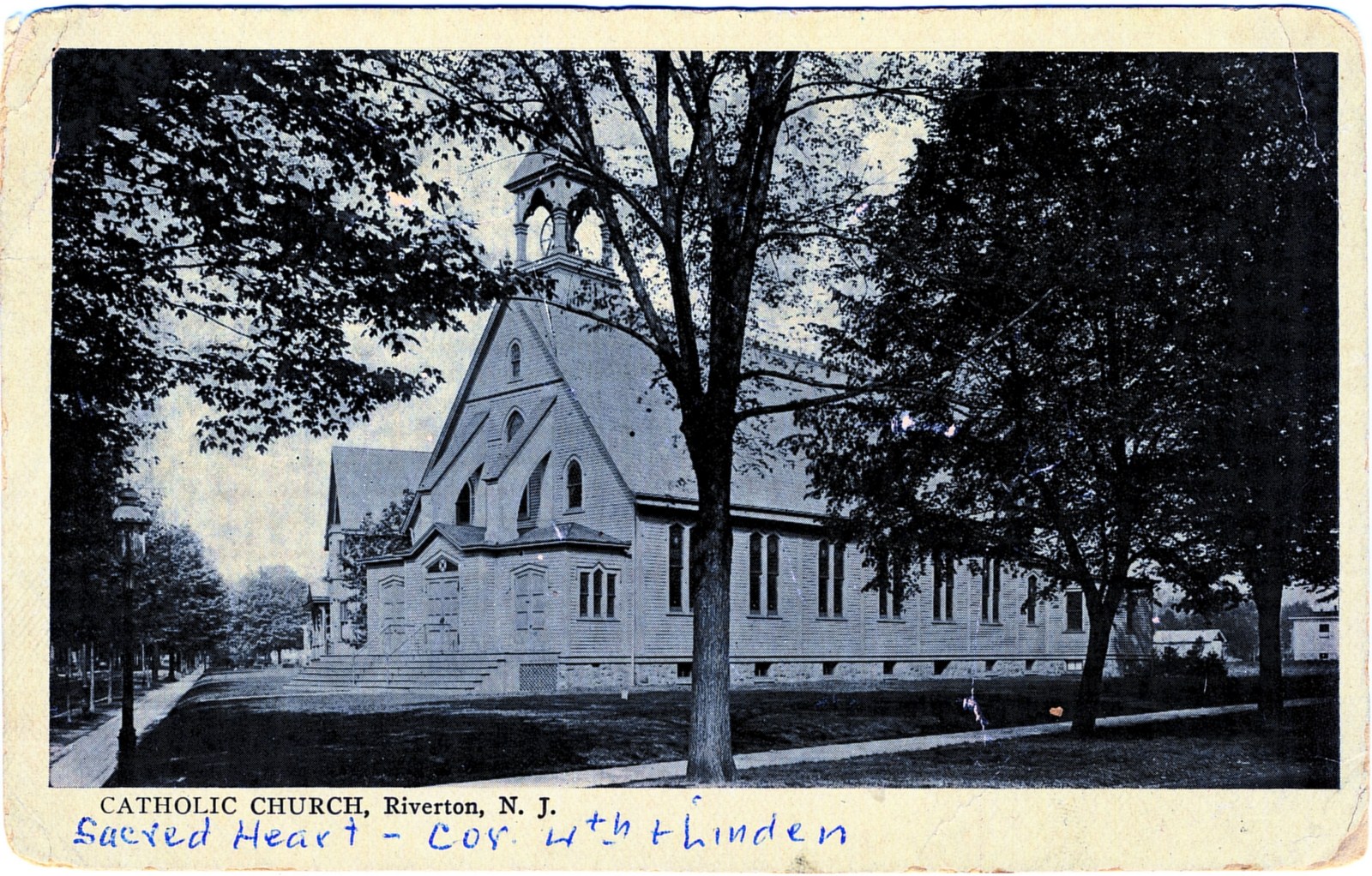
Sacred Heart Church – John Strohlein
John also allowed me to borrow a slim booklet that commemorated the Silver Jubilee of Sacred Heart Church in 1904.

Compiled and written by Reverend J.F. Hendrick, this 16-page Sketch of Sacred Heart Church traces how Riverton Catholics in the early 1870s worshiped in nearby churches at Riverside, Moorestown, and Camden before services shifted to several Riverton homes while parishioners made preparations for construction of their church.

Sacred Heart Church – 1905 Sanborn map detail

When I scanned the booklet in 2007, I made a slideshow of the pages, burned some CDs, and took them over to the pastor along with some replica paper copies that I made with a color laser printer. He was glad to get them because his one original copy was disintegrating and had to be handled with gloves. Here now was a reasonable looking counterfeit that parishioners could read without worries.

Sacred Heart Church booklet cover

Read more details of how a Presbyterian gentleman donated the land for the church after neighbors objected to the sale. Just as there has been more than one Riverton School, the present Sacred Heart Church was the first Catholic house of worship in Riverton.

Click on the following link to view the PDF file for the 16-page Sketch of Sacred Heart Church. – John McCormick, Gaslight News editor

Revised 05/03/2012 I dread making errors about Riverton history on this website because, once out there on the web, stuff just hangs around forever. Thankfully, I have friend and actual professional historian (as opposed to us amateurs), who helps with damage control here at the Historical Society of Riverton. My sincere thanks to Paul for making this correction.

Paul writes:

John:

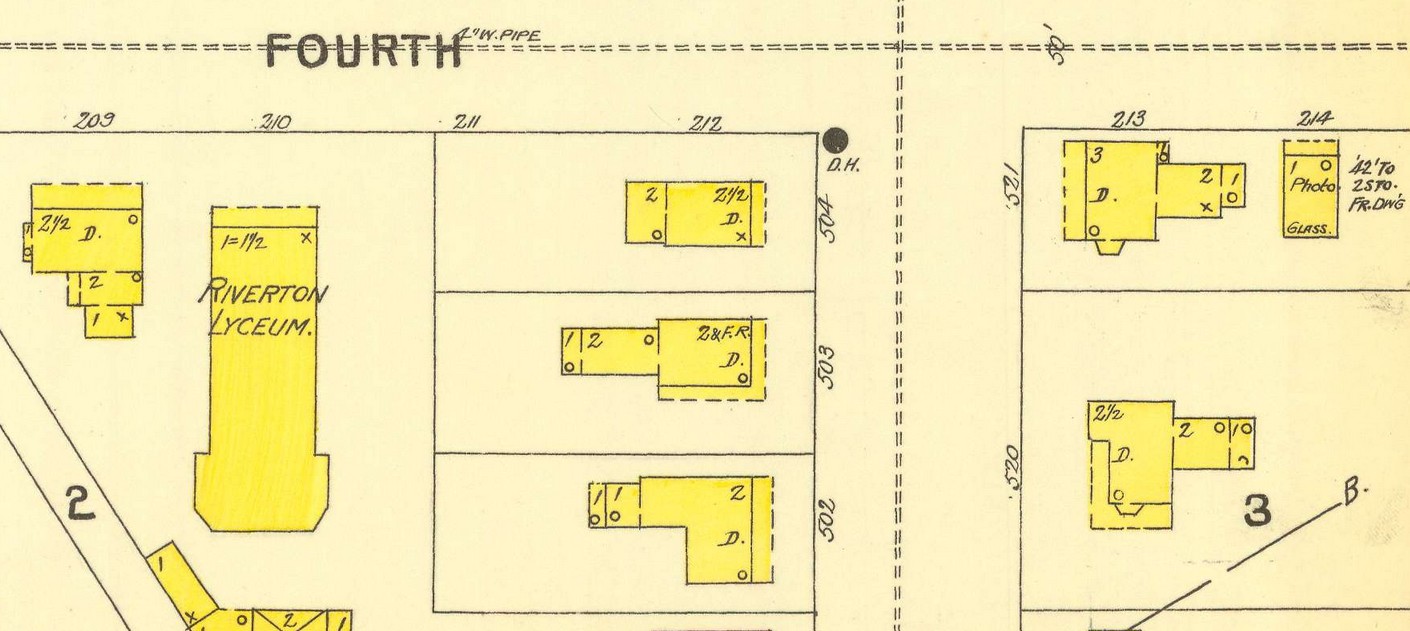
Nicely done, as usual. Regarding the photographer, he did not operate out of the Lyceum. Rather, if you examine Plate 2 of the 1896 Sanborn maps, you will find his studio directly behind his house. The south-facing elevation of the building was glass, allowing Lothrop to take full advantage of natural sunlight in his professional work.

Best regards,
Paul Schopp

From the 1896 Sanborn Insurance Map section shown below, you can see the Lyceum at left and the Lothrup Studio at right. Fourth Street runs left and right on this map and that’s Main Street running up and down. For more about the Lyceum, use the search tool at the top right of this page.

Sanborn Insurance Map section, Riverton , NJ 1896

HSR member and Master Gardener Jeannie Francis speak at Delran Historical Society April 17

Spring has sprung and I am already anticipating the arrival of Jersey tomatoes at the local farm stands. They are the best.

I don’t mean those genetically engineered supermarket mutants that have been miraculously bred to fit three to a cardboard cello-wrapped sleeve.  Most commercially farmed tomatoes are hybrid varieties developed to withstand the rigors of harvesting, shipping, and handling, often looking far better than they taste. You really can recapture that old-fashioned intense flavor and heady aroma of a real Jersey tomato if you seek out “heirloom” tomatoes.

three tomato and two turnip varieties from Dreer's 1880 Garden Calendar
What is an heirloom tomato plant? Definitions vary, but basically it is an open-pollinated plant with valued characteristics. You may find a school of thought that says seeds must be a hundred years old, fifty years old, date from World War II, or before 1950; in any case, the seeds for heirlooms have usually been passed down for through a family for several generations.

Master gardener and herbalist Jeannie Francis raises tomatoes from seeds that she has saved from previous seasons, and she has done it for years. Who does that?

It turns out, plenty of people do who want to stem the genetic erosion caused by commercial growers’ widespread use of fewer hybrid tomatoes, bred for their commercially attractive characteristics. Or maybe she just loves great tasting tomatoes.

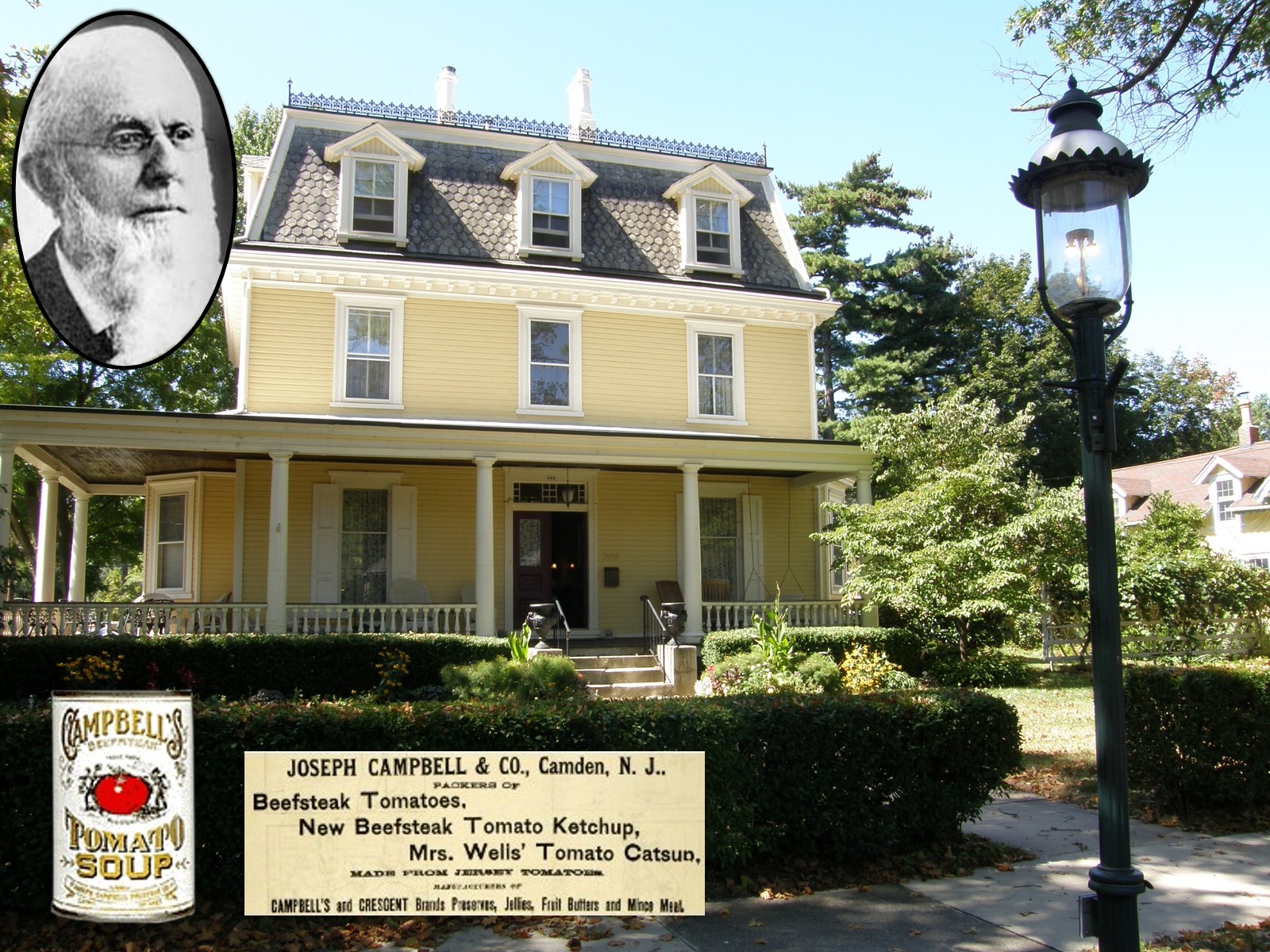
308 Main St. - former home of Joseph Campbell

Come to hear Master Gardener, Herbalist, and Plant Historian Jeannie Francis talk about heirlooms, “the True Jersey Tomato and explore the history of the “Garden State” tomato, the importance of local farms, Campbell’s Soup, Dreers, and more on April 17 at 7 p.m. at the Delran Historical Society.

Delran Historical Society meets in Community Room 3 of the Delran Municipal Building at 900 Chester Avenue, Delran. – John McCormick, Gaslight News editor

Only 27 more lost RPS 8th grade class pictures remain to be found

RPS Class of 1969 – scanned from Cindy Klabe Robertson’s original
In anticipation of the 100th Birthday of the present Riverton Public School in 2010,  I collected scans of eighth grade graduating class photos that were missing from the display in the school hallway for several years and gave prints to the principal.

You would think that the school would have a record of all of those photos but, when I started, over half of the photos were missing. I appealed to HSR members in the Gaslight News to lend us their old school photos to scan, and Mrs. Mabel Kloos did the same during a presentation she made to mark the school’s 100th Birthday.

Just when I thought we had all the RPS eighth grade graduation pictures that we could find, Cindy Klabe Robertson brought this Riverton School Eighth Grade Class of 1969 photo to my attention. A few minutes of photo-editing restored the 43 year-old photo to mint condition. I gave an 8×10 inch print to Mabel to take into school the next time she went in to sub.

Years for which we still need RPS 8th grade class photos

Shortly afterwards, Mabel knocked on my door with a list of the remaining photos that are still needed for the school’s hallway display of eighth grade graduation photos. Please contact me if you can donate an original or loan one so that I may make a copy.

I still hold out the hope that some of these photos will show up in an old family album, a forgotten trunk, or grandmother’s attic.

The pictures don’t have to be in perfect condition either. If you find one of the absent photos and it is showing its age, please don’t hesitate to contact me as I can often restore even torn and faded photos.

RPS Class of 1935 – original scan
RPS Class of 1935 – edit
Here’s one that was a particular challenge. The whole top part of the photo was gone so I borrowed a top from another similar picture and blended them together to make a passable photo of a Class of 1935.

As Betty Hahle so patiently pointed out to me in 1985 when Principal Rip Kilne was organizing the 75th Riverton School Birthday, the brick school that was built in 1910 was not the first Riverton School.

1903 RPS Grads, 1903-06-10, Philadelphia Inquirer, pg 3

Recently, I found this account of the RPS  Class of 1903 in a newspaper archive. So definitely please contact me if you find any class photos, graduation programs, newspaper articles, etc. about Riverton student activities prior to 1910 that you want to donate or loan for scanning.  – John McCormick, Gaslight News editor


More of Clara’s postcards from near and far

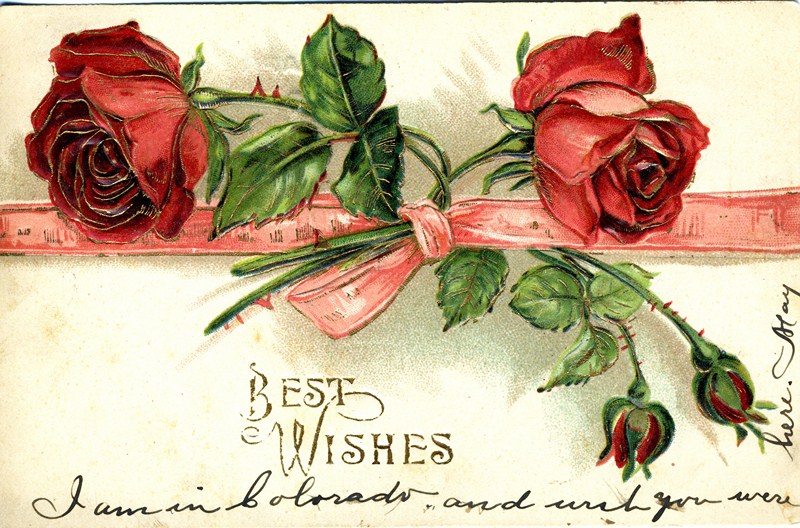
Best Wishes 1909 postmark " I am in Colorado and wish you were here."
The majority of the over 200 postcards that once belonged to Miss Clara Yearly, Riverside, NJ,  date from the Golden Age of postcards, roughly 1907-1915–a time during which the sending and collecting of picture postcards became the rage.

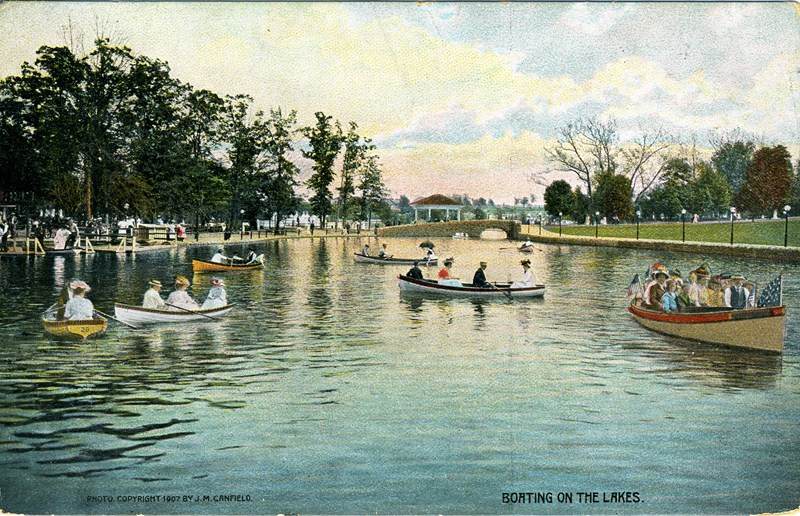
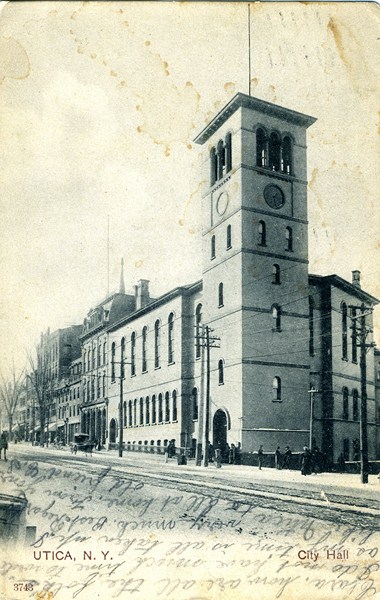
The scans displayed here are a diverse mix of greeting and travel postals received by from Clara from nearby and far away.

Plain non-pictorial message postcards for simply sending correspondence had been around for some time, but the first picture postcards in the United States began with the souvenir issues sold at the World Columbian Exposition in Chicago in 1893. Each postal had a picture and space for a message on one side, with the other side reserved for the address and cost only one cent to mail.

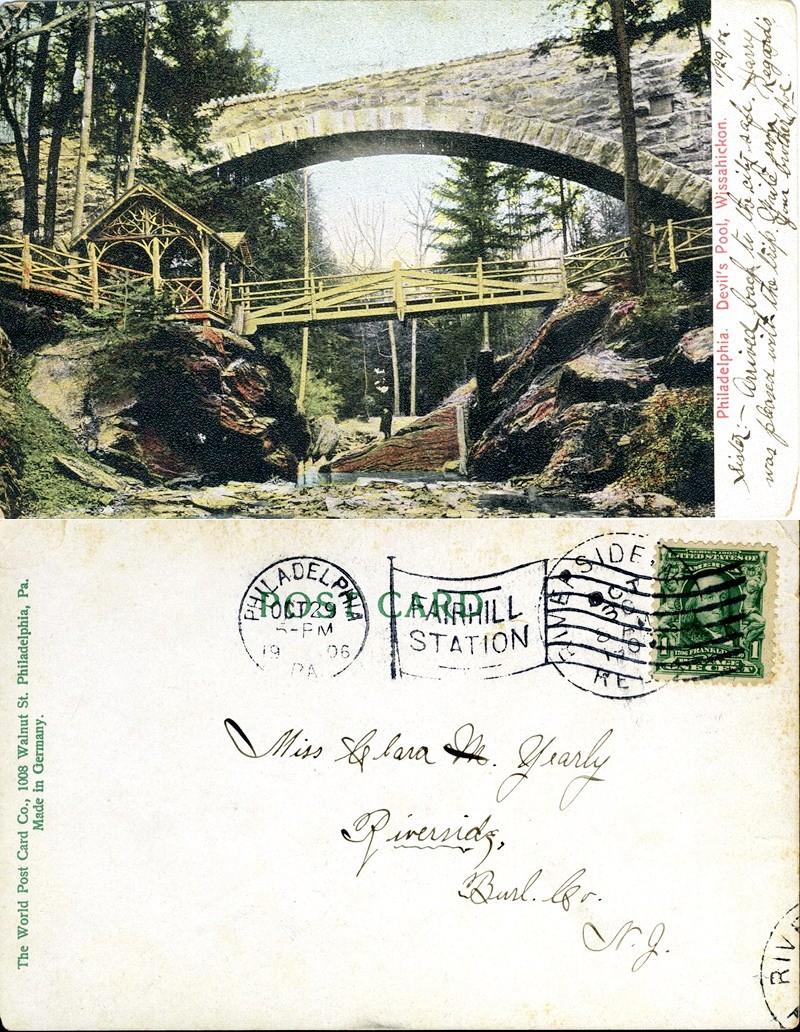
Philadelphia, Devil's Pool, Wissahickon 1906 both sides

The card at right is from a time when postal regulations required that only addresses be written on the back of the card. The 1907 postal rule change which allowed “divided back” cards and writing on back launched the Golden Age of Postcards. Divided back postcards came along later in 1907, with the image on one side and, on the other side, a section for a message and another for the address.

The divided back postcards allowed for short messages, not unlike the  text-based posts of up to 140 characters known as “tweets” posted by twitter  followers today. Many vintage postcards have very short messages or none at all, and some are “postally unused,” having never been mailed.

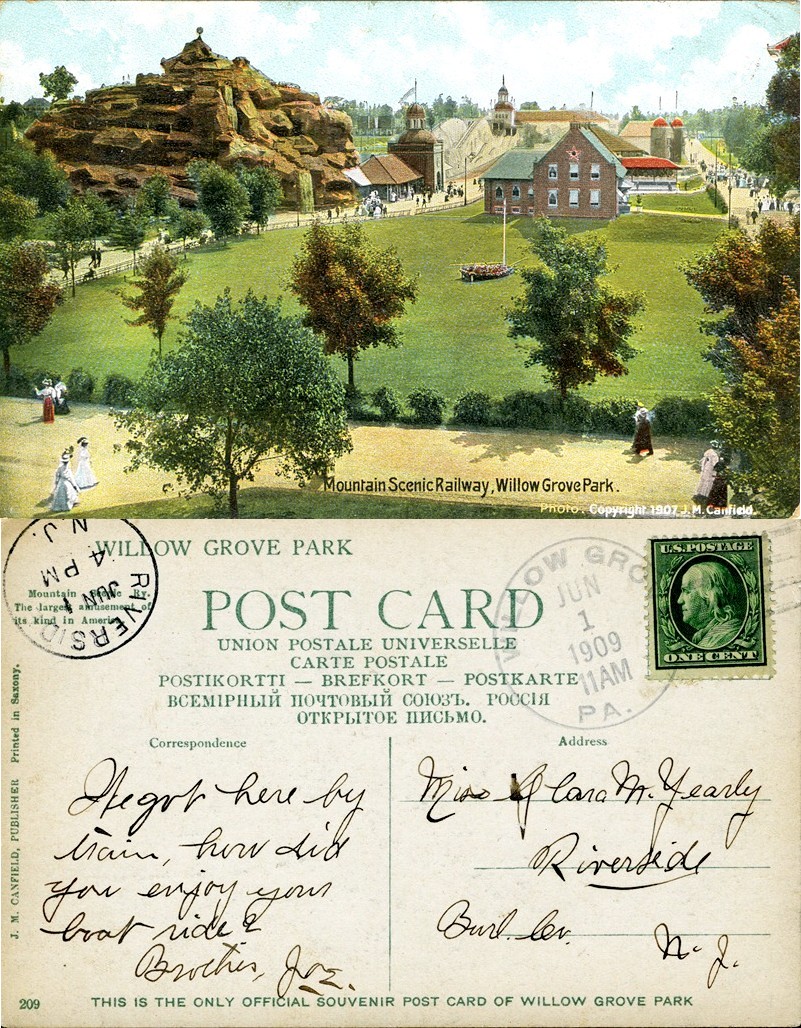
Mountain Scenic Railway, Willow Grove Park, PA 1907 front and back - 5 hours in transit - printed in Saxony, then a kingdom, part of the German Empire

Note the two postmarks on this divided back postcard. One postmark was imprinted when the postcard was mailed, canceling the stamp, and another was imprinted when the postcard was received. Do the math and you will see that the postcard left Willow Grove at 11 a.m. on Jun 1, 1909, and a mere five hours later landed in Riverside. Remarkable postal service for a penny!

Can any reader verify that back in the day (don’t ask me how far back) towns along the Delaware enjoyed two mail deliveries daily?

With the increased mobility brought on by the automobile, people traveled more and the penny postcards were an inexpensive alternative to telegraph or long-distance telephone rates for sending brief messages. Improvements in photography and printing technology, and the growth of a middle class with more money to spend on non-essentials are other factors that contributed to the picture postcard craze that exploded across America during the early 1900s. US Postal Service records show in 1908 that the population of 88,700,000 Americans mailed 677,797,798 postcards; that’s an average of over seven for every person!

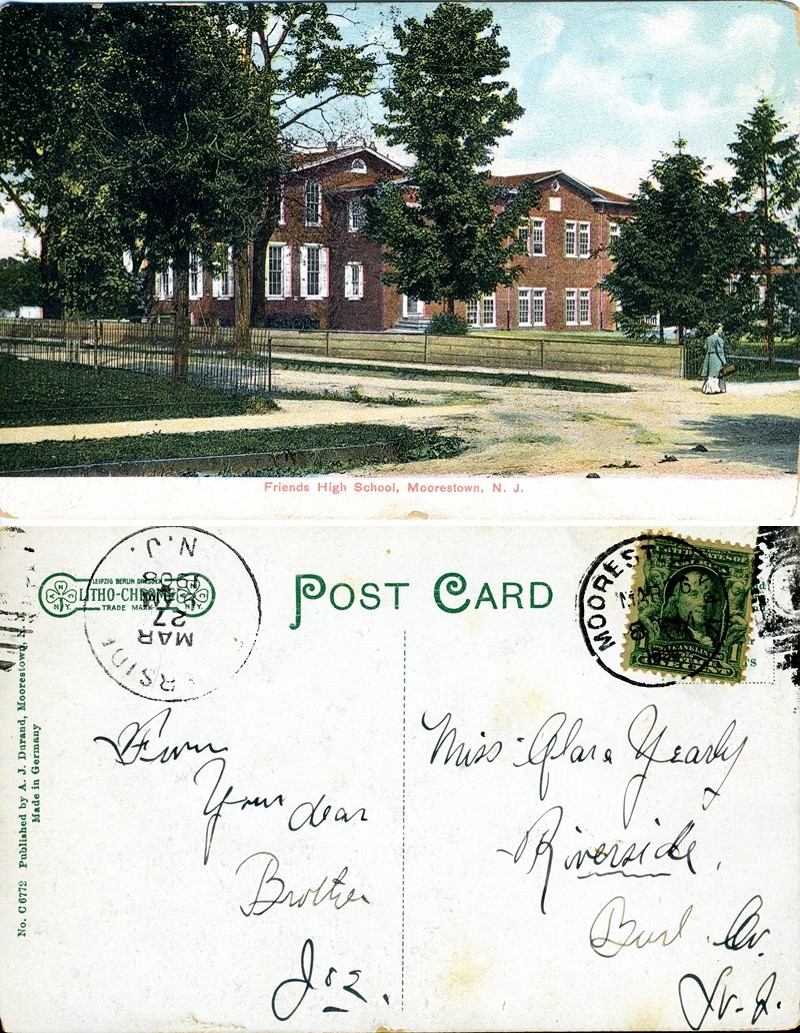
Friends High School, Moorestown, NJ 1908 - Litho Chrome Leipzig Berlin Dresden

Germany had a lock on producing the finest quality color lithography postcards until the onset of World War I curbed the  civilian German printing industry. Most of this area’s superior color postcard views are consistent with this development, having postmarks before 1915.

In 1903 Eastman Kodak introduced a type of camera that enabled the public to take their own black and white photographs and have them printed on to postcard backs. Soon, Kodak and other manufacturers marketed more postcard format cameras, thus igniting the era of the real photo post card, or RPPC. Many RPPCs  instead have a sepia tone, and they may, or may not, have a white border.

These unique cameras had a small thin door at the rear that could be lifted to allow the photographer to write a caption on the negative with an attached metal scribe. Inexpensive to produce at the time, these real photo postcard views can be among the most costly and sought after ones by collectors because of their one-of-a kind nature.

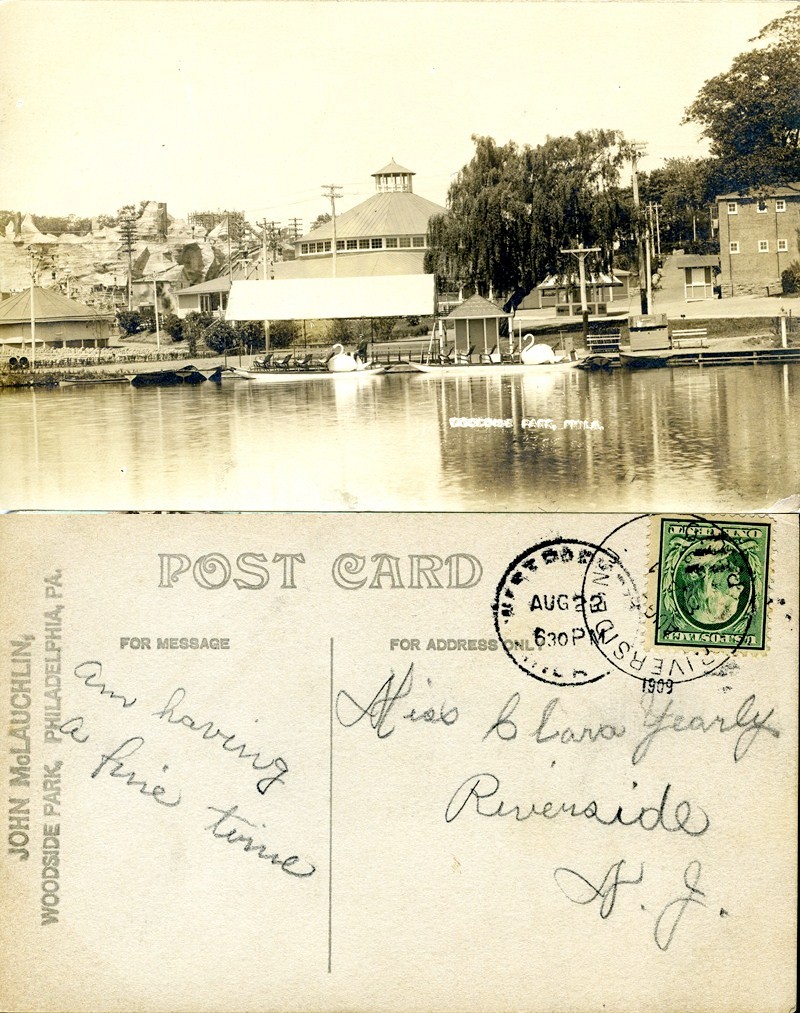
RPPC - Woodside Park, Philadelphia, PA 1909

You can distinguish between a mass-produced lithography process printed postcard and a RPPC in a couple of ways. The  lithograph process produces the image as little dots, but the photo image shows no dots when viewed closely. In a RPPC, the image has smooth transitions from one tone to another. In addition, older RPPCs sometimes show a silver sheen in the darker areas when viewed at an angle due to the silver used in the early photographic process.

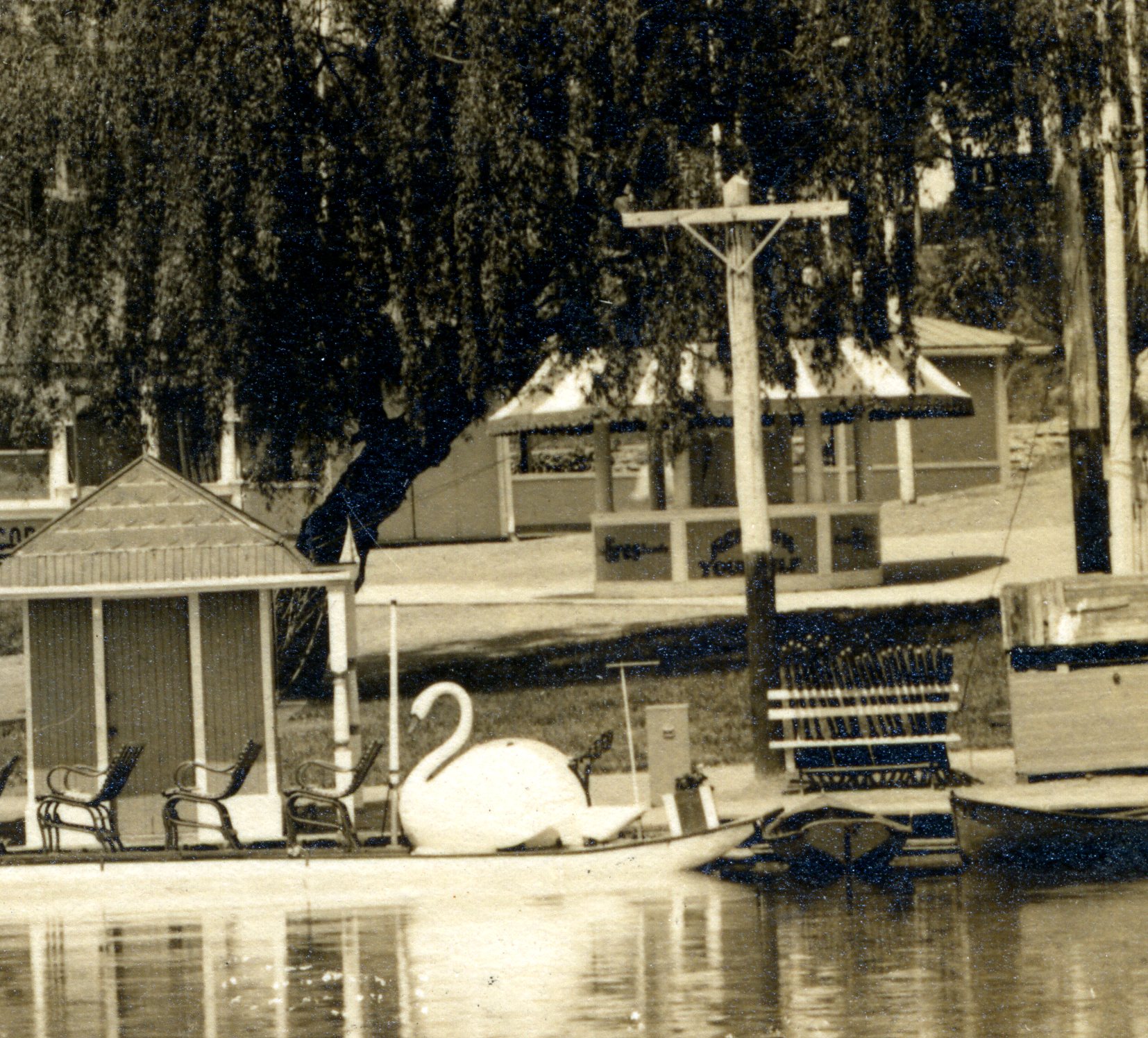
Woodside Park, Philadelphia, PA 1909 detail - silvering evident in dark areas of tree trunk

The detail of the RPPC of Woodside Park in Pennsylvania at right exhibits this silvering in the darkest parts of the tree trunk above the swan.

During this time, just about any town appearing on a map had an array of hometown views to represent it. Riverton’s population was 1,788 in the 1910 US Census, and it easily is depicted in over a hundred unique postcard views of which we are aware so far.

A town with numerous postcards of its landmarks, parks and public spaces, schools and churches, government and civic buildings, business establishments, and such could promote itself as a good place to work, live, and visit to outsiders. Persons passing through the towns picked up the inexpensive cards as souvenirs of their travels as well as for jotting off a quick message to the folks back home.

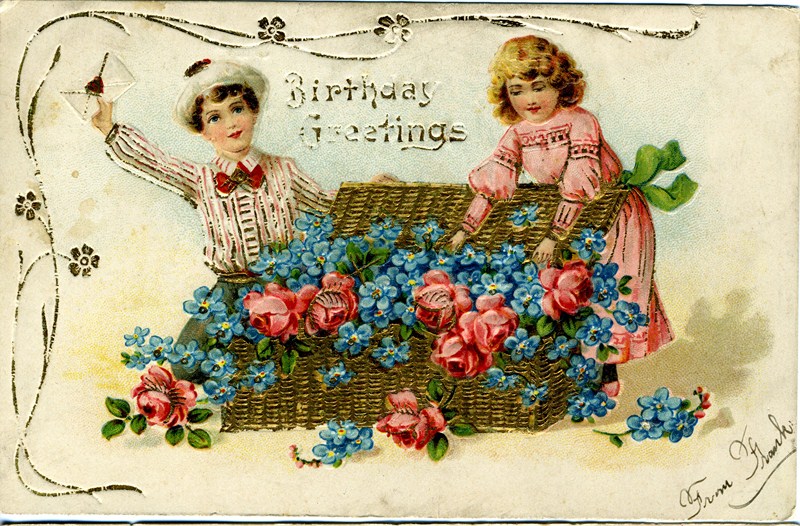
Happy Birthday 1907 - embossed card with gold ink
Just as today one might point to their number of Facebook friends or Myspace connections, it was fashionable in the early 1900s for families to have a postcard album proudly displayed so visitors could browse through their social network. Postcard albums were the “coffee table books” of that era. Except for a few images, these postcards are not views of Riverton, but are greeting and travel postcards that Clara Yearly received from her relatives and acquaintances.

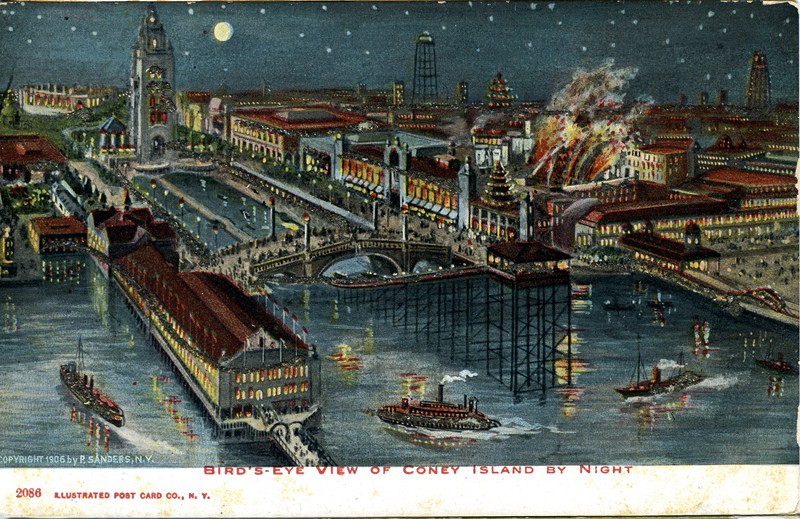
Bird's -Eye View of Coney Island by Night 1906
Postcard recipients carefully preserved the cards sent by their friends and family in albums, and the senders had high expectations of receiving many in return. Several of the messages on Clara’s cards mention receiving a card or say “many thanks for your postal,” so we might infer that Miss Clara gave as good as she got.  If so, then there must be a lot of Riverton postcards out there from this young woman. 

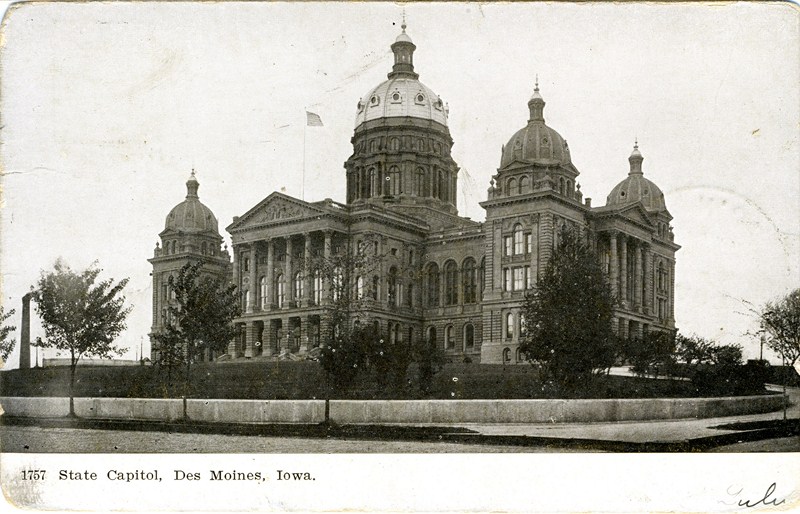
State Capitol, Des Moines, Iowa 1907

Readers and visitors, know that the Society is fortunate indeed to have received so many wonderful donations over the years from generous people who have helped enrich our understanding of Riverton history with their gifts.

The many gifts of artifacts, collectibles, ephemera, vintage clothing, and scans of collectors’ postcards related to local history all combine to help to better achieve our mission to discover, restore, and preserve local objects and landmarks, and to continue to expand our knowledge of the history of the area.

Today, as in days gone by, a spirit of altruism and civic-mindedness continues to be part of what it means to be a Rivertonian.

Please do not hesitate to contact us if you have something you wish to add to this growing internet archive. We invite readers’ comments, corrections, and submissions of photos, articles, or research projects.  – John McCormick, Gaslight News editor


Best Wishes from the Society

Best Wishes - undated
Whew! You’d be tired too if you just scanned over 200 old postcards.

Recently, Mary Yearly Flanagan emailed me and offered to let us display her family’s collection of vintage picture postcards.

Except for a couple of dozen postcards from the 1930s, it is an eclectic mix of greeting and travel postcards that her ancestor received from relations and acquaintances over a century ago.  We sincerely thank Mrs. Flanagan for generously allowing us to display her treasured family mementos.

A typical album for a postcard collection from the "Golden Age" of American postcards c. 1910. The album model is "The Ideal", and it was made by the J.L. Hanson Co., Chicago.

These penny postcards were the social media of the day and an easy and affordable way for folks to keep in touch.  During the so-called Golden Age of Postcards from about 1907-1915, people mailed them to friends and relatives, not just for special occasions, but also for everyday communication. Postcard sending and collecting became a huge craze and every household had its family postcard album out on display.

If you are a regular visitor to this website, then you already know that the massive photo and postcard collection shown on the Images page is mostly just a virtual collection. Of course we do have a physical photo archive, but it is a fraction of the size of the many hundreds of image scans shown on the Images page.

If you have historic photos or postcards. artifacts, ephemera, or collectibles please consider donating them to the Historical Society of Riverton. As an alternative, we also welcome scans or photos for our records if you are going to dispose of the items elsewhere.

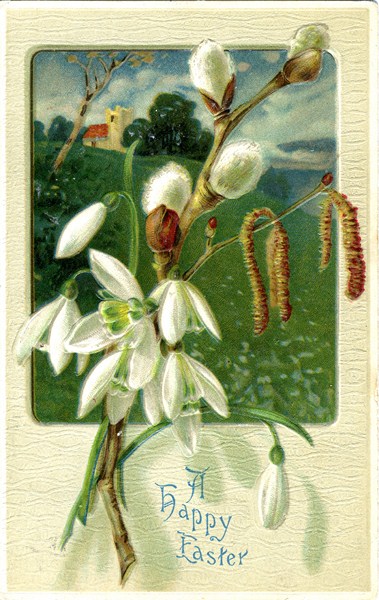
Enjoy this first perfectly timed first installment–a handful of Easter postcards simply addressed to Miss Clara Yearly, Riverside, NJ, over one hundred years ago.  How extraordinarily lucky Mary’s family is that these “postals” (as the writers of yesteryear referred to them) have survived with their vintage images and endearing messages intact.

In this age of instant messaging, cell phones, and emails what evidence of our everyday images and correspondence will remain for future generations to look back upon a century from now? – John McCormick, Gaslight News editor


Happy St. Patrick’s Day to all; Join the fray and add your chapter to the Riverton Saga

vintage St. Patrick's Day card - image courtesy Moore's Postcard Museum

Happy St. Patrick’s Day to all!

Today is a good day to reprise the popular back-issue of the Gaslight News from March 2010 that ran the article about Riverton’s Irish Row by Priscilla Taylor.

At the time, so many people asked for extra copies to send to family members,  we had to get more printed.


The article apparently also evoked memories and motivated several comments on the website about growing up Irish in Riverton.

It also irked at least one reader because a family name was not included in the “A Sampling of Irish Row Occupants Living on Cinnaminson Street —Irish Row (according to Riverton’s 1900 Census).”

    • 703 – Annie McDonald (hairdresser)
    • 707 – Nora Williams
    • 709 – Julia & Patrick Ford (day laborer)
    • 710 – James Flynn (florist)
    • 712 – Annie & James McIlvain (coachman)
    • 717 – Virginia & Patrick Rarins
    • 721 – Maggie & John McDermott (steamfitter)
    • 723 – Mary & Patrick Jordan (day laborer)

Certainly, there are many more names that could be included for 1900, and more still for other years. With increasing interest in genealogy and the popularity of websites such as ancestry.com that help with the task of discovering family stories, it is very likely that someone reading this can add another paragraph to this article, if not an entire chapter.

The person who is in the best position to tell your story is the person most closely connected to it.  So please, send us more information, and we will incorporate it into what we have.  Maybe someone will write a sequel.

Irish Row children Cinnaminson Ave., Oct. 1922

Since the original publication, several readers have volunteered information or images such as this one sent in by Mary Yearly Flanagan.

In 2011, a reader recognized the photo of Kate the Cook shown in the March 2010 Gaslight News, pg. 5 as her great-grandmother.

That is just the kind of connection I hope that can happen here as we all collaborate on gathering more information.

Catherine “Kate” Toohey McLyndon

At the Museum for a Day this past December, a woman remarked that her mother had been one of those Irish servants working in the big houses on the river. I gave her my card and pleaded with her to contact me so that I could find out more.

But it’s almost four months later, and no word. People get busy and, let’s face it, this stuff is way at the bottom of one’s to-do list.

If there is ever anything whatsoever that you can add to this collection, please do not hesitate to contact us.  Don’t think that something is too small or insignificant because that bit might be just what we need to fill in a missing piece of a larger puzzle. Don’t imagine that we are experts or that we know it all.

We thank Moore’s Postcard Museum for the vintage St. Patrick’s Day card pictured above. This one came from the March 2011 post, but there are three more antique St. Patrick’s Day cards just posted there today, March 17, 2012.

Mayor Bill Brown tells us that so far he has eight names to add to the Riverton Honor Roll next Memorial Day.  Last week we added another photo to the Riverton Honor Roll Album -Donald Rogers Taylor.

The landscape improvements and beautification efforts at the War Memorial  site have truly revitalized that public space. Expanding eligibility for veterans to include “…any present or former resident of the Borough of Riverton, New Jersey who served on active duty in the Armed Forces of the United States of America during a time of war” has brought well-deserved recognition to veterans of other conflicts in addition to World War Two.

Please visit the Riverton War Memorial next to Riverton Square on South Main Street, next to the River LINE tracks. See information on the Veterans Page if you want to submit a veteran’s name for consideration. – John McCormick, Gaslight News editor


Batsto bus trip April 28 sponsored by Palmyra Historical & Cultural Society

No, you’re not on the wrong webpage.

Will Valentino from THE PALMYRA HISTORICAL AND CULTURAL SOCIETY asked if we could help get the word out about a bus trip to Batsto, so here it goes. Will’s copy follows:

Now that Spring is in the air and the Daffodils are blowing in the cool breeze of March, you may wish to reconsider The Palmyra Historical Society’s bus trip to Batsto village on April 28th. Information and updated revised flyer attached.

PLEASE FORWARD THIS E-MAIL TO ANYONE INTERESTED OR PRINT THE ATTACHED FLYER AND POST IT IN A PUBLIC VENUE FOR US !

Hello Friend of the Palmyra Historical & Cultural Society ,

On April 28th, join fellow residents and history buffs  as we travel back in time to Batsto village in the heart of the Pine Barrens. I have attached a brochure listing details,cost and tour schedule.

There  are only 55 seats available . We recommend you book your reservations early for this fascinating trip into New Jersey’s past.

If you have any questions, you can e-mail  Society trustee Genevieve Lumia  @  gen.lumia@comcast.net  or call Judy at 856-456-1121.  We will be accompanied by a tour guide who is an expert on pinelands history.

So, travel back in time with us and help support the Palmyra Historical & Cultural Society.

Hope to see you there.

Will Valentino Author of BACK IN TIME Trustee, Palmyra Historical & Cultural Society

As citizens dealt with the Great Depression in 1933, Dreer’s prepared for the Philadelphia Flower Show

New Era masthead March 23, 1933

Marge Habernn’s recent donation of a rare 1933 New Era newspaper proves here to be grist for the first of several posts from this blog mill.

Readers of that nickel weekly hometown gazette in the first quarter of March 1933 were no doubt hopeful to receive some good news that would release them from the grip of economic hardships brought on by the Great Depression.

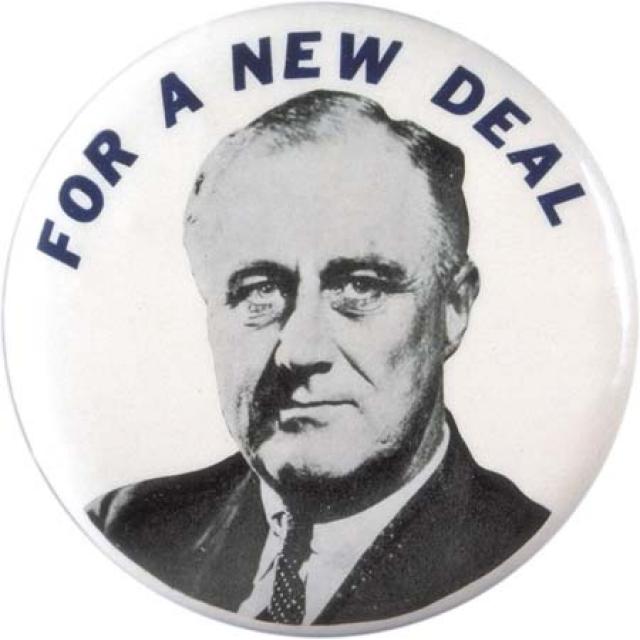
An upbeat editorial titled “American Morale” supported the recent “bank holiday” and remarked on the amazing power given President Roosevelt during this “new deal,” calling it a “great event.”

Apparently, the Palmyra National Bank was reopening after being put into the hands of a conservator.  The article explained that old accounts were restricted— “no checks against them will be honored.” The good news—the bank recorded $33,000 in deposits from Saturday to Tuesday.

Historical note: President Roosevelt had only just assumed the presidency of a nation in economic chaos on March 4. Prior to his taking office, there had been a month-long run on banks. He immediately declared a nationwide bank holiday that shut down the banking system for a week. Congress introduced the Emergency Banking Act of 1933 on March 9 and passed it the same evening. Roosevelt appealed directly to Americans to prevent a resumption of bank withdrawals in his first Fireside Chat on March 12. The following week banks reopened on as depositors stood in line to return their hoarded cash.

Riverton’s slashed tax rate made the front page—down fifty-eight cents to $3.60 from $4.18 the previous year. Borough and school taxes took hard hits, with employees taking a ten percent pay cut. They even pared down the fund for Riverton’s beloved Fourth of July celebrations. The dire situation downstream prompted Palmyra to issue scrip with which to pay teachers and town employees that was acceptable for payment on taxes, sewer fees, and other such borough indebtedness.

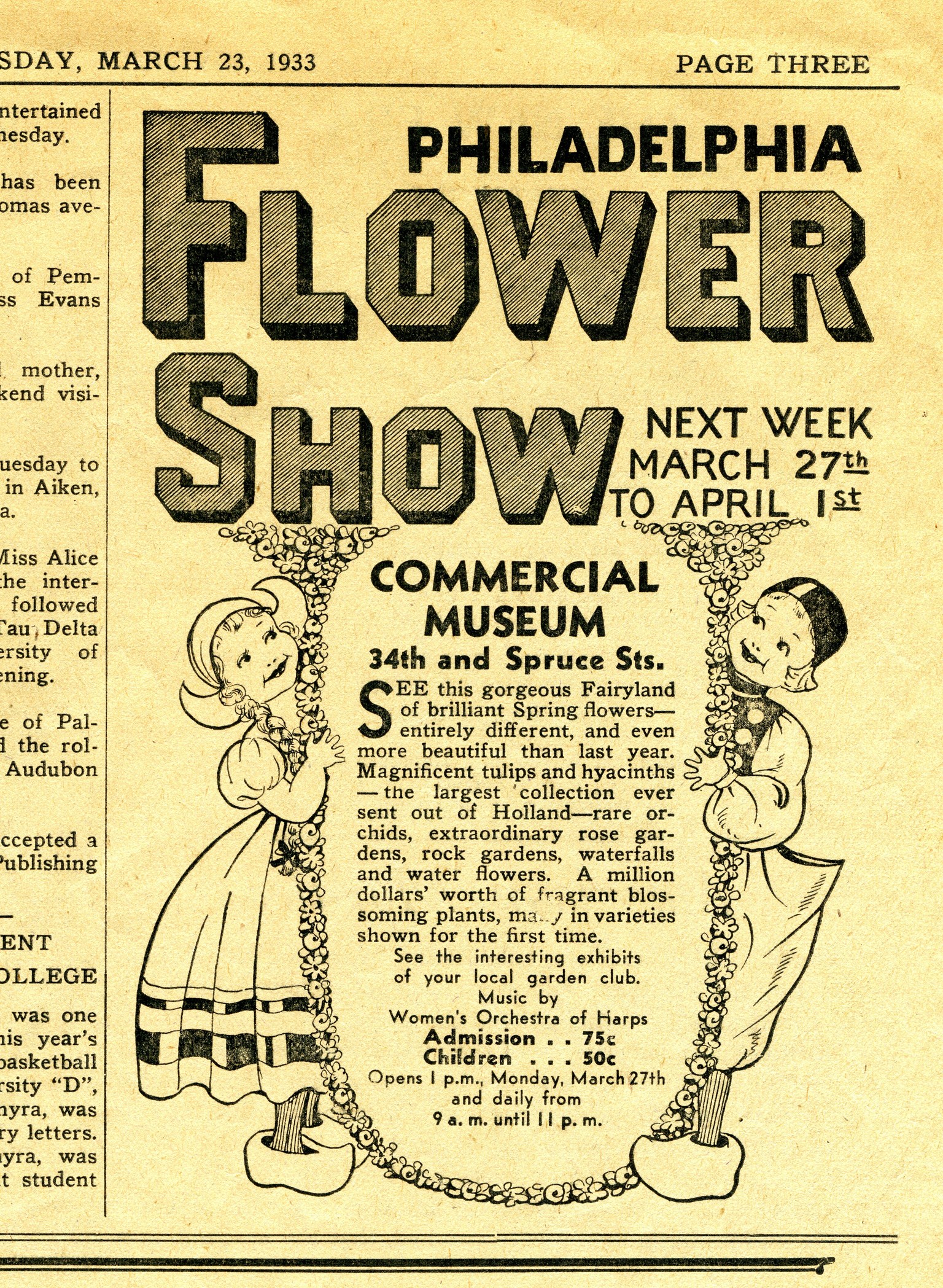
Philadelphia Flower Show, New Era, March 23, 1933, pg 3

Elsewhere in the paper, the Welfare Committee urgently appealed to the generosity of Riverton and Cinnaminson for more funds so that it could aid 133 registered unemployed. They also needed children’s and men’s shoes of every size.(Riverton population would decline during the decade from 1930-1940 from 2483 to 2354, a 5.2% drop)

Things were tough all over, kids.

An ad on page three for the Philadelphia Flower Show was a familiar sign of spring. If one could not live like a millionaire in these tight times, for a 75¢ admission, at least they could go to the Philadelphia Flower Show and see “a million dollars’ worth of fragrant blossoming plants, many in varieties shown for the first time.”

The Philadelphia Flower Show had been a Philadelphia tradition since 1829 when twenty-five Pennsylvania Horticultural Society members showed off their horticultural treasures in a building on Chestnut Street. Billed as “largest indoor flower show in the world,” the Philadelphia Flower Show continues this week at the Pennsylvania Convention Center from Sunday, March 4 – Sunday, March 11, 2012.

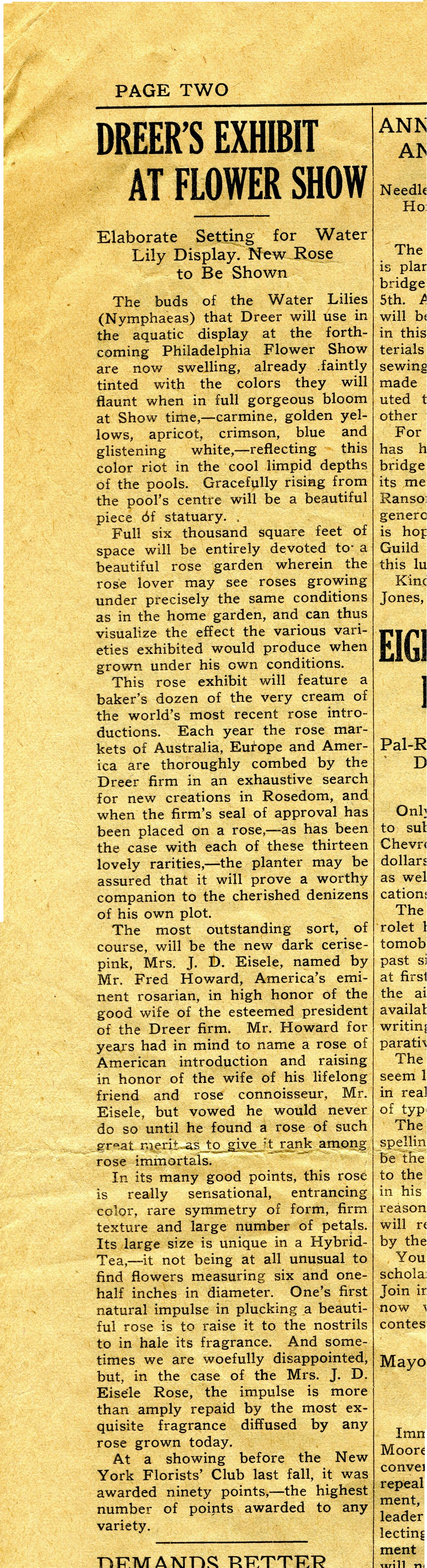
Dreer Flower Show, New Era, March 23, 1933, pg 2
New Dawn 1932 Dreer Garden Book pg 134

The employees of Henry A. Dreer very likely must have prepared for some time for the upcoming Philadelphia Flower Show. A page two column, “Dreer’s Exhibit at the Flower Show” gave New Era readers an insider’s preview of the elaborate display of water lilies in a pool encircling a piece of statuary and a full 6,000 square feet of space devoted entirely to a garden of Dreer’s famed roses.

Among rose growers, the announcement of a new hybrid was, and still is, a highly anticipated event, even in tough times. The first patented plant in the world was “New Dawn,” introduced by Henry Dreer in 1930. Decades later, the repeat-flowering climbing rose remains a classic choice for gardeners today.

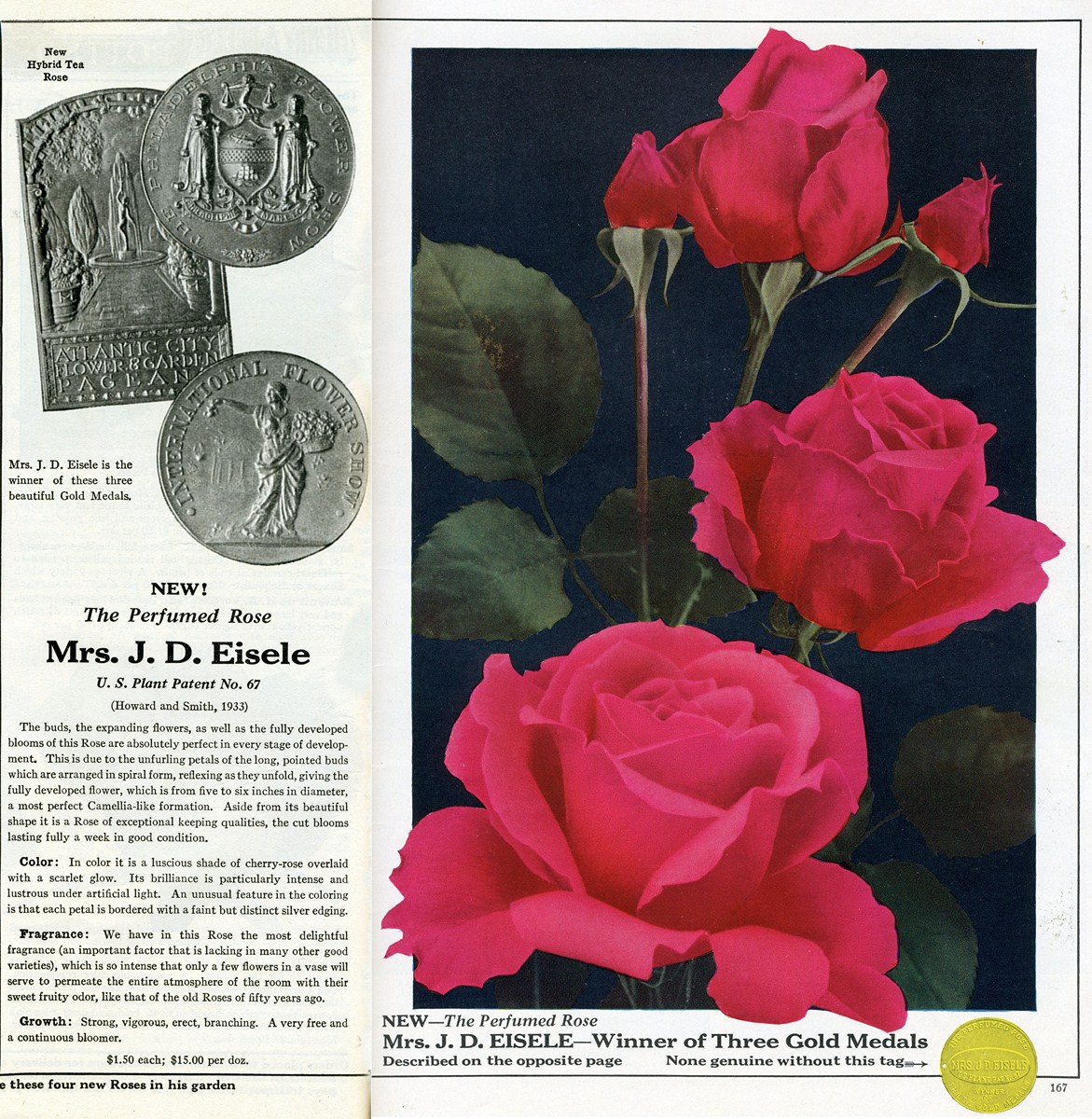
Mrs. J.D. Eisele Rose Dreer Garden Book 1934, pg 166-167
The star of the show in 1933 was the sensational new dark cerise-pink, Mrs. J. D. Eisele, named in honor of the wife of then-president of the Dreer firm.

For the rest of this post, I refer you to what former Riverton Town Historian, Mrs. Betty B. Hahle, wrote for her “Yesterday” column in the December 1977 Gaslight News about the impact of Dreer’s on Riverton. Betty’s column follows exactly as she wrote it 35 years ago.

– John McCormick, Gaslight News editor

Yesterday

Dreer greenhouses

Dreer’s Nurseries in Riverton were known throughout the world. It was founded in Philadelphia in 1838 as a seed and plant farm, prospered and grew, moved, and in 1873 located permanently in Riverton.  It became the town’s largest industry, and was instrumental in its development from a tiny resort area to a bustling community of families who built homes and churches and who were active in a large number of clubs and civic organizations.

Original Calvary Presbyterian Church

The site had been selected 5 years before, influenced by available land, proximity to major cities, and excellent transportation (railroad and boat). It spread northward from Cinnaminson St., on both sides of the railroad, to cover about 100 acres. On the river side of the railroad were greenhouses covering almost 8 acres which, in the early 1900s, required 3000 tons of coal per season to heat. At the same time, 150 men were regularly employed in gardens, packing sheds, and other parts of the Nurseries, and in the busy season the number increased to 200.

Mrs. Dreer presented a pulpit to the Presbyterian church, a memorial to Henry A. Dreer, which both had been instrumental in founding the year after the nursery came to Riverton.

Dreer lily ponds – Riverton

The Nurseries became an integral part of the town. Dreer’s whistle sent many a housewife scurrying to have a meal on the table when her husband or son came home for lunch, and was a dependable check on the old parlor clock.

A leisurely Sunday afternoon found many people, visitors and residents alike, strolling through magnificent greenhouse showrooms of rare specimens from all over the world, or through the rose gardens, where over 500 varieties of standard and hybridized roses bloomed.

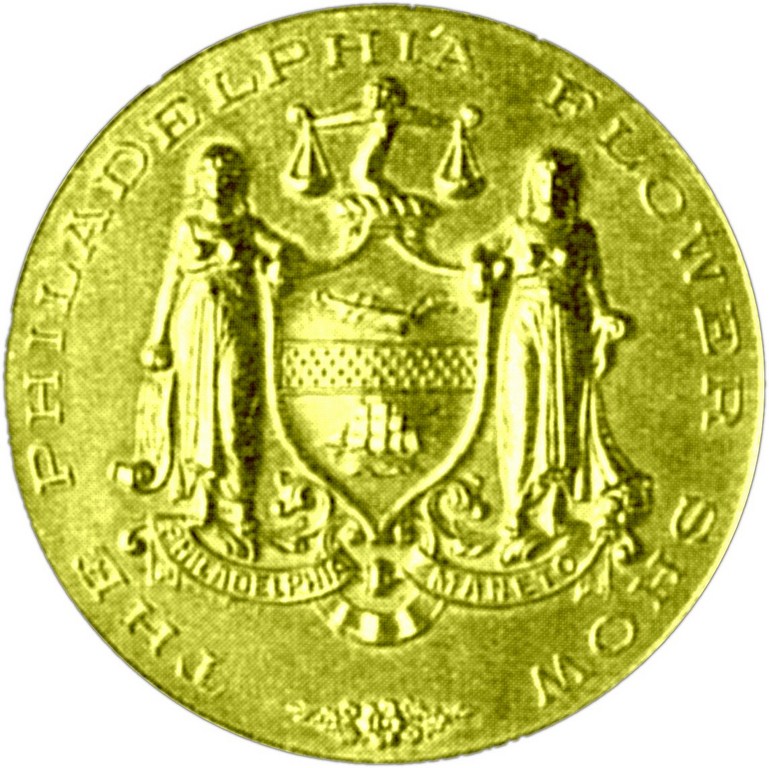
Philadelphia Flower Show medal – Mrs. J.D. Eisele Rose

Or to the lily ponds, over 8 acres of them along the creek and on both sides of the railroad, where some specimen plants had pads 6 feet across and could support a man’s weight, and where not only goldfish swam, but also some tropical varieties accidentally imported along with the water plants. In the 1930s it was even possible to fly over the acres of flowers in bloom in a small open plane (remember the little airport on S-17). Helen Van Pelt Wilson illustrated her garden books with pictures taken at Dreer’s Nurseries, and in some of the local gardens. And at the Philadelphia Flower Show, Dreer’s roses were consistent 1st place winners.

The late Town Historian, Mrs. Betty B. Hahle

After a century of developing improved strains of vegetables, grasses, small fruits, and many flowers and shrubs, Dreer’s Nurseries closed their doors for the last time, during WW II. In less than 30 years the stores, parking lots, houses and apartments and industries that replaced the nurseries have erased it all, making it hard to picture the beauty that was once there. – BBH 1977

(Some inf. from The New Era, Christmas, 1909)

Dreer rose trial grounds 1932 Garden Book, pg 120

Filling in some missing pieces

Just want to let you know that a couple of new posts are on the website – they are just on other tabs. There’s a recap of the Feb. 24th Plum Run performance at Riverview Estates on the Programs and Events page.

At the conclusion of that program, a Riverview staff member gave me two hardback “coffee table” books that someone attending the performance had asked him to give to the Historical Society. No word of the anonymous benefactor, so I’ll just express our thanks here.

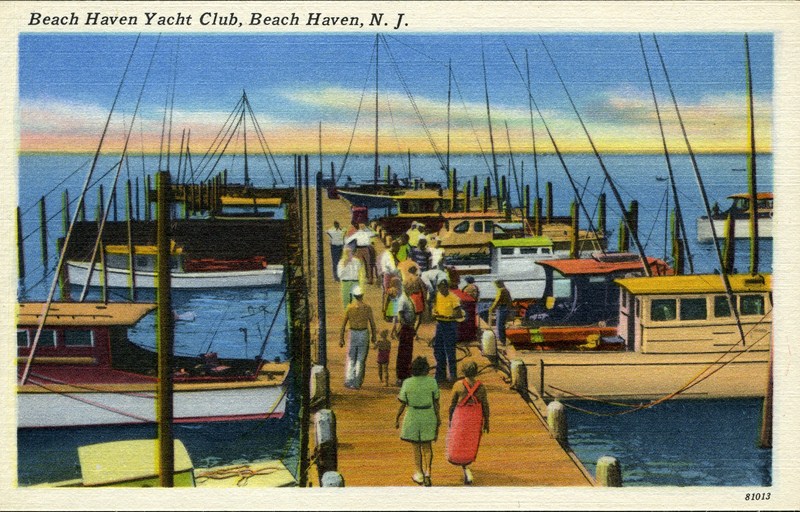
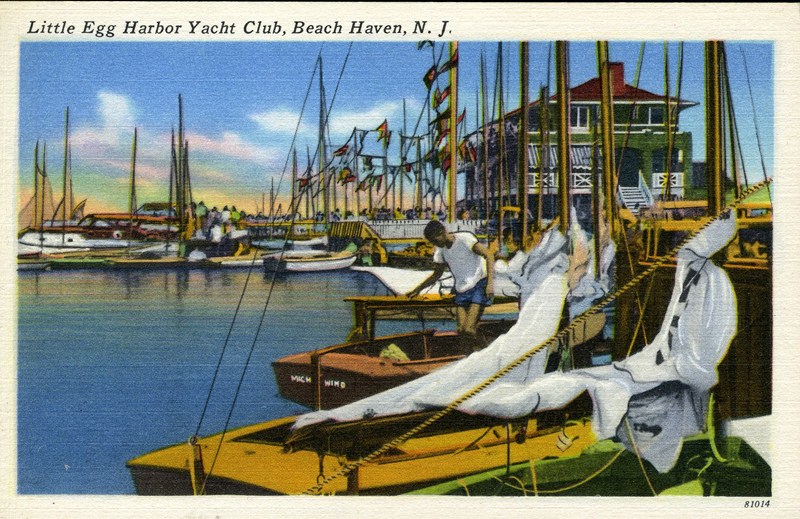
Beach Haven Yacht Club, Beach Haven, NJ
Another bonus was that HSR member John Palko sought me out to loan us some postcards for scanning and posting to the LBI section of the Images page. These seven vintage linen-era postcards truly are in mint condition. They are shown in the picture gallery below and are also integrated with the dozens of other Long Beach Island views on the Images page.

Regular visitors to this website know that the Society actually owns a scant few of the postcards displayed on the Images page. Almost all the images are the result of the kindnesses of many people who have either sent us files of scanned images or allowed us to do the scanning.

We, of course, love to receive donations of items. However, given the limited supply of these unique and historically important artifacts and collectibles, a photo of the item is preferable to nothing at all. We are fortunate indeed to have received so many scanned images and are in a position to share them with a wider audience.

When you send in your comments and recollections about an image or a story posted here, it becomes part of what might be termed the Society’s “collective memories” and often helps fill in missing pieces or gives another perspective to a topic. So please, find those comment icons throughout this website and leave some memories behind.

Riverton Post Office RPPC courtesyDoug D’Avino, “Post Offices of New Jersey – A History Told Through Postcards,” New Jersey Postal History Society
While on the subject of postcards, here is a choice real photo post card (RPPC) of a  Riverton landmark. Better known as Freddy”s Shoe Repair today, this frame building at 609 Main Street has experienced several past lives in its various reincarnations through Riverton’s former times.

Click on the image to get the larger resolution version. Notice the shape of the windows on the back addition to 609 Main.

The pointed tops of those Gothic shaped windows are a clue to the building’s first purpose as a Sunday school building that William P. Ellison presented to Christ Episcopal parish in 1876 as a Centennial  offering. (1909 New Era, pg. 12)

When the church erected a new Parish House in 1895,  Samuel Rudderow, purchased the structure and moved it to its present site at 609 Main. Rudderow was a local architect-builder who constructed a number of the houses on Lippincott Avenue- at least some of them of his own design. (BBH GN #035 Sept 1984)

From 1904-1907 the newly formed Porch Club rented the building; they took possession of their permanent quarters at Fourth and Howard in 1909. (1909 New Era, pg. 19)

The building at 609 Main, now occupied by Freddy’s Shoe Repair, served as the fifth of Riverton’s eight post office locations from 1909-1931.

In 1937, the New Era newspaper moved its operation from 607 Main (partly visible at the left side of the postcard) where it remained until about 1975. (1965 New Era, pg. 18).

This rare postcard came into our virtual collection after the publication of the February newsletter  – the one with the article I co-wrote with Mrs. Pat Solin called, “Special Delivery – Riverton’s United States Post Office.”  While trolling the internet hoping to catch more information so I could produce a beefed up version of that post office story for our website I happened to find this picture displayed in a New Jersey Postal History Society’s photo gallery. 

To cut to the denouement, I struck a deal with the postcard owner – we get to display the former Riverton Post Office image and I will send him the extended version of our Riverton Post Office story when I finish it for publication in his newsletter. Win-win.

The longer article with more text, maps, photos, and newspaper clippings, etc. than could be fitted into the print edition is still in production. I’ll post it here when completed.

The New Jersey Postal History Society, established in 1972, has an extensive website filled with a wealth of research, information, resource links, a member photo gallery, and a calendar of events. Check out NJPHS member Doug D’Avino’s incredible photo gallery, “Post Offices of New Jersey – A History Told Through Postcards” where you will see dozens of NJ post offices from Adamston to Yardville represented on postcards .

You can find the latest February issue of our newsletter, the Gaslight News, under the Gaslight News tab.

I just picked up the March 2011 issue of The Positive Press when I was out today.  Publisher Regina M. Collinsgru did a super job on the layout for the Society’s article. It’s the same “Special Delivery” post office story that is in the Gaslight News, but that publication reaches many more households than we have on our membership rolls.

True to its name, The Positive Press prints news stories and human interest articles with an upbeat perspective, often with a nostalgic aspect. Send the link to a friend or family member across the miles so that they can catch up on hometown news from Riverside, Delanco, Delran, Palmyra, Riverton, and Cinnaminson.

Another recent post that might have been missed is the one on the creation of the Riverton Military and Veterans Affairs Committee by Riverton Borough Council. Find out more about it and see the updated Honor Roll Album – the HSR’s salute to honor those men and women of Riverton who have served their country in time of war – under the Riverton Veterans tab.

Since I posted the PowerPoint presentation about the Welsbach Streetlamp Company on which  Jeff Cole and I collaborated in 2007 (along with some other Welsbach literature), we have received several queries from visitors who have needed technical help or parts for their gaslamps. Find lots more Welsbach items here. Just to be clear – the Society doesn’t maintain the streetlights.

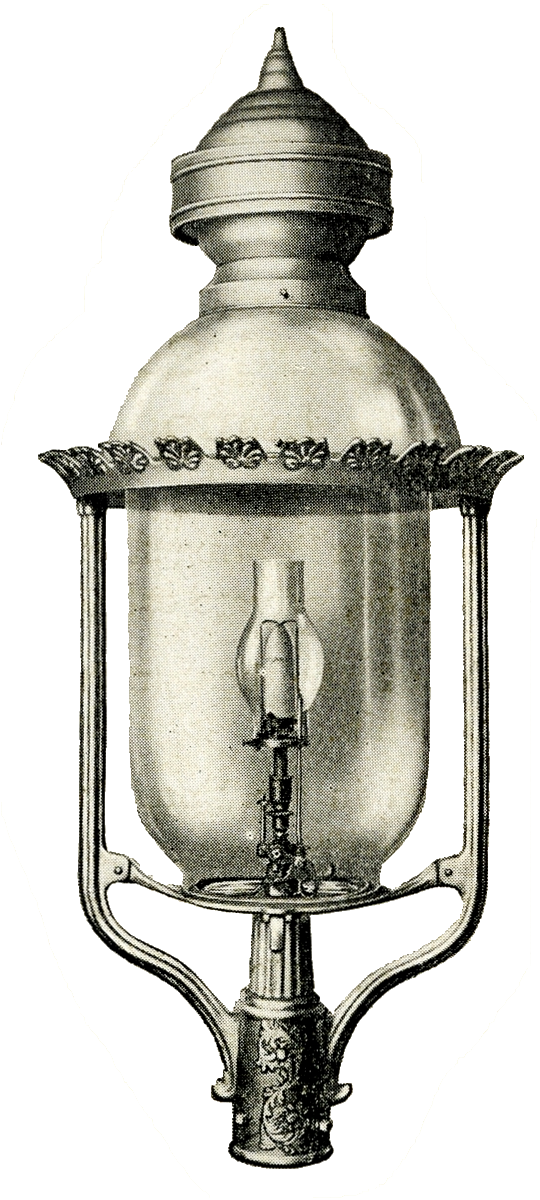
Boulevard Model Welsbach Gaslamp

These links are for suppliers that sell glass and acrylic globes for Welsbach lamps. The original company is long out of business. The only help I can give is to refer readers to the following vendor list.  Hope it helps. Like anything else, just be sure that you are getting the right part for your model. Riverton lamps are the Boulevard model.

http://www.gas-lights.com/globes.html  Gas-lights.com is based in Wisconsin. This page shows the globe (glass or acrylic)  and milkglass dome – parts often needing replacement.

http://www.charm-lite.com/index.php?main_page=index&cPath=8_11 Same deal – Boulevard model reproduction parts

http://www.pennglobe.com/  This company lists parts on the Victorian section of the catalog http://www.pennglobe.com/index_files/Page1966.htm

I received word that former Riverton resident Marge Habernn moved to Virginia and left a New Era newspaper with an acquaintance to be donated to the Society. I only had to pick it up from Mike Digney – literally a block away from my home in Delran. This was extraordinarily thoughtful of Marge since this is an issue that is not in the microfilm collection of Riverton Library. There will be more about what we can glean from this priceless time capsule on another blog post. With no forwarding address for Ms. Habernn, I can only express my heartfelt thanks.
POCAX-2012 Announcement

If an interest in old postcards brought you here, you may want to save this date: May 5, 2012. The South Jersey Postcard Club is having a postcard show at Double Tree Suites Hotel in Mount Laurel. The next regular membership meeting is March 11 in Marlton. Find more information on their website.

That is how it goes here as we try to fill in the missing pieces of this Riverton history jigsaw puzzle.

Let us know if you can fill in another piece or if we have one in the wrong place. It’s more fun if we do this together.

– John McCormick, Gaslight News editor