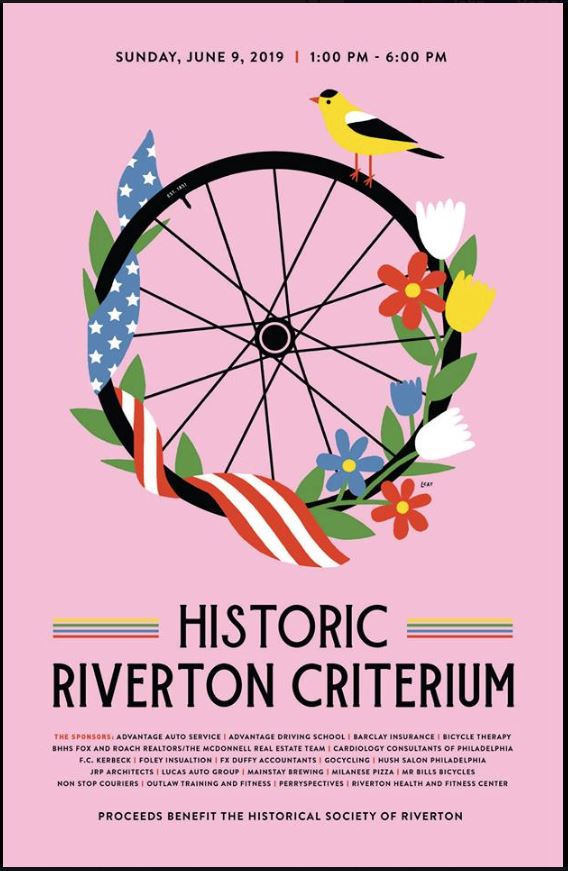
Did you see the ingenious official 2019 HRCriterium poster on Facebook that Lauren West designed? She even included New Jersey’s State Bird, the American goldfinch!
2019 HRC poster by Lauren West
The two mugs below each incorporate her design elements and include a photo of Carlos Rogers, creator of the race, along with descriptive text.
To preorder a LIMITED EDITION 2019 HRCriterium Commemorative Mug, please use the form below, and someone will contact you to work out payment and delivery details.
(Actually, they are limited only to how many people order one.)
If you can spare just an hour next Sunday to cover one of the seven corners during the Criterium, please contact us thru the form below.
We extend a hearty THANK YOU to Suzanne Cairns Wells and Kevin Harris for responding to our request here on May 8 to serve as race marshals.
Marshal Coordinator, Iris Gaughan, explains more below.
Regards, Bill Brown President, Historical Society of Riverton
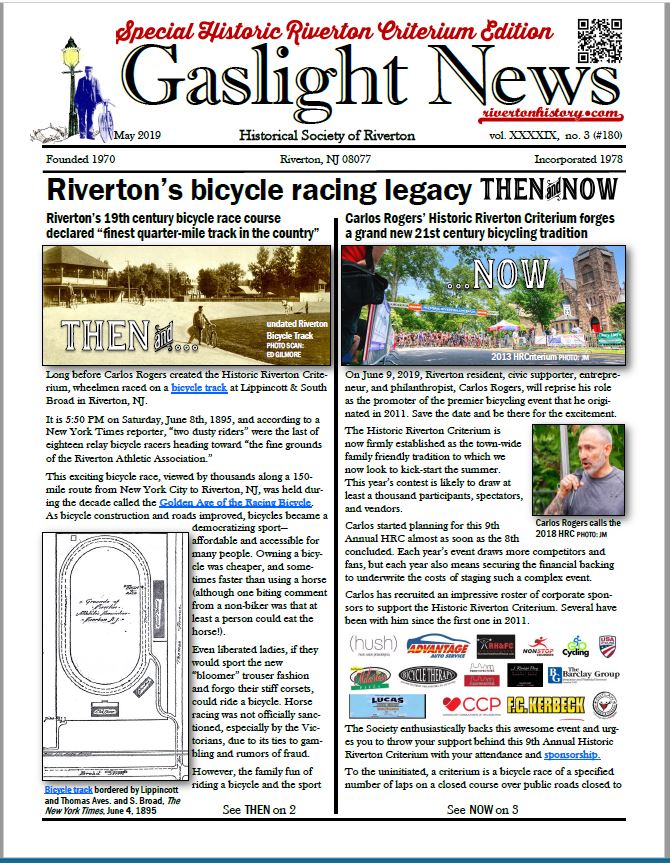
If you have read the Special Historic Riverton Criterium Editionof the Gaslight News you know that this year, money raised from this town-wide tradition will benefit the Historical Society of Riverton.
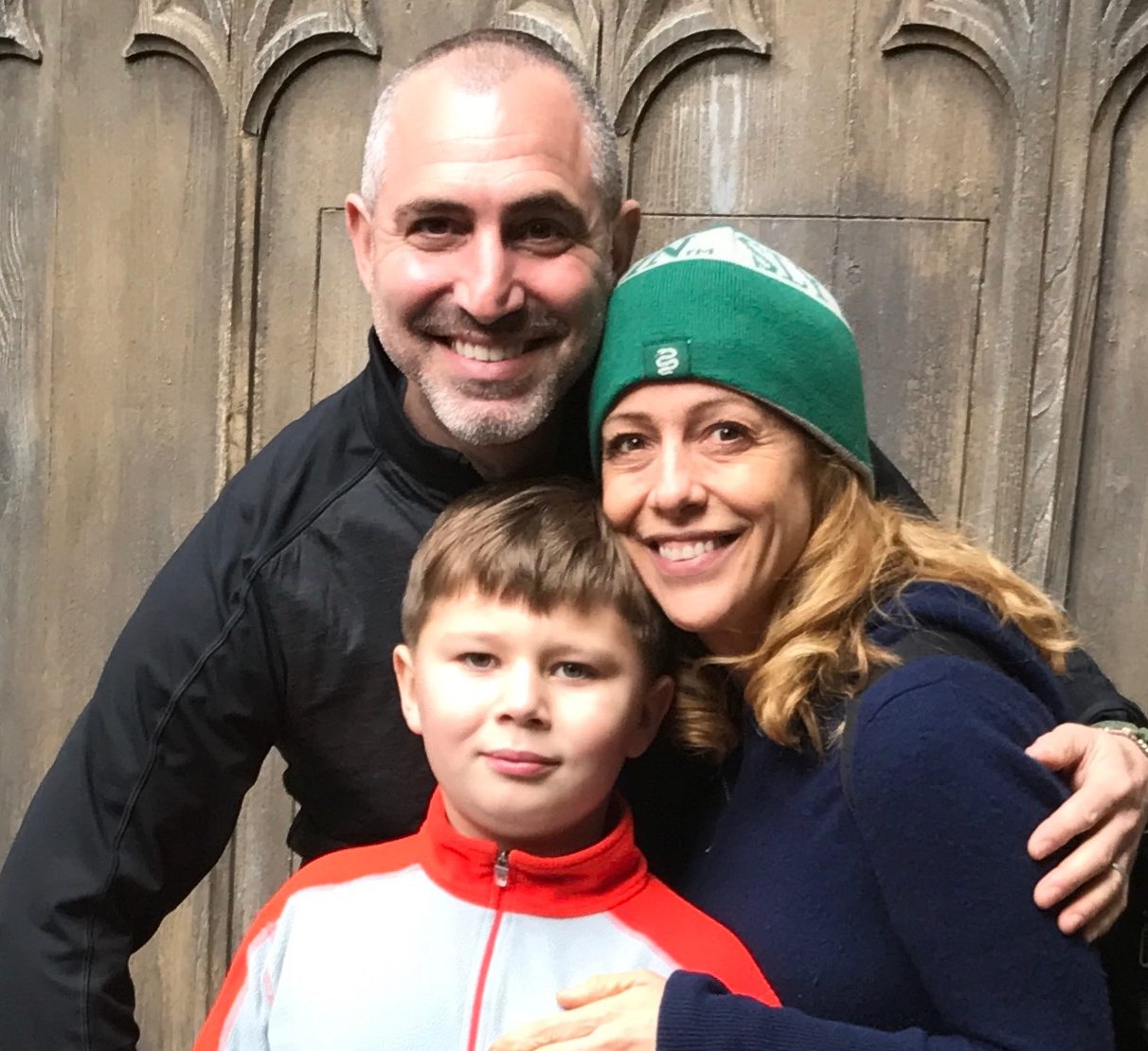
Carlos, Adrienne, & Leo Rogers
On June 9, 2019, Riverton will host the 9th Annual Historic Riverton Criterium. Carlos Rogers, a Riverton resident and civic supporter, has been the promoter of this event since its inception in 2011. The day is filled with professional bicycle racing and fun-filled activities. Many community members along the race course have front yard picnics and gatherings.
Iris Gaughan, 2017
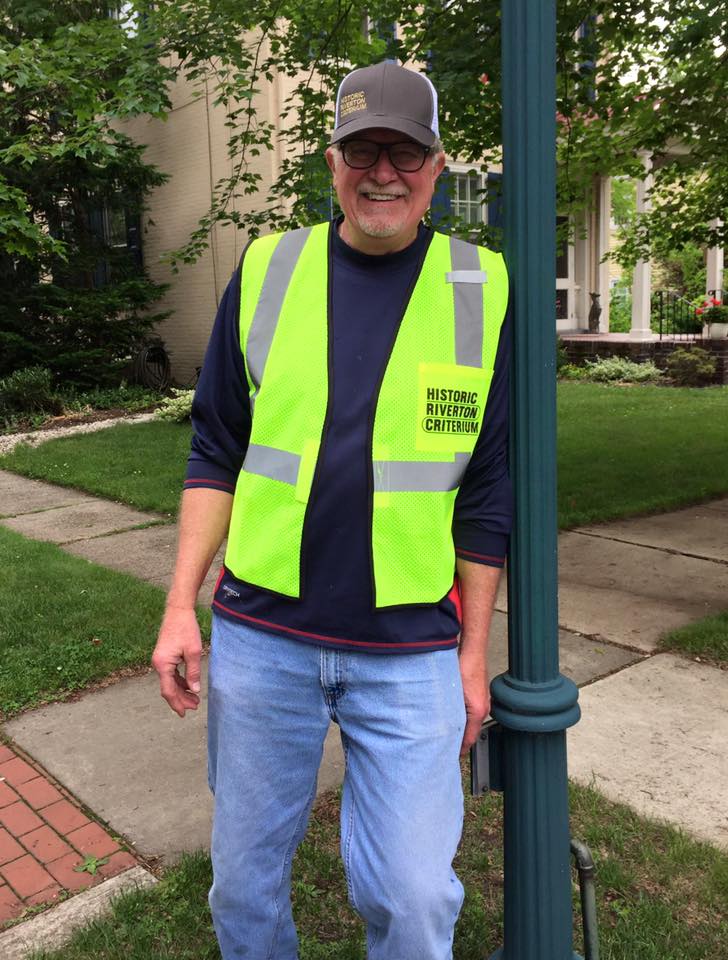
I am the marshal coordinator for the race. This bicycle race cannot happen without a marshal on each of the race corners.
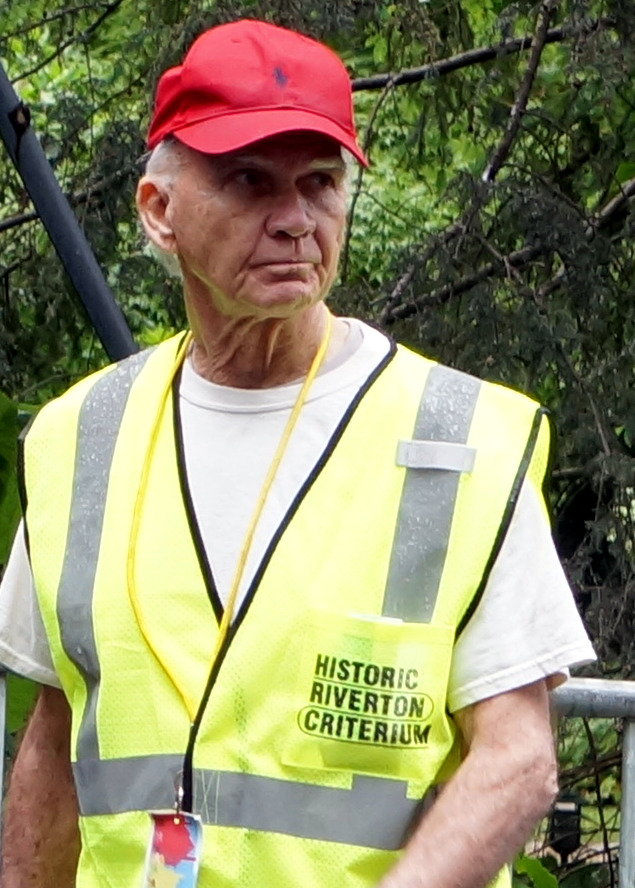
Dennis DeVries, 2015 HRC Marshal
The marshal’s job is essentially to make sure that no one crosses the street during the race. Each marshal will be given specific directions and guidelines before the race. Each marshal will only need to be on duty for 1 hour. Forty-four marshals are needed to cover the 7 corners for 5 races (some corners need 2 marshals).
It is incumbent upon race beneficiaries to volunteer to help. Please turn to a friend, colleague, and/or neighbor and ask them to marshal.
Society membership is not a requirement. All I need from you is a list of names and email addresses and I will contact the individuals. Please use the contact form below.
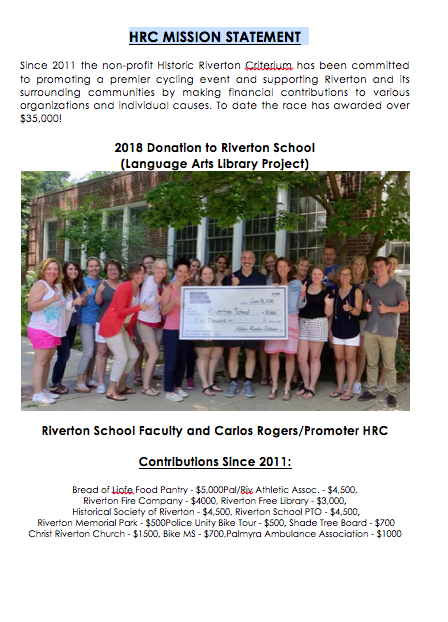
The Historic Riverton Criterium has become a great Riverton tradition with over $35,000 given to local organizations. Your help is greatly appreciated.
With a mere three weeks to go before the Historic Riverton Criterium returns to the streets of Riverton, we remind readers that a previous post explained that women cyclists first competed in the 2015 Historic Riverton Criterium.
In cycling, as in other areas of sports, women have often been forbidden to compete in major contests. Men had their first Olympic Games cycling race in 1896, but women had to wait until 1984 for the first women’s Olympic road race.
Witnessing the determined women competing in high performance women’s cycling apparel, it may be hard to imagine a time when Victorian attitudes and long skirts made it difficult, if not impractical, for women to enjoy bicycling at all.
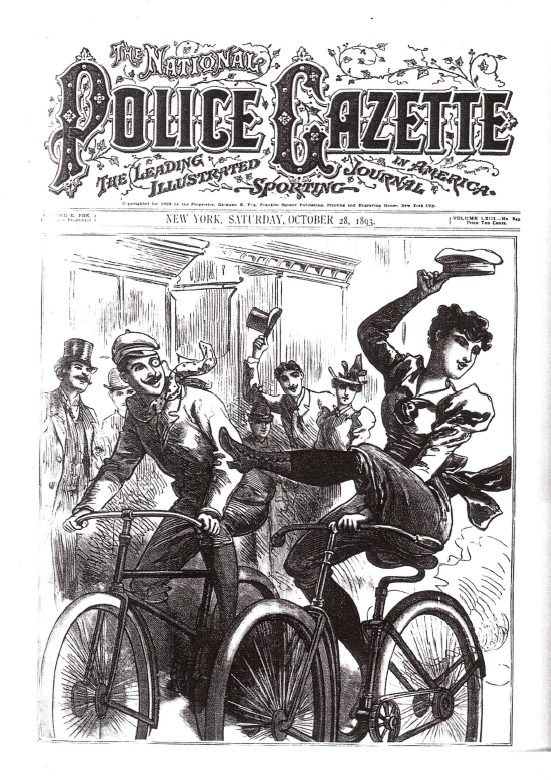
The cover of the National Police Gazette, October 28, 1893, shows Angelina Allen from New York, a daring reformer of clothing
Indeed, a popular thesis is that the late 19th century bicycle craze helped liberate women.
The story of Angeline Allen may serve as an example.
In 1893, Angeline Allen of Newark, NJ, created a sensation when she rode a bike through town wearing blue corduroy bloomers.
This brazen act was met with astonishment, derision, and a public scolding in the newspapers.
They were just pants!
But in a world where customs and laws restricting this manner of dress sometimes still criminalized such behavior even into the early 1900s, this was a brave act in reforming women’s fashion.
Today’s women cyclists owe a debt to the legacy of Angeline Allen and Annie Londonderryfor moving the ball forward in the struggle for women’s rights.
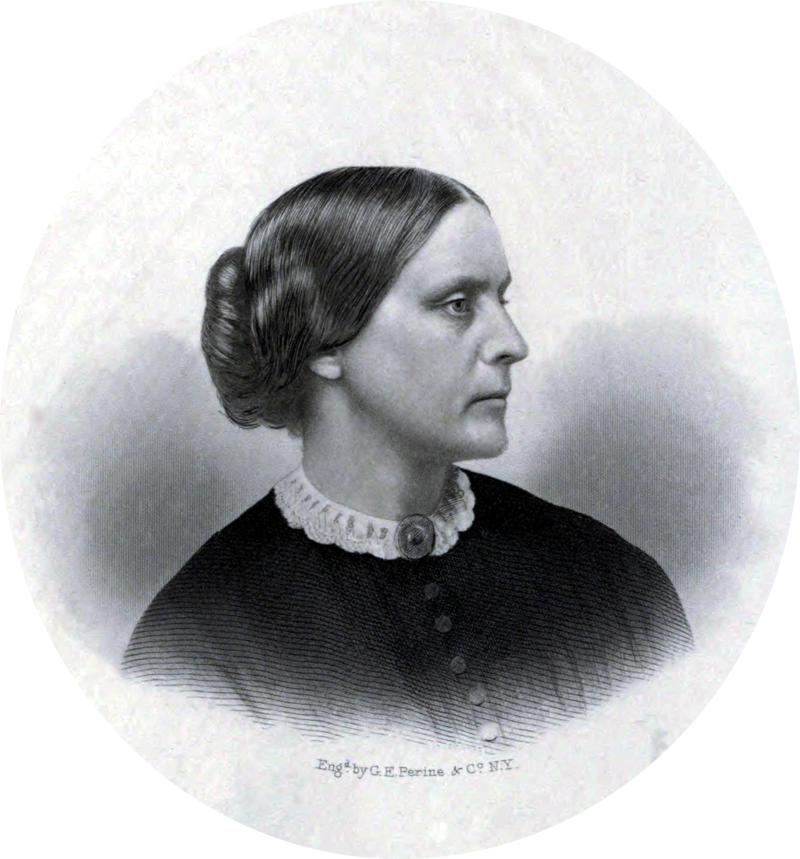
Susan B Anthony c1855
In 1896, suffragist Susan B. Anthony observed, “Let me tell you what I think of bicycling. I think it has done more to emancipate women than anything else in the world. It gives women a feeling of freedom and self-reliance. I stand and rejoice every time I see a woman ride by on a wheel…the picture of free, untrammeled womanhood.”
Society, and bicycles, may have evolved since then, but to see how far, we will leave it to author Margaret Guroff to tell more about Miss Allen and explain how we got to this point.
In her recent book, The Mechanical Horse: How the Bicycle Reshaped America Life, Guroff also examines how the invention of the safety bicycle ignited other changes in society – the development of better roads and changing attitudes of consumers, for example.
In this interview of the authorwe learn that finding out the role that bikes played in paving roads got her started, but her book also explores the bike’s influence on many other aspects of American life.
This amazon.com book blurballows a peek inside other parts of her lively cultural history book.
As you enjoy the races on June 9, remember the history that got us to this moment.
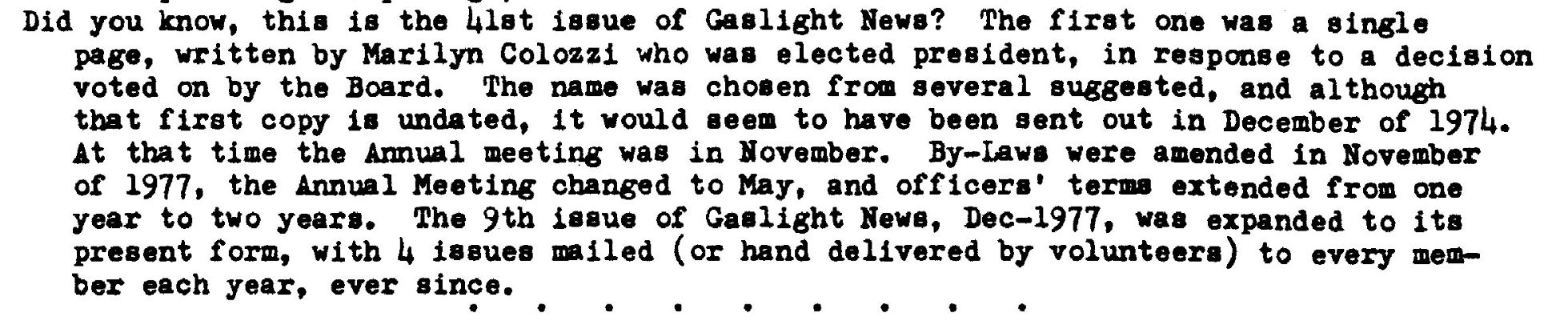
Ok, Kids, time for another installment of old Gaslight News back–issues. But first, a little history of the publication.
This clipping from issue #41, Feb. 1886 explains the origin of the Society’s newsletter…
After producing at least 65 issues of the newsletter, Betty Hahle handed the editorial reins to Paul W. Schopp in the fall of 1993. He ushered in the use of desktop publishing when he composed the layout for the September 1993 issue of the Gaslight News with a word processing program. By 1995, this innovation made it possible to include black and white photos and graphics with which to illustrate the text.
Then President Dan Campbell assumed editorial duties in September 1996, and essentially continued the same format. Gerald Weaber took charge of the newsletter in September 2003.
Four years later, John McCormickapprenticed under Gerald Weaber for the September issue and then struck off on his own commencing with the November 2007 printing. That issue was the first to include color photos.
McCormick updated the layout template in January 2008, giving it only minor tweaks since then.
1950s mimeograph machine
We have come a long way since that 1974 single-page typewritten and mimeographed newsletter, but there would be no Gaslight News today were it not for those who came before.
(Raise your hand if you remember the fresh smell of dittos in the morning.)
Without further ado, here are the latest scanned and uploaded back-issues of the Gaslight News. Only 20 more issues to go…
The earliest issue we have is #9, Dec. 1977, which must mean that eight issues dated from December 1974 through the fall of 1977 are still missing. Please, if you come across any, let us know.
Carlos Rogers, has quite literally made history in Riverton in more ways than one.
Besides bringing back a new era of competitive bicycling to Riverton after more than a century’s absence, perhaps no other individual in Borough history has proven to be a more generous donor to worthy local causes than he has – over $35,000 so far.
Another way has more to do with the level of professionalism with which he has promoted and managed the Historic Riverton Criterium since 2011.
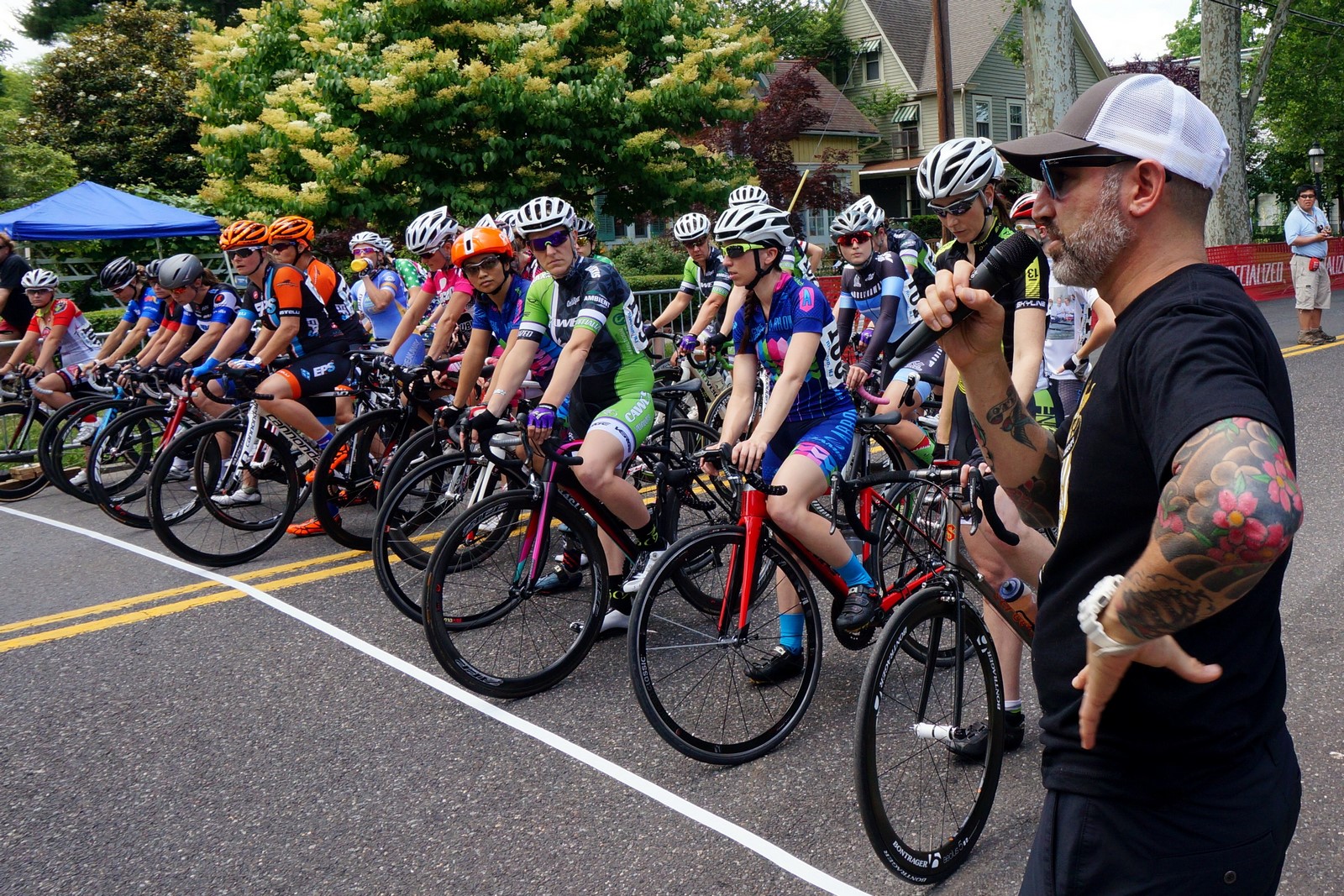
Start of the Women’s Race, HRC 2015
Some followers of Carlos Rogers may not be aware of his efforts to champion the promotion of women’s racing. As the CAWES Cycling Team observed in 2015, “…he made a decision that many promoters are not willing to make: he added a women’s field!!!”
Women’s races have been part of the Historic Riverton Criterium ever since.
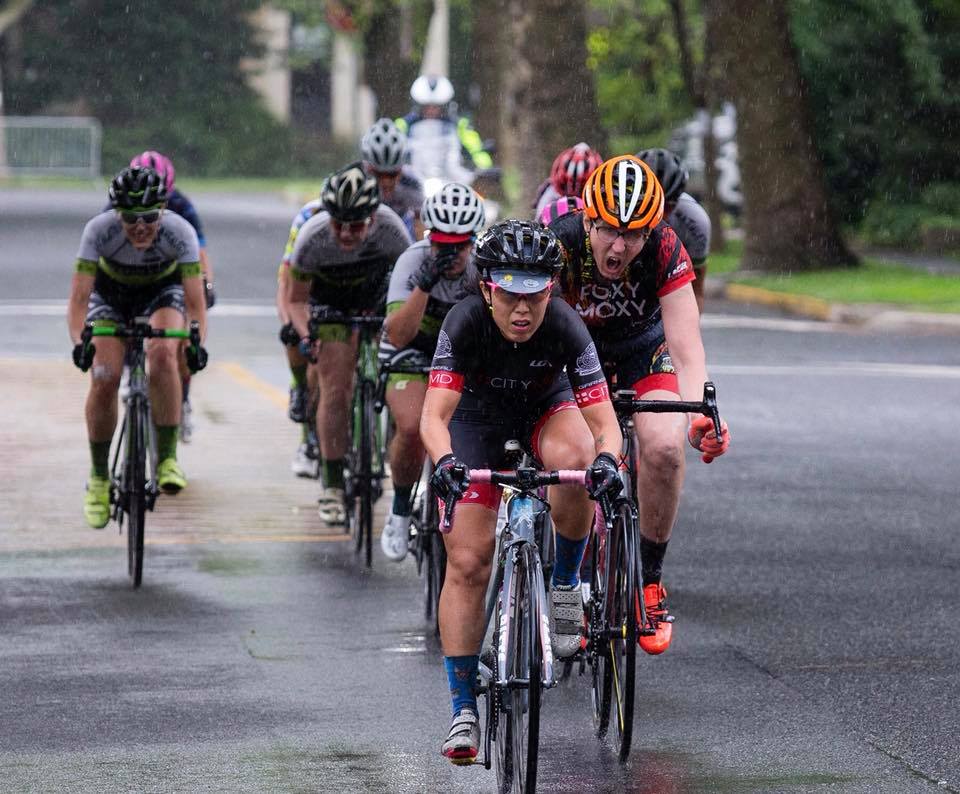
2018 Women’s race, HRC Facebook photo
One can sense their teamwork and passion for the sport that the women of RIPTIDE-CAWES Cycling Team have from their vivid descriptions of the 2018 Historic Riverton Criterium races.
Their website post added,” A special thanks to the race organizer and sponsors for not only including a Women’s 4/5 category, but also increasing the 1/2/3 prize money.”
The performance of today’s trailblazing women cyclists reminds us of Abbie Rollins, the pioneering New York cyclist who competed in the 1895 NYC-Riverton relay race and became the first woman relay rider.
Sporting Life, June 15, 1895, p32
Weak segue? Maybe… Find out more about women cyclists discussed here in previous posts:
In his 2016 address during a ceremony marking the arrival of Historic Riverton Century riders, Borough Historian Mr. Paul W. Schopp described the 1895 Tri-State Relay Race which inspired Rob Gusky to create the ride in 2014. Paul acknowledged that “…women have always maintained a keen interest in cycling and the mix of riders in today’s Riverton Century uphold the long legacy of female cyclists.” See an excerpt below.
If you think the first Tri-State Relay Race was an all-male event, you would be wrong! Twenty-two-year-old Abbie Rollins resided in New Brunswick, New Jersey, and worked as a stenographer and typist for the city’s Parson & Blish architectural firm.
Born in New Jersey, Abbie represented her home state in the first leg of the relay race, riding with two men from the Times building to the ferry and then on to Little Falls. She was reportedly the first woman cyclist to ever take part in a race of this type.
Evening Star (Washington, DC) August 7, 1895. Page 3
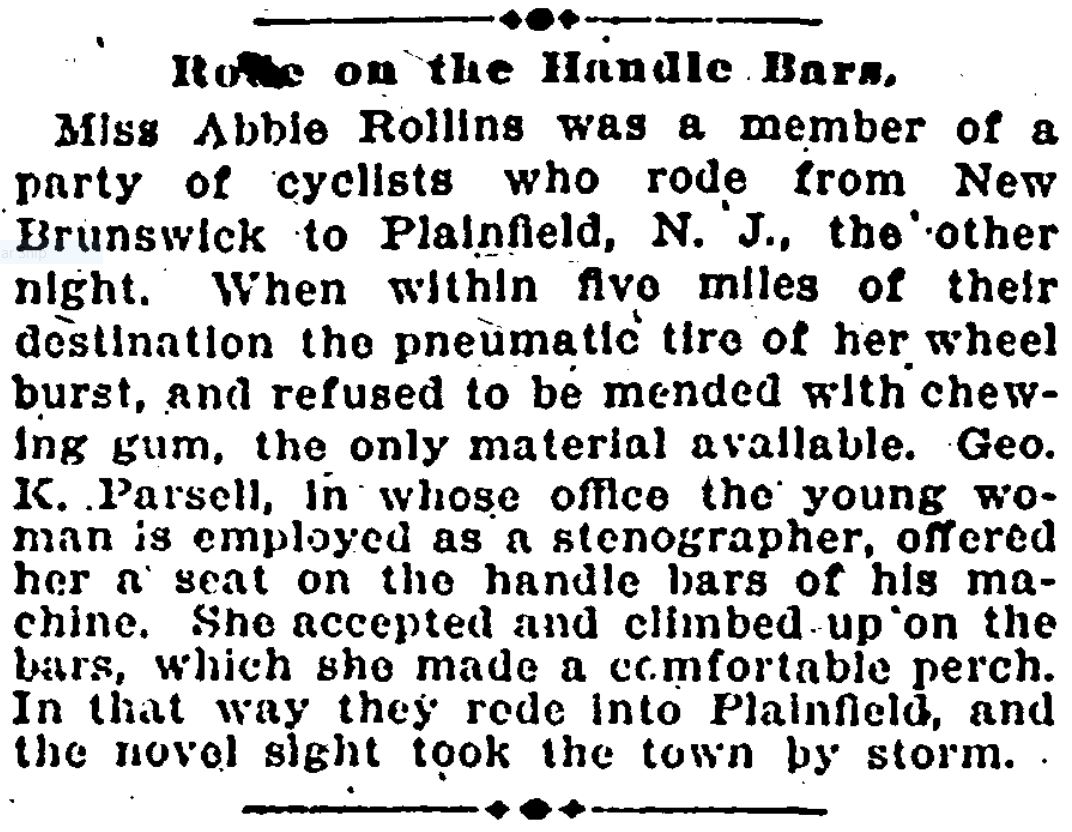
Abbie obviously loved cycling, for a brief newspaper article mentioned that she was with a group of riders traveling between New Brunswick and Plainfield about two months after the relay race. Approximately five miles from Plainfield, she suffered a burst pneumatic tire. Another cyclist attempted to perfect a repair with chewing gum, the only substance readily available, but it did not hold.
George K. Parsell, an architect working in the same office as Abbie, offered her a seat on his bicycle handlebars. She accepted the offer and deposited herself there. She found the ride quite comfortable and, as the would-be couple entered Plainfield, people flocked to the sidewalks with their mouths open as Parsell and Abbie rode by.
Abbie left the cycling world in November 1901, when she married the Rev. Howard Rutsen Furbeck, who had received his pastoral training at the Reformed Theological Seminary in New Brunswick. The couple had one son and four daughters. Abbie accompanied her husband to the various churches he served until his death on October 16, 1917. She continued to care for her children and then lived for many years with her son, Howard Rollins Furbeck Sr., until she died on March 12, 1961.
Find the complete text file of Schopp’s address here.
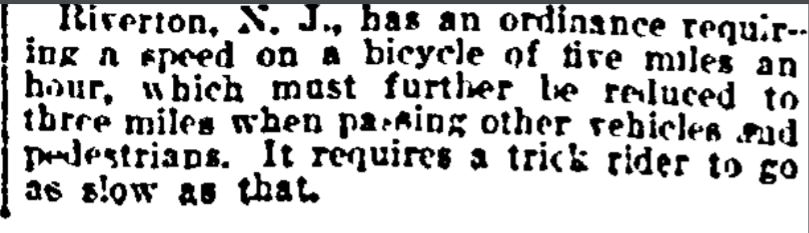
Riverton bicycle speed limit, Springfield Republican, July 2, 1899
During the height of the late 1800s bicycling craze, Riverton decided to crack down on speeding cyclists, or scorchers, as they were known.
An 1897 Borough ordinance limited the speed of bicyclists to 5 miles per hour, or an even slower speed of 3 mph when passing other vehicles or pedestrians. A journalist suggested that a trick rider would have difficulty going that slow.
Luckily, the athletes competing in the upcoming Historical Riverton Criterium on June 9 will not be so constrained. There will definitely be scorching.
Come to Riverton on the second Sunday in June for an afternoon of amateur and professional bicycle races set on the Borough’s closed off streets. Live music, vendors, food trucks, and Wade’s Snoooo Train lend a house party flavor to the event.
HRC Facebook page, June 12, 2018
Races take place over a 0.8 mile, 6 turn, technical flat and fast course through residential streets in the center of Riverton.
The first of 5 races begins at 1 pm. All races to follow. In-between the adult races, kids 8-10 yrs. can race in separate boys/girls races.
If you have read the Special Historic Riverton Criterium Editionof the Gaslight News you know that this year, money raised from this town-wide tradition will benefit the Historical Society of Riverton.
Carlos, Adrienne, & Leo Rogers
On June 9, 2019, Riverton will host the 9th Annual Historic Riverton Criterium. Carlos Rogers, a Riverton resident and civic supporter, has been the promoter of this event since its inception in 2011. The day is filled with professional bicycle racing and fun-filled activities. Many community members along the race course have front yard picnics and gatherings.
Iris Gaughan, 2017
I am the marshal coordinator for the race. This bicycle race cannot happen without a marshal on each of the race corners.
Dennis DeVries, 2015 HRC Marshal
The marshal’s job is essentially to make sure that no one crosses the street during the race. Each marshal will be given specific directions and guidelines before the race. Each marshal will only need to be on duty for 1 hour. Forty-four marshals are needed to cover the 7 corners for 5 races (some corners need 2 marshals).
It is incumbent upon race beneficiaries to volunteer to help. Please turn to a friend, colleague, and/or neighbor and ask them to marshal.
Society membership is not a requirement. All I need from you is a list of names and email addresses and I will contact the individuals. Please use the contact form below.
The Historic Riverton Criterium has become a great Riverton tradition with over $35,000 given to local organizations. Your help is greatly appreciated.
On June 9, 2019, Carlos Rogers, Riverton’s most preeminent advocate and civic champion, will reprise his role as the promoter of the premier bicycling event that he originated in 2011.
The Historic Riverton Criterium is now firmly established as the town-wide family friendly tradition to which we now look to kick-start the summer. This year’s contest is likely to draw a thousand participants, spectators, residents and vendors.
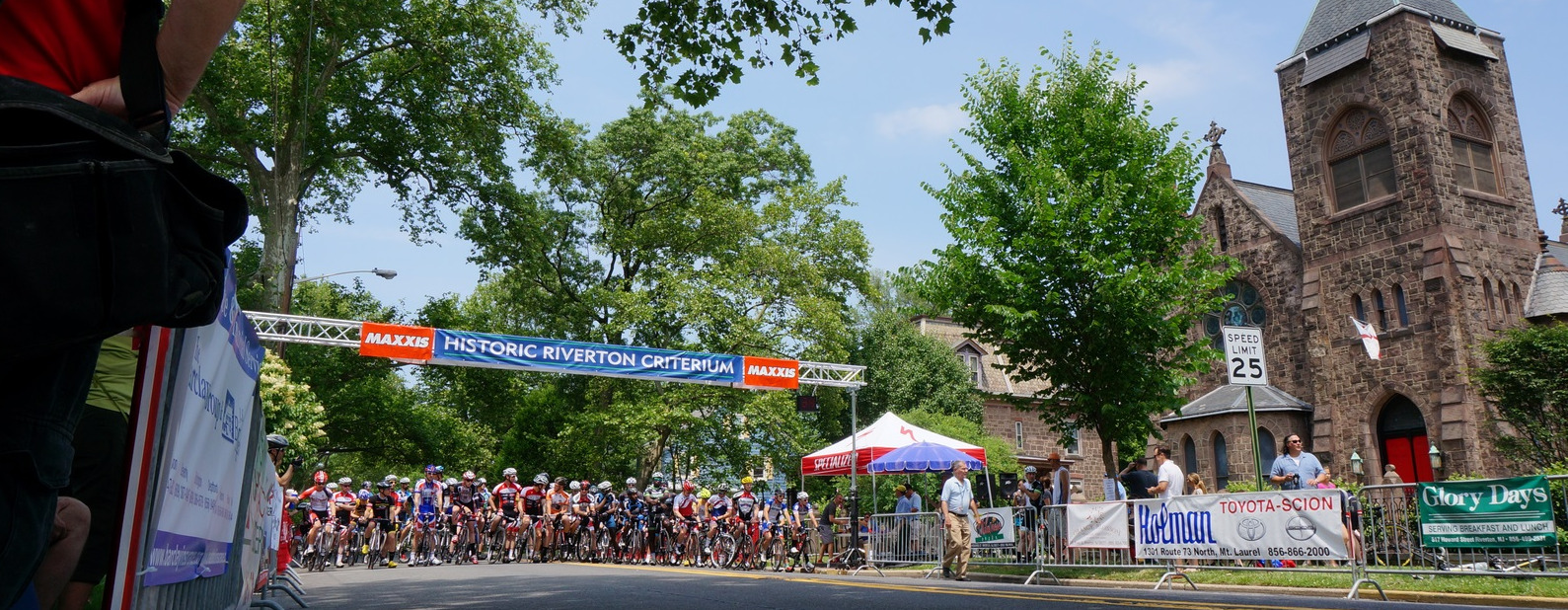
Each race starts and ends here at 4th & Main Sts. HRCriterium 2013 PHOTO: JM
Carlos started planning for this 9th Annual HRC almost as soon as the 8th concluded. Each year’s event draws more competitors and fans, but each year also means securing the financial backing to underwrite the costs of staging such a complex event.
Carlos has recruited an impressive roster of corporate sponsors to support the Historic Riverton Criterium. Several have been with him since the first one in 2011.
Now is the crucial time to gain grassroots support, donations, and endorsements. See the attached sponsorship packet for information on how you can throw your support behind this great event. Your participation can make this 9th Annual HRCriterium the most spectacular and productive one yet and make everyone a winner!
Mirriam-Webster defines criterium as: a bicycle race of a specified number of laps on a closed course over public roads closed to normal traffic, but that doesn’t begin to cover it.
Live music on DeVries’ porch keeps the beat going, HRC 2013 PHOTO: JM
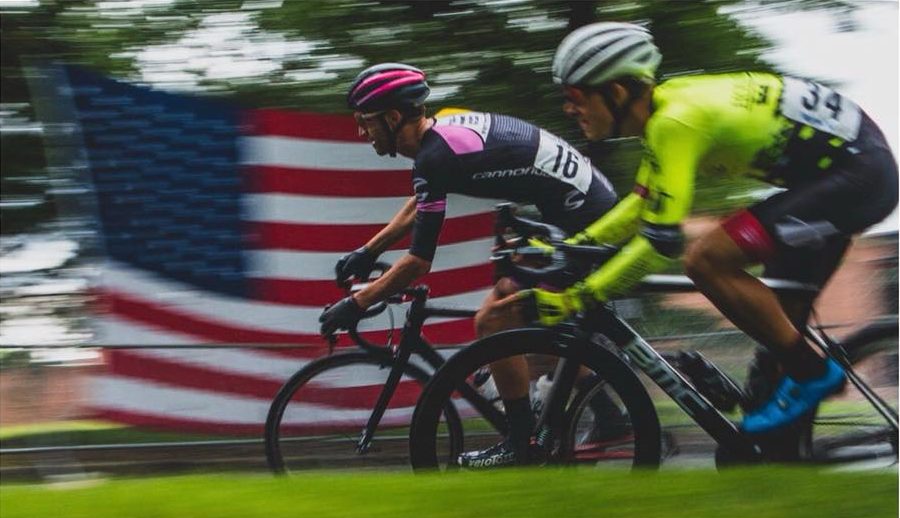
Amateur and professional women and men complete 15-40 laps on 0.8mi, 6 turn, flat and fast course through the historic, tree-lined streets of Riverton, New Jersey.
Cyclists compete in several categories, including Pro-Am Men, Amateur Men, and Amateur Women.
Even the kids get in on the fun with races sandwiched between amateur races and trophies and medals going to participants.
Wade McDaniels’ snow cones keep us cool, HRC 2017 PHOTO: JM
Live music, food trucks, Wade’s Snow Cones, and a balloon twister add to the block party atmosphere as spectators enthusiastically cheer on competitors this USA Cycling sanctioned bicycle race.
Josh Matisoff, balloon twister, entertainer, and decorator. He can twist anything out of balloons. PHOTO: JM
Returning for the ninth consecutive year, Historic Riverton Criterium serves the dual purpose of providing a unique hometown venue for bicycle racing while raising funds that benefit community organizations and charities.
Incredibly, the NJ nonprofit 501(c)3 organization has awarded to date over $35,000 to at least a dozen worthy causes.
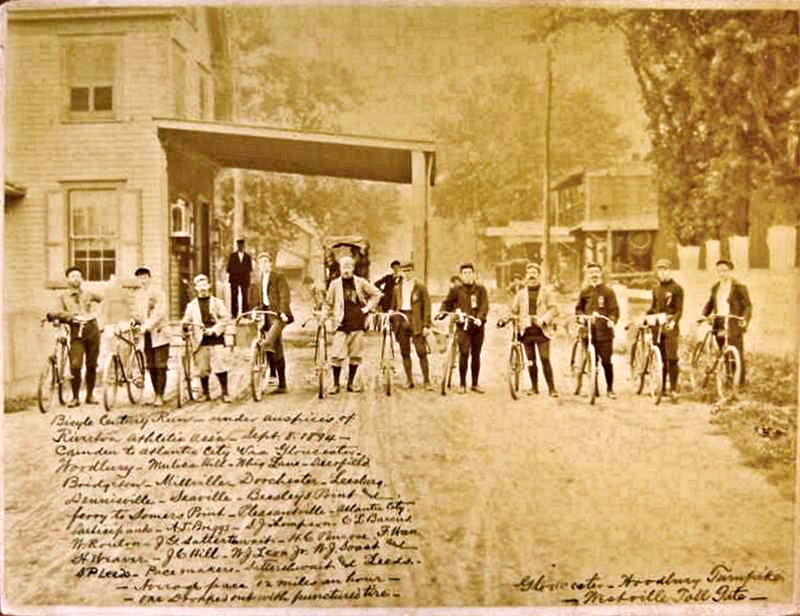
Bicycle Century Run under auspices of Riverton Athletic Assn. Camden to Atlantic City via Gloucester – Gloucester-Woodbury Turnpike, Westville Toll Gate – Sept. 8, 1894
Full disclosure, the Historic Society of Riverton will benefit from part of the proceeds this year.
Everyone knows we have been fans of the HRC since Carlos the beginning. Heck, we each have the word HISTORIC in our names!
Riverton Bicycle Track sign, 8-1-2014 PHOTO: JM
Carlos once explained that the reason for his inspired description of the race as “historic” was Riverton’s great tradition of bicycle racing going back to the 1890s.
Newark Daily Advertiser, Thursday, April 10, 1851 Newark, New Jersey, Page 2
Read more about Riverton’s cycling legacy in the only place where you can learn about the awesome characters and fascinating stories that have contributed to Riverton history since 1851.
Won’t you please help spread the word so this worthwhile community event gains the financial support and attendance it needs.
Let’s hear in the COMMENTS below how the Historic Riverton Criterium has affected you or your organization. -JMc
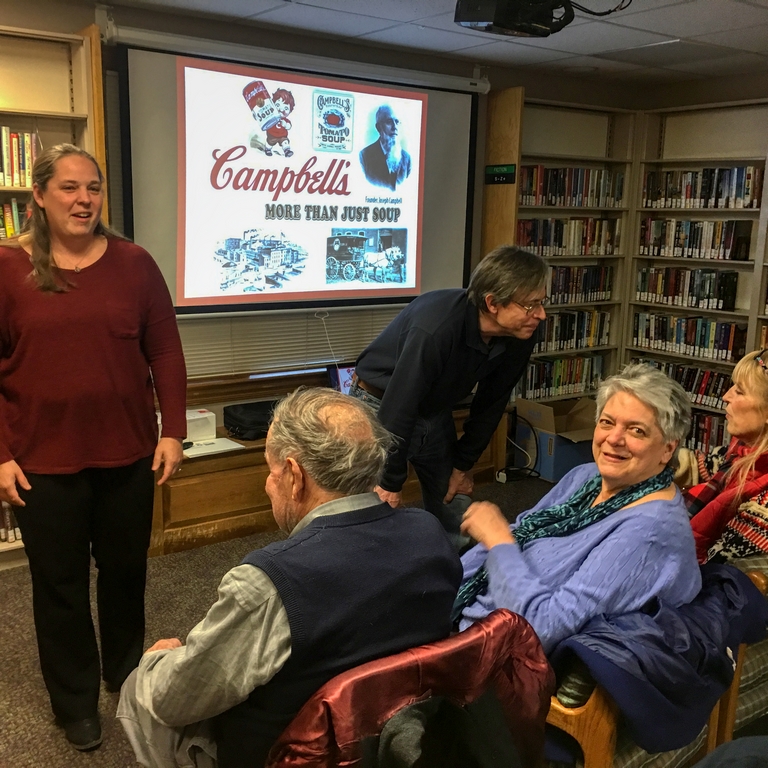
ACT I: “Campbell’s… more than just soup” slideshow
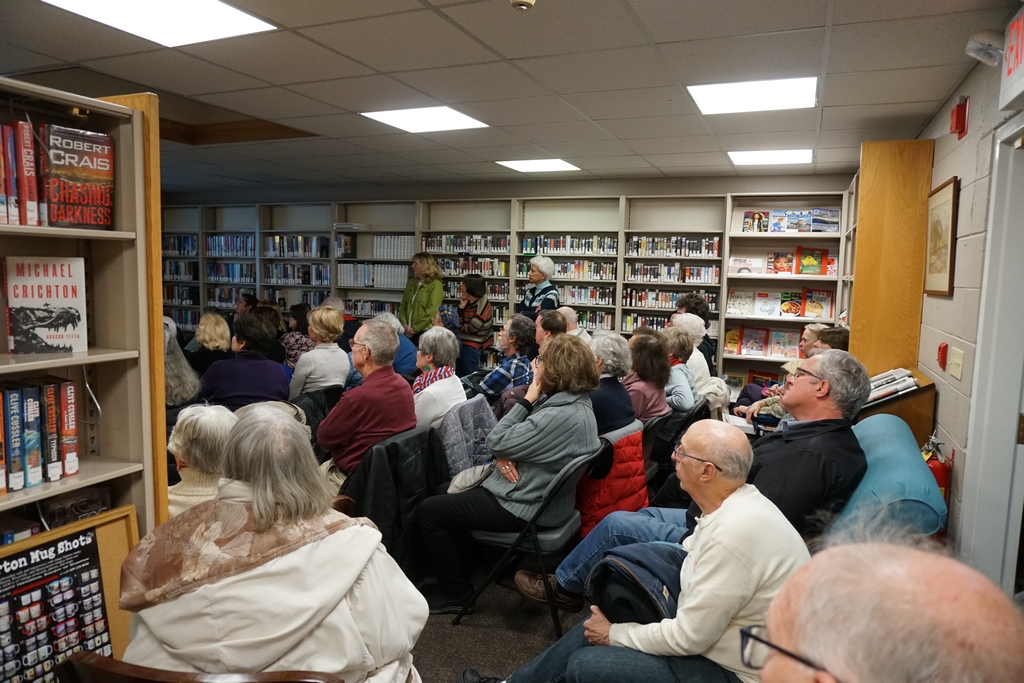
capacity crowd at the RFL PHOTO : JMThe audience needed every available space PHOTO: JMc
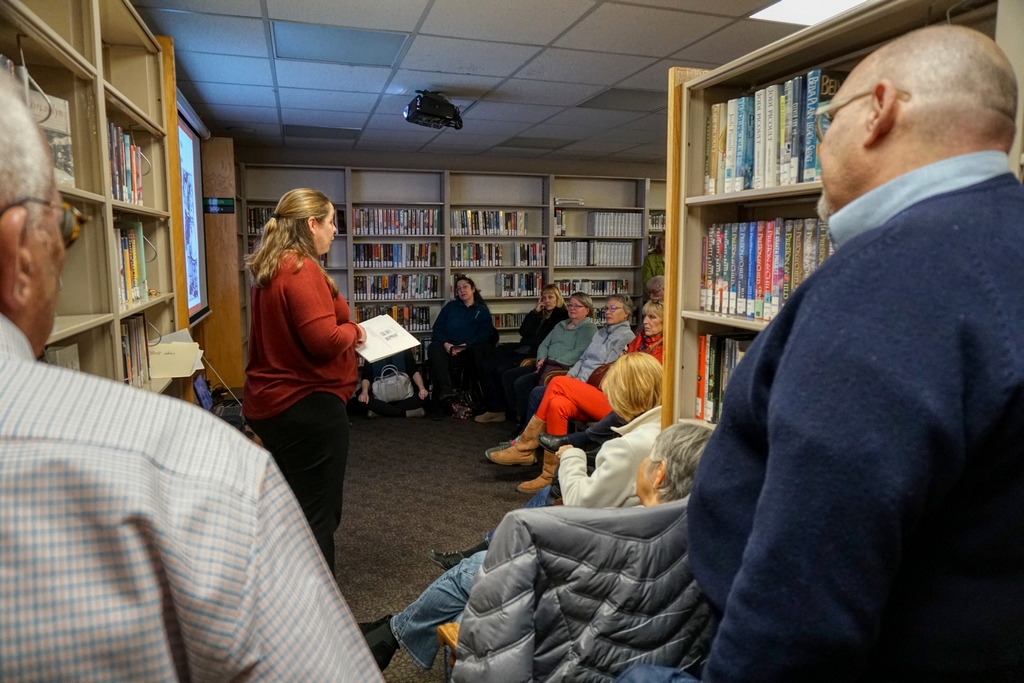
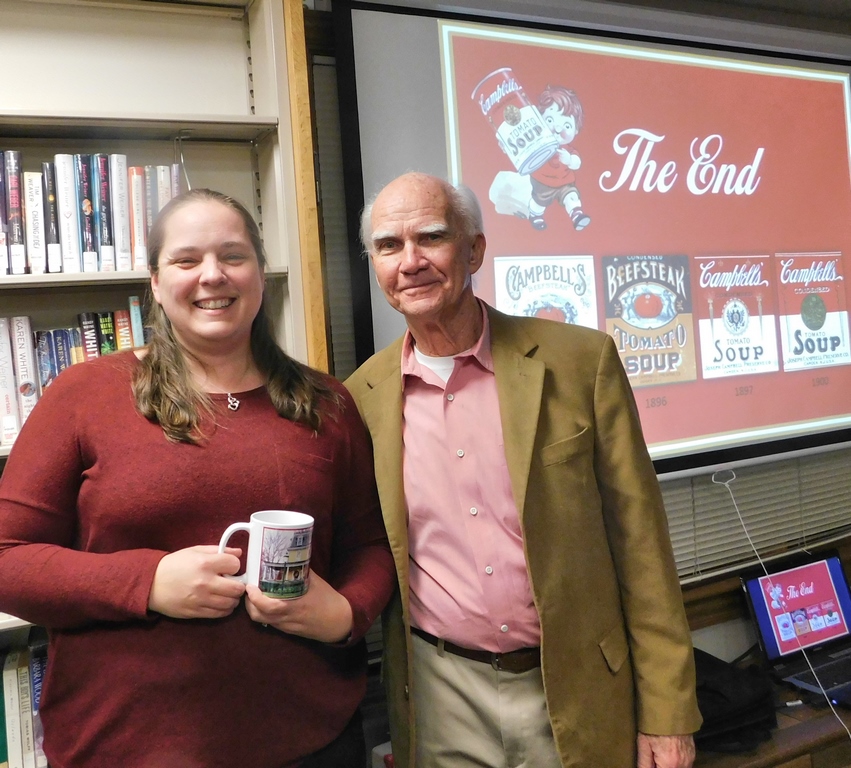
We sincerely thank the 80 or so hardy history buffs and lovers of Campbell’s Soup nostalgia who sat in chairs, sat on the floor, and stood (some with obstructed views), to hear Marisa Bozarth as she chronicled the history and development of Campbell’s Soup Company.
Even Jan DeVries, our reception hostess, stands PHOTO: JMPeople spilled over to the next room PHOTO: SD
The turnout for Tuesday night’s program sponsored by the Historical Society of Riverton took us off-guard, so we apologize to several folks who looked at the overflow crowd and left.
ACT II: Reception at the former Campbell home
Some really good sports are sitting on the floor PHOTO: JMEntryway PHOTO: JM
After the engrossing slide show, the meeting carried over next door to the home of Jan and Dennis DeVries who graciously showed us the former home of Joseph Campbell.
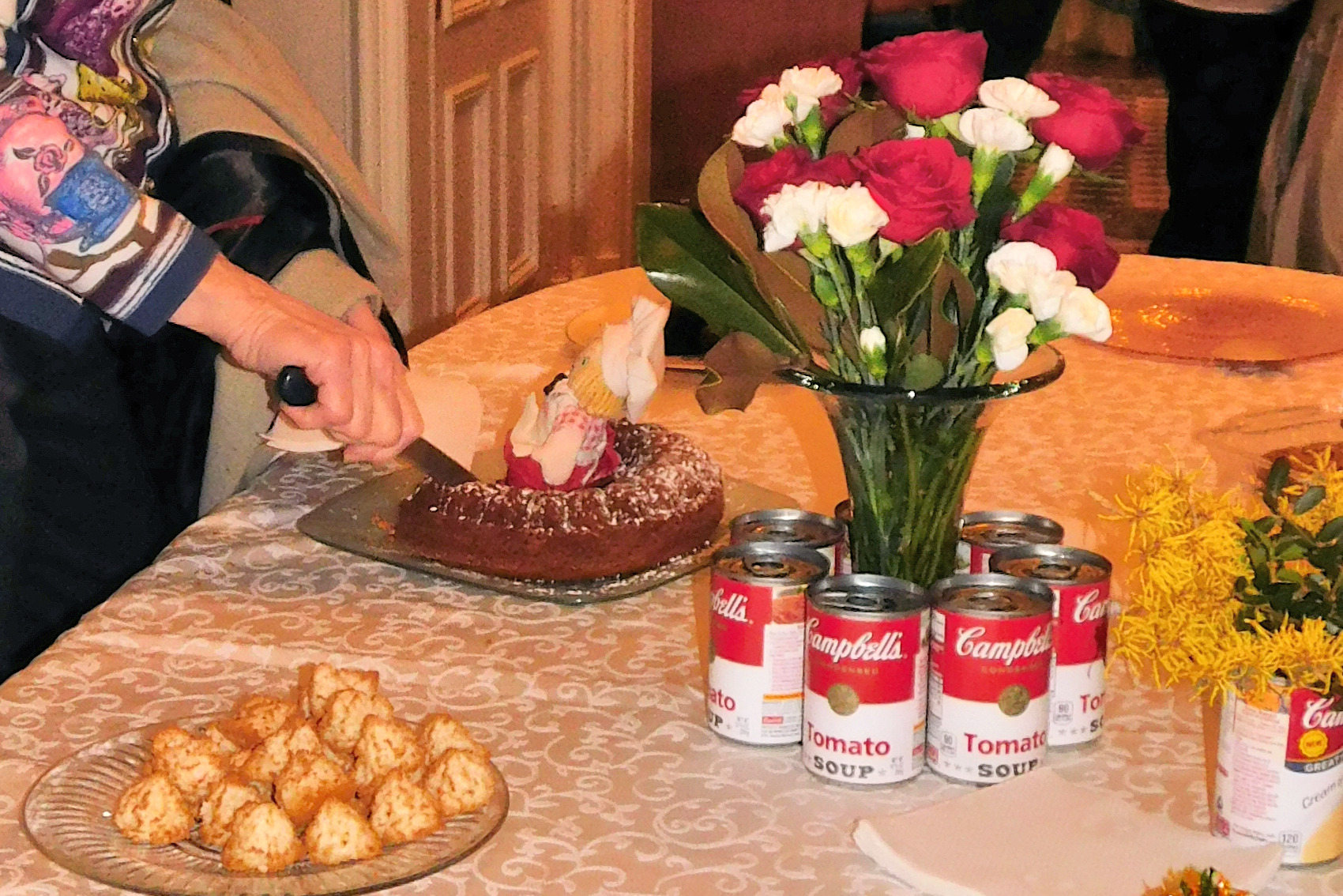
Pat Brunker cuts Susan Dechnik‘s Tomato Soup Cake PHOTO: SDHow serendipitous was it that the former Campbell is next to the Library? PHOTO: SD
A splendid dining room table centerpiece of carnelian-red and white flowers in a vase surrounded by cans of tomato soup reinforced the theme of the evening.
Mmmm…good! PHOTO: SD
The delicious desserts and confections arrayed there fueled animated conversations about how much folks enjoyed the well-researched topic and Marisa’s buoyant delivery.
Framed Campbell’s embellish the pantry wall PHOTO: SD
Our hosts, Mr. and Mrs. DeVries, doubled-down on the evening’s refrain and carried out the Campbell’s Soup motif by hanging a portrait of the home’s early owner in the kitchen area next to a framed print of a soup can and an illustration of a Campbell’s Kid.
PHOTO: SD
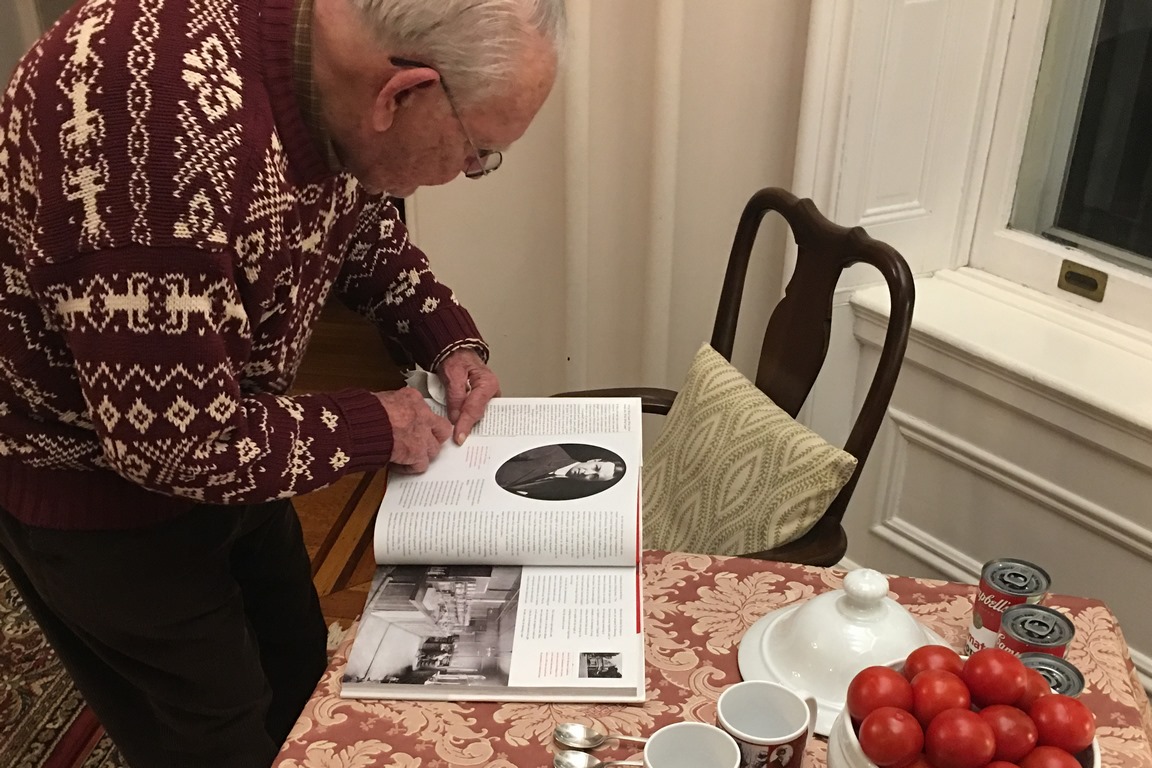
A soup tureen filled with fresh tomatoes, a Campbell’s coffee table book, a Campbell’s recipe book (doesn’t everyone have at least one in their kitchen?) and actual cans of tomato soup consummated the theme.
HSR President Bill Brown presented Jan and Dennis with mugs that depict their home and information about Joseph Campbell PHOTO: SD
Marisa wrote later, “It was wonderful! Everyone was so welcoming and I loved getting the opportunity, not only share the Campbell’s story with everyone, but also to talk to so many people afterwards!”
She is so right.
This important aspect of our meeting helps to carry out the Society’s several-fold mission to bring together those people interested in history, to increase awareness of our heritage, and to continue to expand our knowledge of the history of the area.
Our current membership of fewer than 100 households is at a historic low. We need your support in the form of membership dues and donations to underwrite our efforts to bring such programs to the public.
ACT III: History is the topic of conversation
Marisa also has a Campbell themed mug as a memento of the evening PHOTO: SDBill Brown and Alice Smith, President of the Riverside Historical Society discuss cooperating on a future presentation PHOTO: SD
Another side benefit to having people with a common interest in history assemble together is the networking, or sharing of information, that often happens.
Given the thousands of local people over the years whose farm products supplied the plant or whose labor produced soup, it comes as no surprise that a few in the group either worked there themselves or had a family member employed.
One woman volunteered that she has photos of the old Campbell Experimental Farm in Cinnaminson I can scan.
Bill Hall once worked on Taylor’s Farm and delivered tomatoes to the Camden plant PHOTO: JM
It turns out that one of our members had first-hand experience with working on local farms growing and delivering tomatoes, and another worked for a time in the Camden plant. Look for more about their anecdotes in another post if I can twist their arms to be interviewed.
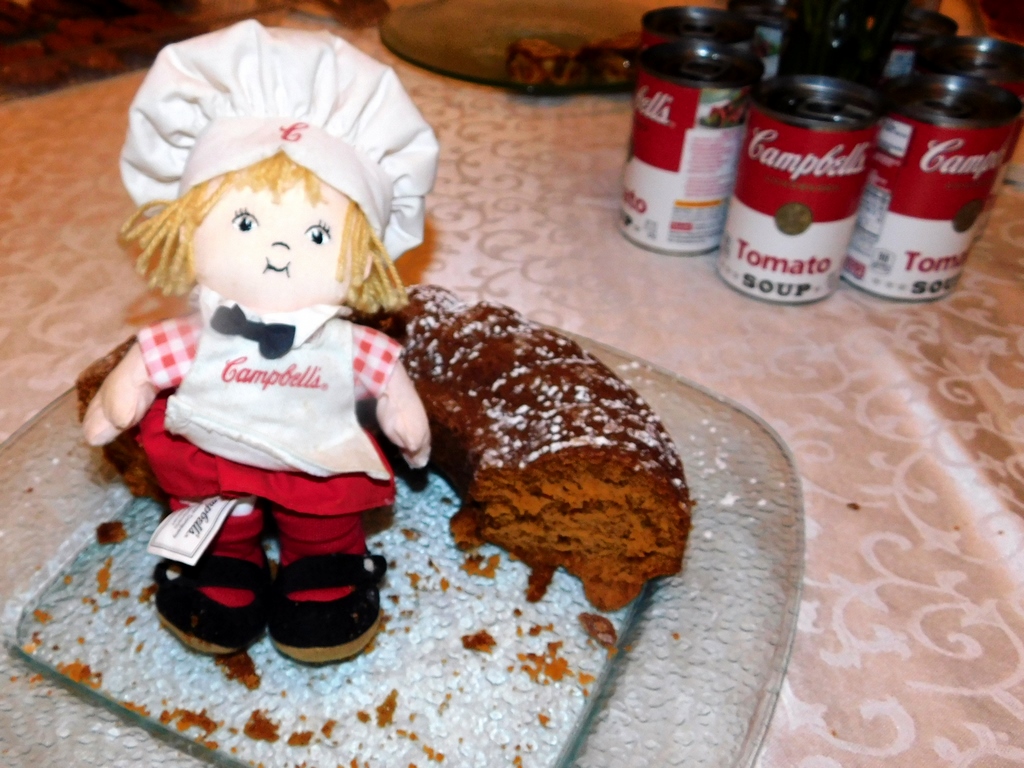
Tomato Soup Cake – Don’t say no until you try it PHOTO: SD
Maybe we can get Susan Dechnik to reveal the recipe for her Campbell’s Tomato Soup Cake.
Roger Prichard will have two more historic signs ready for Bank Avenue properties this spring PHOTO: JM
If you have another memory of Campbell’s from back in the day, please contact us through the form below so that we may add your voice to this collaborative effort that is rivertonhistory.com.
Marisa may have to add another slide or two to that PowerPoint. – JMc
PHOTOS BY SUSAN DECHNIK AND JOHN McCORMICK
See the Campbell’s Soup Company 9.78MB PDF slideshow here.